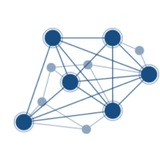
📄Graph (Network - Nodes and edges)
💥Technical paper
💥 In this paper, the auther will cover: Graph (Network - Nodes and edges), About, Articles Related, Application, Type, Structure, Example, Map, Directed Graph, Dominating set, Grow Algorithm, Shrink Algorithm, Path, Definition, Cycle, Spanning, Forest, Analysis, Documentation / Reference
🌐 Study
📲Channel: @ComplexNetworkAnalysis
#paper #Graph #python #code
💥Technical paper
💥 In this paper, the auther will cover: Graph (Network - Nodes and edges), About, Articles Related, Application, Type, Structure, Example, Map, Directed Graph, Dominating set, Grow Algorithm, Shrink Algorithm, Path, Definition, Cycle, Spanning, Forest, Analysis, Documentation / Reference
🌐 Study
📲Channel: @ComplexNetworkAnalysis
#paper #Graph #python #code
Datacadamia - Data and Co
Graph (Network - Nodes and edges)
A graph is a set of vertices connected by edges. See Data representation that naturally captures complex relationships is a graph (or network). Except of the special graph that a tree is, the ...
👍4
🎞 Machine Learning with Graphs: Theory of Graph Neural Networks
💥Free recorded course by Jure Leskovec, Computer Science, PhD
💥The topics: Introduction to Graph Neural Networks, A Single Layer of a GNN, Stacking layers of a GNN
📽 Watch: part1 part2 part3
📝Slides
💻code
📲Channel: @ComplexNetworkAnalysis
#video #course #Graph #Machine_Learning #code #python
💥Free recorded course by Jure Leskovec, Computer Science, PhD
💥The topics: Introduction to Graph Neural Networks, A Single Layer of a GNN, Stacking layers of a GNN
📽 Watch: part1 part2 part3
📝Slides
💻code
📲Channel: @ComplexNetworkAnalysis
#video #course #Graph #Machine_Learning #code #python
YouTube
Stanford CS224W: Machine Learning with Graphs | 2021 | Lecture 7.1 - A general Perspective on GNNs
For more information about Stanford’s Artificial Intelligence professional and graduate programs, visit: https://stanford.io/3BjIqNd
Lecture 7.1 - A General Perspective on Graph Neural Networks
Jure Leskovec
Computer Science, PhD
In this lecture, we introduce…
Lecture 7.1 - A General Perspective on Graph Neural Networks
Jure Leskovec
Computer Science, PhD
In this lecture, we introduce…
👏5👍1
2017-Python for Graph and Network Analysis.pdf
13 MB
📕Python for Graph and Network Analysis
🗓Publish year: 2017
📎 Study the book
📱Channel: @ComplexNetworkAnalysis
#book #Python #Graph
🗓Publish year: 2017
📎 Study the book
📱Channel: @ComplexNetworkAnalysis
#book #Python #Graph
👏3
📄Python modularity Examples
💥Technical paper
🌐 Study
📲Channel: @ComplexNetworkAnalysis
#paper #Graph #code #python #modularity
💥Technical paper
🌐 Study
📲Channel: @ComplexNetworkAnalysis
#paper #Graph #code #python #modularity
📄Community Detection
💥Technical paper
🌐 Study
📲Channel: @ComplexNetworkAnalysis
#paper #Graph #code #python #Community_Detection
💥Technical paper
🌐 Study
📲Channel: @ComplexNetworkAnalysis
#paper #Graph #code #python #Community_Detection
👍1
📄GCN-tutorial
💥Technical paper
💥 Graph Convolutional Network. Perform convolution operations on a graph using the information embedded into each node. The main idea is to "look" at neighboor nodes and update the currently embedded information into a higher or lower dimensional space by performing a ReLU or softmax operation.
🌐 Study
📲Channel: @ComplexNetworkAnalysis
#paper #Graph #code #python #GCN #Coda
💥Technical paper
💥 Graph Convolutional Network. Perform convolution operations on a graph using the information embedded into each node. The main idea is to "look" at neighboor nodes and update the currently embedded information into a higher or lower dimensional space by performing a ReLU or softmax operation.
🌐 Study
📲Channel: @ComplexNetworkAnalysis
#paper #Graph #code #python #GCN #Coda
👍3
🎞 pytorch geometric tutorial: graph attention networks implementation
💥Free recorded course
📽 Watch
📲Channel: @ComplexNetworkAnalysis
#video #course #Graph #GAT #code #python
💥Free recorded course
📽 Watch
📲Channel: @ComplexNetworkAnalysis
#video #course #Graph #GAT #code #python
YouTube
Pytorch Geometric tutorial: Graph attention networks (GAT) implementation
In this video we will see the math behind GAT and a simple implementation in Pytorch geometric.
Outcome:
- Recap
- Introduction
- GAT
- Message Passing pytroch layer
- Simple GCNlayer implementation
- GAT implementation
- GAT Usage
Download the material…
Outcome:
- Recap
- Introduction
- GAT
- Message Passing pytroch layer
- Simple GCNlayer implementation
- GAT implementation
- GAT Usage
Download the material…
👍2
📄Graph Attention Networks Paper Explained With Illustration and PyTorch Implementation
💥Technical paper
🌐 Study
📲Channel: @ComplexNetworkAnalysis
#paper #Graph #code #python #GAT #Coda
💥Technical paper
🌐 Study
📲Channel: @ComplexNetworkAnalysis
#paper #Graph #code #python #GAT #Coda
towardsai.net
Graph Attention Networks Paper Explained With Illustration and PyTorch Implementation | Towards AI
Author(s): Ebrahim Pichka Originally published on Towards AI. A detailed and illustrated walkthrough of the “Graph Attention Networks” paper by Veličković e ...
👍6👏1
🎞Tutorial: Graph Neural Networks in TensorFlow: A Practical Guide
💥Free recorded Tutorial by Sami Abu-el-Haija, Neslihan Bulut, Bryan Perozzi, and Anton Tsitsulin.
💥Graphs are general data structures that can represent information from a variety of domains (social, biomedical, online transactions, and many more). Graph Neural Networks (GNNs) are quickly becoming the de-facto Machine Learning models for learning from Graph data and hereby infer missing information, such as, predicting labels of nodes or imputing missing edges. The main goal of this tutorial is to help practitioners and researchers to implement GNNs in a TensorFlow setting. Specifically, the tutorial will be mostly hands-on, and will walk the audience through a process of running existing GNNs on heterogeneous graph data, and a tour of how to implement new GNN models. The hands-on portion of the tutorial will be based on TF-GNN, a new framework that we open-sourced.
📽 Watch
📲Channel: @ComplexNetworkAnalysis
#video #Tutorial #GNN #code #python #TensorFlow
💥Free recorded Tutorial by Sami Abu-el-Haija, Neslihan Bulut, Bryan Perozzi, and Anton Tsitsulin.
💥Graphs are general data structures that can represent information from a variety of domains (social, biomedical, online transactions, and many more). Graph Neural Networks (GNNs) are quickly becoming the de-facto Machine Learning models for learning from Graph data and hereby infer missing information, such as, predicting labels of nodes or imputing missing edges. The main goal of this tutorial is to help practitioners and researchers to implement GNNs in a TensorFlow setting. Specifically, the tutorial will be mostly hands-on, and will walk the audience through a process of running existing GNNs on heterogeneous graph data, and a tour of how to implement new GNN models. The hands-on portion of the tutorial will be based on TF-GNN, a new framework that we open-sourced.
📽 Watch
📲Channel: @ComplexNetworkAnalysis
#video #Tutorial #GNN #code #python #TensorFlow
YouTube
Tutorial: Graph Neural Networks in TensorFlow: A Practical Guide
Organizers: Sami Abu-el-Haija, Neslihan Bulut, Bryan Perozzi, and Anton Tsitsulin
Abstract: Graphs are general data structures that can represent information from a variety of domains (social, biomedical, online transactions, and many more). Graph Neural…
Abstract: Graphs are general data structures that can represent information from a variety of domains (social, biomedical, online transactions, and many more). Graph Neural…
👍4
🎞 Tutorial: Graph Neural Networks in TensorFlow: A Practical Guide
💥Free recorded course by Sami Abu-el-Haija, Neslihan Bulut, Bryan Perozzi, and Anton Tsitsulin
💥Graphs are general data structures that can represent information from a variety of domains (social, biomedical, online transactions, and many more). Graph Neural Networks (GNNs) are quickly becoming the de-facto Machine Learning models for learning from Graph data and hereby infer missing information, such as, predicting labels of nodes or imputing missing edges. The main goal of this tutorial is to help practitioners and researchers to implement GNNs in a TensorFlow setting. Specifically, the tutorial will be mostly hands-on, and will walk the audience through a process of running existing GNNs on heterogeneous graph data, and a tour of how to implement new GNN models. The hands-on portion of the tutorial will be based on TF-GNN, a new framework that we open-sourced.
📽 Watch
📲Channel: @ComplexNetworkAnalysis
#video #course #Graph #GNN #code #python #tensorflow
💥Free recorded course by Sami Abu-el-Haija, Neslihan Bulut, Bryan Perozzi, and Anton Tsitsulin
💥Graphs are general data structures that can represent information from a variety of domains (social, biomedical, online transactions, and many more). Graph Neural Networks (GNNs) are quickly becoming the de-facto Machine Learning models for learning from Graph data and hereby infer missing information, such as, predicting labels of nodes or imputing missing edges. The main goal of this tutorial is to help practitioners and researchers to implement GNNs in a TensorFlow setting. Specifically, the tutorial will be mostly hands-on, and will walk the audience through a process of running existing GNNs on heterogeneous graph data, and a tour of how to implement new GNN models. The hands-on portion of the tutorial will be based on TF-GNN, a new framework that we open-sourced.
📽 Watch
📲Channel: @ComplexNetworkAnalysis
#video #course #Graph #GNN #code #python #tensorflow
YouTube
Tutorial: Graph Neural Networks in TensorFlow: A Practical Guide
Organizers: Sami Abu-el-Haija, Neslihan Bulut, Bryan Perozzi, and Anton Tsitsulin
Abstract: Graphs are general data structures that can represent information from a variety of domains (social, biomedical, online transactions, and many more). Graph Neural…
Abstract: Graphs are general data structures that can represent information from a variety of domains (social, biomedical, online transactions, and many more). Graph Neural…
👍4
📄Network Graphs in Python
💥Technical Paper
🌐 Study
📲Channel: @ComplexNetworkAnalysis
#paper #Graph #code #python #Visualisation
💥Technical Paper
🌐 Study
📲Channel: @ComplexNetworkAnalysis
#paper #Graph #code #python #Visualisation
Plotly
Network
Detailed examples of Network Graphs including changing color, size, log axes, and more in Python.
👍3❤1🔥1
📄Graph Neural Networks
💥In this video, you will learn the application of neural networks on graphs.
💥Graph Neural Networks (GNNs) have recently gained increasing popularity in both applications and research, including domains such as social networks, knowledge graphs, recommender systems, and bioinformatics. While the theory and math behind GNNs might first seem complicated, the implementation of those models is quite simple and helps in understanding the methodology. Therefore, this webinar will discuss the implementation of basic network layers of a GNN, namely graph convolutions, and attention layers. Finally, we will apply a GNN on a node-level, edge-level, and graph-level tasks.
🎞Watch: part1 part2
👨💻Code
📲Channel: @ComplexNetworkAnalysis
#Video #Graph #code #python #Colab #GNN
💥In this video, you will learn the application of neural networks on graphs.
💥Graph Neural Networks (GNNs) have recently gained increasing popularity in both applications and research, including domains such as social networks, knowledge graphs, recommender systems, and bioinformatics. While the theory and math behind GNNs might first seem complicated, the implementation of those models is quite simple and helps in understanding the methodology. Therefore, this webinar will discuss the implementation of basic network layers of a GNN, namely graph convolutions, and attention layers. Finally, we will apply a GNN on a node-level, edge-level, and graph-level tasks.
🎞Watch: part1 part2
👨💻Code
📲Channel: @ComplexNetworkAnalysis
#Video #Graph #code #python #Colab #GNN
YouTube
Tutorial 7: Graph Neural Networks (Part 1)
In this tutorial, we will discuss the application of neural networks on graphs. Graph Neural Networks (GNNs) have recently gained increasing popularity in both applications and research, including domains such as social networks, knowledge graphs, recommender…
👍5❤1
📄Stanford Network Analysis Platform (SNAP)
💥Purpose:
SNAP is a general-purpose network analysis and graph mining library.
🔹Language: It is written in C++.
🔹Scalability: SNAP easily scales to handle massive networks with hundreds of millions of nodes and billions of edges.
💥Functionality:
Efficiently manipulates large graphs.
Calculates structural properties.
Generates regular and random graphs.
Supports attributes on nodes and edges.
🔹Python Interface: Snap.py provides a Python interface for SNAP, combining the performance benefits of SNAP with the flexibility of Python.
💥Stanford Large Network Dataset Collection:
This collection includes over 50 large network datasets:
🔹Social networks: Represent online social interactions between people.
🔹Networks with ground-truth communities: These are community structures in social and information networks.
🔹Communication networks: Email communication networks, where edges represent communication between individuals.
💥Tutorials and Recent Events:
SNAP hosts tutorials on topics such as deep learning for network biology, representation learning on networks, and more.
They have organized workshops and tutorials at conferences like ISMB, The Web Conference, and WWW.
🌐 Study
📲Channel: @ComplexNetworkAnalysis
#paper #Graph #code #Python #Tutorials #Dataset
💥Purpose:
SNAP is a general-purpose network analysis and graph mining library.
🔹Language: It is written in C++.
🔹Scalability: SNAP easily scales to handle massive networks with hundreds of millions of nodes and billions of edges.
💥Functionality:
Efficiently manipulates large graphs.
Calculates structural properties.
Generates regular and random graphs.
Supports attributes on nodes and edges.
🔹Python Interface: Snap.py provides a Python interface for SNAP, combining the performance benefits of SNAP with the flexibility of Python.
💥Stanford Large Network Dataset Collection:
This collection includes over 50 large network datasets:
🔹Social networks: Represent online social interactions between people.
🔹Networks with ground-truth communities: These are community structures in social and information networks.
🔹Communication networks: Email communication networks, where edges represent communication between individuals.
💥Tutorials and Recent Events:
SNAP hosts tutorials on topics such as deep learning for network biology, representation learning on networks, and more.
They have organized workshops and tutorials at conferences like ISMB, The Web Conference, and WWW.
🌐 Study
📲Channel: @ComplexNetworkAnalysis
#paper #Graph #code #Python #Tutorials #Dataset
🔥2👏2👍1