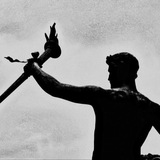
Le Pen kept in touch with various neofascist groups, in turn linked to the Movimento Sociale Italiano (MSI). The MSI quickly rebuilt itself from the ashes of fascism and regained an electoral foothold, rising to 9 percent in 1972. The MSI actively supported its friends across the Alps, who took over the flame of its logo free of charge. Suitcases of cash passed between Rome and Paris. Terrorism was their main connecting thread: former OAS members took refuge in Italy and offered weapons training to the killers who carried out attacks during the Years of Lead. The neofascists were convinced that they were the vanguard of the anti-Soviet war, in the combined defense of Europe, Western civilization, and the white race. These went together, as when Holeindre explained in one of his books that communists, “being red, cannot be completely white.” This self-proclaimed “New Right” was fully in line with the strategy of tension aimed at establishing an authoritarian regime.
❤26⚡3💘1
Our new campaign has already invaded the streets of Turin.
Europa, Nazione, Rivoluzione!🇾🇪
https://www.instagram.com/p/DHEXxuSIRBA/?img_index=4&igsh=M2JpeHNqYTEyNm9q
Europa, Nazione, Rivoluzione!🇾🇪
https://www.instagram.com/p/DHEXxuSIRBA/?img_index=4&igsh=M2JpeHNqYTEyNm9q
⚡26❤5
Gabriele Adinolfi pens a message to all the European nationalists that found themselves cheering on the invasion of Europe.
https://radicaldose.com/to-the-lost-boys-in-samarkand/
Radical Dose
https://radicaldose.com/to-the-lost-boys-in-samarkand/
Radical Dose
Radical Dose
To The Lost Boys in Samarkand - Radical Dose
Gabriele Adinolfi appeals to all the pro-Russian European nationalists, the lost boys in far-away Samarkand, to reexamine their position.
⚡10
In Syria today there is no government but a clique of cutthroats who have taken power. The same ones that the Syrian people have fought for fourteen years.
Self-proclaimed cutthroats as president, murderers as ministers, criminals dressed as gendarmes. Fanatics with the power of authority and impunity. The massacre against religious minorities continues.
We ask everyone to spread the word. So that the cry of pain of the Syrian people resonates throughout the world.
🇸🇾 European Front for Syria
Self-proclaimed cutthroats as president, murderers as ministers, criminals dressed as gendarmes. Fanatics with the power of authority and impunity. The massacre against religious minorities continues.
We ask everyone to spread the word. So that the cry of pain of the Syrian people resonates throughout the world.
🇸🇾 European Front for Syria
🙏29🗿4❤1👍1👌1
This media is not supported in your browser
VIEW IN TELEGRAM
Rockin' swastikas 'cause all my niggas' Nazis
Reading Mein Kampf, 2 chapters 'fore I go to sleep
Reading Mein Kampf, 2 chapters 'fore I go to sleep
🔥16❤1
Forwarded from Μέτωπο Νεολαίας | Youth Front
Anti-capitalist action in Thessaloniki 🇬🇷🏴
On Sunday, Youth Front activists organised a public speech in one the working class neighborhoods of Thessaloniki, followed by a mass distribution of nationalist leaflets.
Our Comrades were received with great enthusiasm by many of the local Greeks who consistently voted for Golden Dawn in the past.
The main slogan of the action was:
"Austerity, insecurity, degeneracy: The only solution is Nationalism"
➡️Watch the video on ANTEPITHESI.GR
On Sunday, Youth Front activists organised a public speech in one the working class neighborhoods of Thessaloniki, followed by a mass distribution of nationalist leaflets.
Our Comrades were received with great enthusiasm by many of the local Greeks who consistently voted for Golden Dawn in the past.
The main slogan of the action was:
"Austerity, insecurity, degeneracy: The only solution is Nationalism"
➡️Watch the video on ANTEPITHESI.GR
❤28⚡2
Zarco_Moniz_Ferreira_and_the_Portuguese_radical_ri.pdf
593.7 KB
Zarco Moniz Ferreira and the Portuguese radical right-wing between authoritarianism and democracy: a biographical approach
by Riccardo Marchi, Tiago Pinto
In the 1960s and 1970s, Portugal witnessed a cycle of political radicalisation on the right and left, in the context of the crisis and fall of the authoritarian Salazarist regime, and the transition to democracy after the military coup of 1974. For the right wing, radicalisation was led by young university students inspired by the Portuguese nationalism of the first half of the 20th century, but also by foreign doctrines from the inter-war period, and by the neo-fascist subculture immediately after the second world war. This article explores the mobilisation of this radical subculture, with its links to the Estado Novo and the European far right, through a bibliographical appreciation of one of its best-known leaders, nationally and internationally: Zarco Moniz Ferreira.
by Riccardo Marchi, Tiago Pinto
In the 1960s and 1970s, Portugal witnessed a cycle of political radicalisation on the right and left, in the context of the crisis and fall of the authoritarian Salazarist regime, and the transition to democracy after the military coup of 1974. For the right wing, radicalisation was led by young university students inspired by the Portuguese nationalism of the first half of the 20th century, but also by foreign doctrines from the inter-war period, and by the neo-fascist subculture immediately after the second world war. This article explores the mobilisation of this radical subculture, with its links to the Estado Novo and the European far right, through a bibliographical appreciation of one of its best-known leaders, nationally and internationally: Zarco Moniz Ferreira.
🔥9⚡2