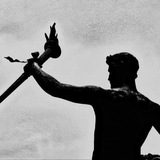
The purity and intensity Brasillach attributed to the actions taken and the sacrifices made by the victims of the failed coup meant to him that the events of February 6, 1934, represented a collective, tragic experience which could not be prolonged in history as such but which had to be memorialized, and perpetuated as myth: “Every year we go to the Place de la Concorde and place violets in front of this fountain become cenotaph ... in memory of the twenty-six deaths. Every year the crowd diminishes, because French patriots are forgetful by nature. Revolutionaries alone have understood the sense of myths and ceremonies.”
👍20⚡8❤3🔥1
“Unité française et unité allemande” (in Socialisme fasciste) indicates that Drieu la Rochelle was in principle willing, or at least he found it amusing to imagine and assert that he was willing, to pay almost any price so that European unification could be accomplished. If “linguistic imperialism is the limit of Germany, the Alps of Germany,” then Germany should be allowed, should even be encouraged to establish its borders in this fashion, for the Anschluss itself could be considered a positive step in the direction of not only German but also European unification: “I am for the Anschluss and, if need be, for the suppression of Belgium and Switzerland. After that, we will see more clearly in Europe. ... And Europe will not be far from being made”.
❤20👍5
Media is too big
VIEW IN TELEGRAM
🇧🇬🏴 Our comrades translated a speech that was given at this year's Lukov March - enjoy!
❤27🔥8⚡2
It is understandable that in its early days socialism turned to the State, even the theoretically democratic but actually bourgeois State, to obtain from it a minimum of aid and protection. But socialism was impregnated by the same spirit as the capitalism against which it was rising up. It too bathed in the democratic atmosphere of the nineteenth century and never grasped clearly the idea of what the true State had to be, namely a strong State, capable of instigating the revolution.
This new function of the State has only been realized and understood, and the new State has only been constructed, by the first European revolutions, and first and foremost by Germany. [...] The great novelty of the German State, the Third Reich, is that it succeeded in being both authoritarian and popular, so that it no longer expressed class interests, and offered something much better than a compromise between the interests of rival classes, or a precarious and constantly challenged balance between antagonistic forces. That was precisely the dangerous stage which our democracy had reached, leading to a visible paralysis of public institutions, a lack of authority, the breakdown of the State.
Marcel Déat, The State and the Revolution, L’Æuvre, 1/3, Nov. 1943.
This new function of the State has only been realized and understood, and the new State has only been constructed, by the first European revolutions, and first and foremost by Germany. [...] The great novelty of the German State, the Third Reich, is that it succeeded in being both authoritarian and popular, so that it no longer expressed class interests, and offered something much better than a compromise between the interests of rival classes, or a precarious and constantly challenged balance between antagonistic forces. That was precisely the dangerous stage which our democracy had reached, leading to a visible paralysis of public institutions, a lack of authority, the breakdown of the State.
Marcel Déat, The State and the Revolution, L’Æuvre, 1/3, Nov. 1943.
🔥11👍2
This media is not supported in your browser
VIEW IN TELEGRAM
Nationalist black bloc Berlin 22.02.25
🇩🇪🏴 Free, Social, National !
🇩🇪🏴 Free, Social, National !
⚡63👍1🙏1🫡1
Forwarded from Dutch Dissident
🇩🇪 Gathering of German Nationalists in Berlin:
On the evening of the German election, hundreds off German nationalist youths gathered, dressed in black. Chants of "if you don't love Germany, leave" were heard.
⚡️ DutchDissident
On the evening of the German election, hundreds off German nationalist youths gathered, dressed in black. Chants of "if you don't love Germany, leave" were heard.
Please open Telegram to view this post
VIEW IN TELEGRAM
👏40👌14⚡9💊2👍1
Forwarded from Europa Revival 🇪🇺 𖦏
Europe is just opening to the realisation that the US will “abandon us”, as the imperialist powers of the world discuss openly today in Saudi Arabia how to divide and cut up our continent once again.
Whilst this short term pain (temporary losing occupied territories in eastern Ukraine) hopefully we can see long term gain, Europe should never had been as dependent on the unreliable and political unstable United States.
The main goal of Europe should be to focus on militarisation, with a strong focus of national and ethnic identity. Close the borders of ‘fortress Europe’ + increase military capabilities, every child in Europe should be taught military patriotic classes like in Poland.
Europe does not want an American Zionist empire nor does it want Mongolian neo-communistic rulers.
A strong, united and white Europe is what both Washington and Moscow fears most.
► Europa Revival
Whilst this short term pain (temporary losing occupied territories in eastern Ukraine) hopefully we can see long term gain, Europe should never had been as dependent on the unreliable and political unstable United States.
The main goal of Europe should be to focus on militarisation, with a strong focus of national and ethnic identity. Close the borders of ‘fortress Europe’ + increase military capabilities, every child in Europe should be taught military patriotic classes like in Poland.
Europe does not want an American Zionist empire nor does it want Mongolian neo-communistic rulers.
A strong, united and white Europe is what both Washington and Moscow fears most.
► Europa Revival
⚡16💊2❤1
Forwarded from Uncensored ➡️@hersantite
Our Spanish comrades @acdevenireuropeo write White Australian political prisoner Stephen Wells a letter of support.
❤18👏5🔥1
“Germany issued debt-free and interest-free money from 1935 and on, accounting for its startling rise from the depression to a world power in 5 years. Germany financed its entire government and war operation from 1935 to 1945 without gold and without debt, and it took the whole Capitalist and Communist world to destroy the German power over Europe and bring Europe back under the heel of the Bankers. Such history of money does not even appear in the textbooks of public (government) schools today.”
Sheldon Emry, Billions for the Bankers, Debts for the People (1984)
Sheldon Emry, Billions for the Bankers, Debts for the People (1984)
❤26👏4💯1
The FN/RN’s ‘proletarianisation’, particularly in the economic field has seen the development of an economic policy with many parallels to counter-globalist movements more often associated with left-wing politics. The party proposes a protectionist, nationalist economy designed to protect French industry, farmers, artisans and workers from Chinese and other Developing World products, to avoid a ‘race to the bottom’ in terms of workers’ living standards. According to Marine Le Pen this would require national preference for French products in governmental acquisition, an increase in the minimum wage, and policies designed to protect the character and economy of rural and regional France. These policies are aimed at appealing to native, ‘ethnic’ French, and sympathetic immigrants concerned about impacts of post industrialism, globalisation and neoliberalism, represented as destroying the French nation: economically, culturally and politically. The argument is made that French industries will be usurped by multi-national corporations, which will see all people as fungible commodities and little more.
In terms of voter intention, Shields’ (2013) analysis of IPSOS polling figures show the FN/RN has a strong working class element in its base of support. The analysis indicates 29% support from manual workers (with the FN the most popular choice), 21% amongst other wage earning employees, and 25% from shopkeepers. The figures characterise the National Front under Marine Le Pen being the most popular party with those of little earning power and the lowest educational levels. Whereas ‘far right’ descriptors are most often applied to the party, supporters come from a demographic traditionally linked to social democratic parties, and report no affinity for left or right. The National Rally (formerly National Front) offers a third position found to be viable for those unrepresented by the established centre parties, or left politics like those offered by Jean-Luc Mélenchon.
This move to the left, in the sense of a targeted interventionism in the economy, would define the RN as a party that is reasonable in its approach and broad acceptability, within the French context. The platform is presented as deeply pro-French, as the first priority, and relates this popular theme to concerns over mass immigration and Islamism as threatening to France.
In terms of voter intention, Shields’ (2013) analysis of IPSOS polling figures show the FN/RN has a strong working class element in its base of support. The analysis indicates 29% support from manual workers (with the FN the most popular choice), 21% amongst other wage earning employees, and 25% from shopkeepers. The figures characterise the National Front under Marine Le Pen being the most popular party with those of little earning power and the lowest educational levels. Whereas ‘far right’ descriptors are most often applied to the party, supporters come from a demographic traditionally linked to social democratic parties, and report no affinity for left or right. The National Rally (formerly National Front) offers a third position found to be viable for those unrepresented by the established centre parties, or left politics like those offered by Jean-Luc Mélenchon.
This move to the left, in the sense of a targeted interventionism in the economy, would define the RN as a party that is reasonable in its approach and broad acceptability, within the French context. The platform is presented as deeply pro-French, as the first priority, and relates this popular theme to concerns over mass immigration and Islamism as threatening to France.
⚡6❤1
In your work on Germany you attach great importance to the so-called 'völkische idea'. Can we also find it in France?
George Mosse: "Yes, think for example of the French writer Maurice Barrès and his 'la terre et la mort'. It is roughly the same. It is perhaps more accentuated in Germany after 1870, after the disappointment with national unity. But it was also important in France after the defeat in 1870. What you get in France, and not in Germany, is this combination of nationalism and socialism. Germany of course had its nationalism, in some cases racism, for example in the case of Wagner. But the social component which was so strong in France, with the distribution of property and the interest in the working class, was much weaker there."
George Mosse: "Yes, think for example of the French writer Maurice Barrès and his 'la terre et la mort'. It is roughly the same. It is perhaps more accentuated in Germany after 1870, after the disappointment with national unity. But it was also important in France after the defeat in 1870. What you get in France, and not in Germany, is this combination of nationalism and socialism. Germany of course had its nationalism, in some cases racism, for example in the case of Wagner. But the social component which was so strong in France, with the distribution of property and the interest in the working class, was much weaker there."
⚡17✍1