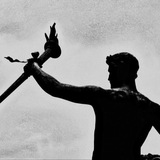
The Holy Roman Empire is a state entity, and a de facto confederation of states in Central Europe, which at its peak encompassed the lands of Germany, France, Italy, and other states that existed from the 9th to the 19th centuries.
The Empire is known for its wide list of liberties granted by the Emperor and the diversity of the lands of the Empire itself. It was the inspiration for many ideologists of the Third Position and the Conservative Revolution, and we believe that the future Imperium should be modeled and adapted to modern conditions precisely from the Holy Roman Empire - as a confederation of free states united in the idea of liberty and common defense against enemies.
The Empire is known for its wide list of liberties granted by the Emperor and the diversity of the lands of the Empire itself. It was the inspiration for many ideologists of the Third Position and the Conservative Revolution, and we believe that the future Imperium should be modeled and adapted to modern conditions precisely from the Holy Roman Empire - as a confederation of free states united in the idea of liberty and common defense against enemies.
⚡33❤🔥4👍3👏2
Forwarded from Arktos
US Nationalists versus Musk and the 'Tech Bros': What If the American Right Implodes?
The following is a translation of an essay published on Éléments on December 31st, 2024, written by Stéphane Brizzi. The essay discusses a growing rift within the American right, with white nationalists clashing with "tech bros" like Elon Musk and Vivek Ramaswamy over issues like H1-B visas and immigration policy, highlighting tensions between economic liberalism and nationalism.
Read the essay here:
https://nouvelledroite.substack.com/p/us-nationalists-versus-musk-and-the
The following is a translation of an essay published on Éléments on December 31st, 2024, written by Stéphane Brizzi. The essay discusses a growing rift within the American right, with white nationalists clashing with "tech bros" like Elon Musk and Vivek Ramaswamy over issues like H1-B visas and immigration policy, highlighting tensions between economic liberalism and nationalism.
Read the essay here:
https://nouvelledroite.substack.com/p/us-nationalists-versus-musk-and-the
👍12👀3💊2🆒1
“The nations which were worth something, which became worth something, never became so under liberal institutions: it was great danger which made of them something deserving reverence, danger which first teaches us to know our resources, our virtues, our shield and spear, our spirit - which compels us to be strong.”
Nietzsche
Nietzsche
⚡36👍1
The Revolutionaries of 1918 lost the War of 1914 because their Revolution was not a German revolution. They thought they had done all that was required of them when they imitated what the west had done before. They were far indeed from grasping, as the Russian Revolutionaries had done—more and more clearly with each passing year—that a people’s revolution must be a national revolution, and acting consistently with this in mind.”
Arthur Moeller van den Bruck
Arthur Moeller van den Bruck
👍23❤2⚡1🙏1
At the start of the twentieth century, Europeans ruled the world. They constituted a third of its population, governed half of its landmass, and controlled vast territories across Africa, India, Southeast Asia, and even parts of China. Their industry, science, philosophy, and art were unparalleled. The world was theirs by right of achievement and strength.
Yet, just a century later, that dominance lay in ruins. Europeans had dwindled to less than 9 percent of the world’s population. Their homelands were overrun by foreign peoples, their industries and technology ceded to emerging rivals, and their institutions transformed beyond recognition. They teetered on the edge of demographic collapse, facing the unthinkable: the potential extinction of their people and civilization.
This reversal was no accident. To understand it, one must confront the immense forces that reshaped the twentieth century. Dominique Venner, a historian of magisterial scope and clarity, though relatively unknown and untranslated in the Anglosphere, meticulously traces these upheavals in Le Siècle de 1914: Utopies, Guerre et Révolutions(The Century of 1914: Utopias, War, and Revolutions). While this book remains untranslated into English, it serves as a masterful guide to understanding the powerful convergence of forces that brought Europe to this precipice.
https://chadcrowley.substack.com/p/europe-awakened
Yet, just a century later, that dominance lay in ruins. Europeans had dwindled to less than 9 percent of the world’s population. Their homelands were overrun by foreign peoples, their industries and technology ceded to emerging rivals, and their institutions transformed beyond recognition. They teetered on the edge of demographic collapse, facing the unthinkable: the potential extinction of their people and civilization.
This reversal was no accident. To understand it, one must confront the immense forces that reshaped the twentieth century. Dominique Venner, a historian of magisterial scope and clarity, though relatively unknown and untranslated in the Anglosphere, meticulously traces these upheavals in Le Siècle de 1914: Utopies, Guerre et Révolutions(The Century of 1914: Utopias, War, and Revolutions). While this book remains untranslated into English, it serves as a masterful guide to understanding the powerful convergence of forces that brought Europe to this precipice.
https://chadcrowley.substack.com/p/europe-awakened
Substack
Europe Awakened
Reflections on Dominique Venner’s “The Century of 1914”
👍20
Since the early 1990s, the French New Right has been influential beyond France, especially in Italy, Germany, and Belgium, and has inspired Alexander Dugin in Russia. Part of the American radical Right and “Alt Right” also claims to have been inspired by de Benoist's writings. Although this is questionable, de Benoist and Dominique Venner are also seen as the forefathers of the “identitarian” movement in Europe.
Jean-Yves Camus
Jean-Yves Camus
❤20
Symbols are very important! Not just how they are used, but most of all in what they represent. Sometimes we see le rune [the runes] in neo-fascist groups; however, they do not belong just to our tradition or culture, but more to a northern European one. We use the fascio littorio, which was a symbol of authority during the Roman Empire. Mussolini used it to signify both a will to regain the territories that once belonged to the Roman Empire and the pursuit of national unity overcoming the North-South tensions that are always evident in Italy. The Celtic cross, linked to the Roman Emperor Constantius is part of our heritage, but, in Italy, it is forbidden by law to display because it is considered neo-fascist! The sun is the most important theme for us; if you listen to the old song of the youth movement of the MSI (‘Tomorrow Belongs to Us’), the sun is always present; we use it because strangely enough it is not infamous as an extreme right anthem.
Marco (Boys)
Marco (Boys)
⚡31👌4✍2❤1😎1
This media is not supported in your browser
VIEW IN TELEGRAM
Björn Höcke at NPD demonstration in 2010
"Free, social and national!"
"Free, social and national!"
🫡29⚡8🔥1🎉1🤩1
🏴 WARRIORS OF THE FUTURE 🏴
In a world of ruins where everyone lives in the shadows and is silent before the enemy, we march with our eyes towards the sun, ready to fight for our future.
School is becoming more and more a laboratory to churn out new slaves in the pay of the capitalist system and single thought... but we are still here!
In a world of ruins where everyone lives in the shadows and is silent before the enemy, we march with our eyes towards the sun, ready to fight for our future.
School is becoming more and more a laboratory to churn out new slaves in the pay of the capitalist system and single thought... but we are still here!
⚡21
Anyone who says he is against a process of European unification using the excuse of the current EU structure or that European nations are very different from each other, forgets the fundamental data that are typical of an Olympic, heroic, traditional and identity-based weltanschauung. Europe has always been united, even if in a truncated and imperfect way. All phases of its history have seen the alternation of hegemonies on the basis of which Europe was unified. From Hellas to Rome, from Rome to the Germans. From France to Central Europe. All our ancestors sensed that the peoples of Europe descended from common lineages. They had a clear concept of the West, evidently very different from what we mean today, in contrast to the East, as demonstrated by shining examples of history, such as the Battle of Lepanto…
⚡36