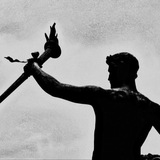
“We condemn all identification with the military and liberticidal regimes of the Greek colonels, of Franco, executioner of the noble Falange of José Antonio Primo de Rivera, of the crudely conservative, classist and colonialist regime of Lisbon, of the racists of South Africa and Rhodesia. Sympathy for the mercenaries of the Foreign Legion, failed tools against Indochinese and Algerian independence, is absurd and uncivil.”
— Giorgio Pini, President of the National Federation of RSI Fighters
— Giorgio Pini, President of the National Federation of RSI Fighters
⚡37🎃5🗿3🤯2
“that from that time seditions and wars and mischievous plots followed each other in quick succession, and never ceased in the city and in all Judea until finally the siege of Vespasian overwhelmed them. Thus the divine vengeance overtook the Jews for the crimes which they dared to commit against Christ.”
— Eusebius of Caesarea
— Eusebius of Caesarea
🔥27👍4⚡3
“My position regarding the foreign influence on the Argentine problem is well known: the country frees itself from the imperialism that neocolonizes it or it will never be able to solve its economic problem... Today's world is moving towards a socialist ideology, as distant from the already lost capitalism as from the dogmatic international Marxism... Justicialism is a Christian national socialism.”
— Juan Perón
— Juan Perón
❤43👍3⚡1
“German racialism has been deliberately distorted. It never was an anti-"other race" racialism. It was a pro-German racialism. It was concerned with making the German race strong and healthy in every way. Hitler was not interested in having millions of degenerates, if it was in his power not to have them. Today one finds rampant alcohol and drug addiction everywhere. Hitler cared that the German families be healthy, cared that they raise healthy children for the renewal of a healthy nation. German racialism meant re-discovering the creative values of their own race, re-discovering their culture. It was a search for excellence, a noble idea. National Socialist racialism was not against other races, it was for its own race. It aimed at defending and improving its race, and wished that all other races did the same for themselves.”
— Léon Degrelle
— Léon Degrelle
⚡60🫡18❤8👍2
René_Guénon_The_Crisis_of_the_Modern_World_Sophia_Perennis_2004.pdf
1.5 MB
The Crisis of the Modern World
by René Guénon
It is no longer news that the Western world is in a crisis, a crisis that has spread far beyond its point of origin and become global in nature. In 1927, René Guénon responded to this crisis with the closest thing he ever wrote to a manifesto and 'call-to-action'. The Crisis of the Modern World was his most direct and complete application of traditional metaphysical principles-particularly that of the 'age of darkness' preceding the end of the present world-to social criticism, surpassed only by The Reign of Quantity and the Signs of the Times, his magnum opus. In the present work Guénon ruthlessly exposes the 'Western deviation': its loss of tradition, its exaltation of action over knowledge, its rampant individualism and general social chaos.
by René Guénon
It is no longer news that the Western world is in a crisis, a crisis that has spread far beyond its point of origin and become global in nature. In 1927, René Guénon responded to this crisis with the closest thing he ever wrote to a manifesto and 'call-to-action'. The Crisis of the Modern World was his most direct and complete application of traditional metaphysical principles-particularly that of the 'age of darkness' preceding the end of the present world-to social criticism, surpassed only by The Reign of Quantity and the Signs of the Times, his magnum opus. In the present work Guénon ruthlessly exposes the 'Western deviation': its loss of tradition, its exaltation of action over knowledge, its rampant individualism and general social chaos.
👍18
gentile1928 (1).pdf
1.8 MB
The Philosophic Basis of Fascism
by Giovanni Gentile
Gentile is remembered today as the “official” philosopher of Italian Fascism. In his 1927 paper The Philosophic Basis of Fascism, Gentile says that, “The authority of the State and the freedom of the citizen constitute a continuous circle wherein authority presupposes liberty and liberty authority. For freedom can exist only within the State, and the State means authority. But the State is not an entity hovering in the air over the heads of its citizens. It is one with the personality of the citizen.” This continuous circle Gentile believed was broken by liberalism.
It has been said that Gentile's philosophy of actual idealism played a role in the development of fascism parallel to the role that Marx’s historical materialism played in the development of communism.
by Giovanni Gentile
Gentile is remembered today as the “official” philosopher of Italian Fascism. In his 1927 paper The Philosophic Basis of Fascism, Gentile says that, “The authority of the State and the freedom of the citizen constitute a continuous circle wherein authority presupposes liberty and liberty authority. For freedom can exist only within the State, and the State means authority. But the State is not an entity hovering in the air over the heads of its citizens. It is one with the personality of the citizen.” This continuous circle Gentile believed was broken by liberalism.
It has been said that Gentile's philosophy of actual idealism played a role in the development of fascism parallel to the role that Marx’s historical materialism played in the development of communism.
🥰23👍3
Dominique_Venner_Julius_Evola_Philosophy.pdf
56.9 KB
Julius Evola: Philosophy and Direct Action
by Dominique Venner
Fergus Cullen's translation of Dominique Venner's short editorial, “Evola: Philosophie et action directe,” Nouvelle Revue d'Histoire 37 (2008). By 2008, Venner was known as an historian; but signs of a sympathy born of youthful activism (in French analogues of the Italian movements he describes) remain. The text is still a good introductory overview.
by Dominique Venner
Fergus Cullen's translation of Dominique Venner's short editorial, “Evola: Philosophie et action directe,” Nouvelle Revue d'Histoire 37 (2008). By 2008, Venner was known as an historian; but signs of a sympathy born of youthful activism (in French analogues of the Italian movements he describes) remain. The text is still a good introductory overview.
👍13⚡4
Reclaiming_the_Patria_Sinarquismo_in_the_United_States_1936_196.pdf
1.5 MB
Reclaiming the Patria: Sinarquismo in the United States, 1936–1966
by Nathan Ellstrand
This dissertation examines the rise and fall of the Catholic, nationalist, and anti-communist Mexican Unión Nacional Sinarquista (UNS or National Synarchist Union) in the U.S. between 1936 and the 1960s. The individuals that became sinarquistas found refuge from the Mexican church-state conflict in the U.S. in places such as Texas, California, and Chicagoland. American Catholics amplified their cause, seeking to sway hearts and minds of Americans, and ultimately the U.S. government, against the Mexican state. The UNS created a transnational fascist community among Mexicans in the U.S. that was eventually brought down through the combined efforts of the political left, media outlets, and both the U.S. and Mexican governments. The Catholic-influenced Mexican nationalism that drew the community to the movement in the U.S. led to its demise as opponents perceived the UNS to be a fascist enemy.
by Nathan Ellstrand
This dissertation examines the rise and fall of the Catholic, nationalist, and anti-communist Mexican Unión Nacional Sinarquista (UNS or National Synarchist Union) in the U.S. between 1936 and the 1960s. The individuals that became sinarquistas found refuge from the Mexican church-state conflict in the U.S. in places such as Texas, California, and Chicagoland. American Catholics amplified their cause, seeking to sway hearts and minds of Americans, and ultimately the U.S. government, against the Mexican state. The UNS created a transnational fascist community among Mexicans in the U.S. that was eventually brought down through the combined efforts of the political left, media outlets, and both the U.S. and Mexican governments. The Catholic-influenced Mexican nationalism that drew the community to the movement in the U.S. led to its demise as opponents perceived the UNS to be a fascist enemy.
👍17🔥4❤1🐳1
“American and Indian, Boer and Zulu, Cossack and Tartar, New Zealander and Maori,—in each case the victor, horrible though many of his deeds are, has laid deep the foundations for the future greatness of a mighty people. The consequences of struggles for territory between civilized nations seem small by comparison. Looked at from the standpoint of the ages, it is of little moment whether Lorraine is part of Germany or of France, whether the northern Adriatic cities pay homage to Austrian Kaiser or Italian King; but it is of incalculable importance that America, Australia, and Siberia should pass out of the hands of their red, black, and yellow aboriginal owners, and become the heritage of the dominant world races.”
— Theodore Roosevelt
— Theodore Roosevelt
🔥34👍5🐳1🍾1
“A leader gets up a program and then he goes out and explains it, patiently and more patiently until they get it. He asks for a mandate, and if they give it to him he goes ahead with the program in spite of hell and high water. He don’t tolerate no opposition from the old gang politicians, the legislatures, the courts, the corporations or anybody.”
— Huey Long
— Huey Long
❤🔥38⚡8🐳2
The_Conservative_Revolution_in_the_Wiemar_Republic_Roger_Woods_1996.pdf
11.2 MB
The Conservative Revolution in the Weimar Republic
by Roger Woods
Embracing some of Germany's best known writers, academics, journalists and philosophers, the Conservative Revolution in the Weimar Republic was the intellectual vanguard of the Right. By approaching the Conservative Revolution as an intellectual movement, this study sheds new light on the evolution of its ideas on the meaning of the First World War, its appropriation of the work of Friedrich Nietzsche, its enthusiasm for political activism and a strong leader, and its ambiguous relationship with National Socialism.
by Roger Woods
Embracing some of Germany's best known writers, academics, journalists and philosophers, the Conservative Revolution in the Weimar Republic was the intellectual vanguard of the Right. By approaching the Conservative Revolution as an intellectual movement, this study sheds new light on the evolution of its ideas on the meaning of the First World War, its appropriation of the work of Friedrich Nietzsche, its enthusiasm for political activism and a strong leader, and its ambiguous relationship with National Socialism.
👍17🐳2
qt7bt808vx_noSplash_42cc71f23d786740f0b6278d3ec02202.pdf
1.8 MB
National Socialism Before Nazism: Friedrich Naumann and Theodor Fritsch, 1890-1914
by Asaf Kedar
This article demonstrates the existence of a national socialism in Germany long before the founding of the Nazi movement, and not just in the dark recesses of racial antisemitism but at the very heart of German bourgeois society. The article focuses on two major cases of pre-Nazi national socialism: left-leaning bourgeois reformist Friedrich Naumann; and the ideology supporting Germany's war effort from 1914 to 1918, a phenomenon also known as the 'ideas of 1914'. National socialism in both these cases rested at its core on a national existentialism: a conviction that Germany is facing a struggle for its very existence as a nation, and that all domestic socioeconomic forces must be systematically regimented and mobilized in the service of the nation's purportedly 'existential' struggles.
by Asaf Kedar
This article demonstrates the existence of a national socialism in Germany long before the founding of the Nazi movement, and not just in the dark recesses of racial antisemitism but at the very heart of German bourgeois society. The article focuses on two major cases of pre-Nazi national socialism: left-leaning bourgeois reformist Friedrich Naumann; and the ideology supporting Germany's war effort from 1914 to 1918, a phenomenon also known as the 'ideas of 1914'. National socialism in both these cases rested at its core on a national existentialism: a conviction that Germany is facing a struggle for its very existence as a nation, and that all domestic socioeconomic forces must be systematically regimented and mobilized in the service of the nation's purportedly 'existential' struggles.
⚡17❤3🐳1