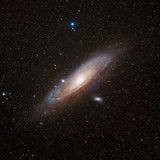
🔭 Antlia Cluster — Deep Field Exploration by
This image explores a deep region of the Antlia Cluster, revealing a rich population of background galaxies embedded in a delicate web of faint galactic cirrus and ionized hydrogen.A remarkable 186 hours of Hα integration were dedicated to this project. Most of this narrowband data was acquired under moonlit skies, which made signal extraction and noise control significantly more challenging. To preserve the natural broadband appearance of the galaxies while isolating genuine emission features, a careful continuum subtraction was applied, allowing the Hα signal to enhance only real ionized structures without contaminating stellar or galactic continua.The result is a complex and subtle field: massive elliptical galaxies characteristic of the Antlia Cluster dominate the central regions, while countless distant spirals and edge-on systems populate the background, each frozen at a different epoch of cosmic history. Wisps of faint hydrogen emission and galactic dust weave through the scene, adding depth and context to this otherwise galaxy-dominated field.Hope you like it!
rafaelss123This image explores a deep region of the Antlia Cluster, revealing a rich population of background galaxies embedded in a delicate web of faint galactic cirrus and ionized hydrogen.A remarkable 186 hours of Hα integration were dedicated to this project. Most of this narrowband data was acquired under moonlit skies, which made signal extraction and noise control significantly more challenging. To preserve the natural broadband appearance of the galaxies while isolating genuine emission features, a careful continuum subtraction was applied, allowing the Hα signal to enhance only real ionized structures without contaminating stellar or galactic continua.The result is a complex and subtle field: massive elliptical galaxies characteristic of the Antlia Cluster dominate the central regions, while countless distant spirals and edge-on systems populate the background, each frozen at a different epoch of cosmic history. Wisps of faint hydrogen emission and galactic dust weave through the scene, adding depth and context to this otherwise galaxy-dominated field.Hope you like it!
🔭 The Geminids meteor shower 2025 by
A winter night of falling starsGeminids are one of the most active meteor showers of the year. The radiant of the shower is located in the constellation Gemini, and the peak of activity occurs in mid-December — in 2025, on the night of December 13–14. Under ideal sky conditions, it is possible to observe as many as 120–150 meteors per hour at maximum.The photograph was created the day before and during the night of the shower’s peak activity. During this time, together with Łukasz Remkowicz and Jarek Cmk, we covered over 20 km at night in the Tatra Mountains, in typically winter conditions. Crampons on our boots, heavy backpacks weighing around 15 kg, snow and ice underfoot.The first night brought almost ideal observing conditions — a clear, starry sky and very good atmospheric transparency, despite equipment problems, including a tripod failure. The second night was clearly more difficult: a struggle with clouds and variable transparency. In both cases, short breaks were spent quickly warming our hands with a cup of hot tea, after which we returned to the tripods.In the foreground, the characteristic “Betlejemka” (the Central Training Center of the Polish Mountaineering Association) on Hala Gąsienicowa is visible, while the sky forms a panorama of the winter Milky Way together with Orion and its surroundings. To the left of the Milky Way lies the region of the sky where the radiant of the Geminids is located.The material was recorded using six cameras working continuously in timelapse mode. From a total of over 10,000 exposures, we selected about 140 frames in which meteors were captured, and then combined them into a single image.Working on such a project is very demanding, but watching the final version of the photograph gives us immense satisfaction.Authors: Marzena Rogozińska and Łukasz Remkowicz
marzenarogoA winter night of falling starsGeminids are one of the most active meteor showers of the year. The radiant of the shower is located in the constellation Gemini, and the peak of activity occurs in mid-December — in 2025, on the night of December 13–14. Under ideal sky conditions, it is possible to observe as many as 120–150 meteors per hour at maximum.The photograph was created the day before and during the night of the shower’s peak activity. During this time, together with Łukasz Remkowicz and Jarek Cmk, we covered over 20 km at night in the Tatra Mountains, in typically winter conditions. Crampons on our boots, heavy backpacks weighing around 15 kg, snow and ice underfoot.The first night brought almost ideal observing conditions — a clear, starry sky and very good atmospheric transparency, despite equipment problems, including a tripod failure. The second night was clearly more difficult: a struggle with clouds and variable transparency. In both cases, short breaks were spent quickly warming our hands with a cup of hot tea, after which we returned to the tripods.In the foreground, the characteristic “Betlejemka” (the Central Training Center of the Polish Mountaineering Association) on Hala Gąsienicowa is visible, while the sky forms a panorama of the winter Milky Way together with Orion and its surroundings. To the left of the Milky Way lies the region of the sky where the radiant of the Geminids is located.The material was recorded using six cameras working continuously in timelapse mode. From a total of over 10,000 exposures, we selected about 140 frames in which meteors were captured, and then combined them into a single image.Working on such a project is very demanding, but watching the final version of the photograph gives us immense satisfaction.Authors: Marzena Rogozińska and Łukasz Remkowicz
🔭 Cometary Globules CG3 & CG25 - HaRGB Continuum Subtracted by
Cometary Globules 3 & 25 are small, dense clouds of gas and dust located in Puppis. Like other cometary globules, they have a distinctive elongated shape with a compact “head” and a faint “tail,” sculpted by the intense radiation and stellar winds from nearby massive stars. These harsh forces compress the globule’s material, sometimes triggering the formation of new stars within its core. Although relatively faint, Cometary Globules offer astronomers an excellent laboratory for studying how stellar feedback shapes interstellar clouds and influences the earliest stages of star formation.…Don’t miss the little PGC 21393 & 492678 ;)
charles_astro_33Cometary Globules 3 & 25 are small, dense clouds of gas and dust located in Puppis. Like other cometary globules, they have a distinctive elongated shape with a compact “head” and a faint “tail,” sculpted by the intense radiation and stellar winds from nearby massive stars. These harsh forces compress the globule’s material, sometimes triggering the formation of new stars within its core. Although relatively faint, Cometary Globules offer astronomers an excellent laboratory for studying how stellar feedback shapes interstellar clouds and influences the earliest stages of star formation.…Don’t miss the little PGC 21393 & 492678 ;)
🔭 Jupiter, Ganymede & Io | 20-Dec-25 by
Finally managed to get some good seeing for this Jupiter apparition - been a while! Plenty of fine details visible across the disc with Ganymede & Io somewhat nearby. The bright Tros Crater can be seen on the eastern (left) limb of Ganymede.Heavy-handed wavelets also revealed the minor moon of Amalthea several hours earlier in the session but I’ve left this out of the final process due to a significant difference in timing. See a GIF of the moon exiting Jovian occultation:📷 Amalthea24" Dob, APM 2.7x (@3.25x), ADC, Uranus-C/M at 8800mm f/14.7. ~20 mins total. This set uses IR wavelet decomposition, although the VIS data was fairly close in resolution already.
tw__astroFinally managed to get some good seeing for this Jupiter apparition - been a while! Plenty of fine details visible across the disc with Ganymede & Io somewhat nearby. The bright Tros Crater can be seen on the eastern (left) limb of Ganymede.Heavy-handed wavelets also revealed the minor moon of Amalthea several hours earlier in the session but I’ve left this out of the final process due to a significant difference in timing. See a GIF of the moon exiting Jovian occultation:📷 Amalthea24" Dob, APM 2.7x (@3.25x), ADC, Uranus-C/M at 8800mm f/14.7. ~20 mins total. This set uses IR wavelet decomposition, although the VIS data was fairly close in resolution already.
🔭 Ced 110 and Ced 111 by
A colorful gem of the southern sky: This 2-frame mosaic captures the reflection nebulae Ced 110 and Ced 111 in Chamaeleon, nestled within the delicate dust clouds of one of the nearest star-forming regions. While Ced 111 glows in cool blue, Ced 110 in warm yellow. In addition the yellow Cha-IR-Nebula and several HH-Objects which are annotated on my website.
FranzHofmannA colorful gem of the southern sky: This 2-frame mosaic captures the reflection nebulae Ced 110 and Ced 111 in Chamaeleon, nestled within the delicate dust clouds of one of the nearest star-forming regions. While Ced 111 glows in cool blue, Ced 110 in warm yellow. In addition the yellow Cha-IR-Nebula and several HH-Objects which are annotated on my website.
🔭 Christmas sky with a view of the Tatra Mountains 19/12/2025 by
Hi, 👋🤩❄🏹✨🏔️🌌 🇸🇰✨🎄Christmas sky on the first day of winter🎄✨What wouldn't you do to see the starry sky accompanied by the Tatra Mountains! It was a good decision; watching the weather, the forecast showed hope for a clear night from Thursday to Friday, so without hesitation, I called a friend to ask if he wanted a quick trip to the Tatra Mountains. A quick pack, and by 11 a.m. I was in the car, packed, and heading south. It was a long drive, about 460 km, but if you're willing, it's easy. That's what I needed: a break from this gray everyday life and a walk, under the starry sky crunching on the ice while hiking through the Białka Valley. That's how this panorama was created while returning to the car at the parking lot in Łysa Polana, on the Slovak side. If I'm not mistaken, which I could be, we can see the constellation of Orion just above the peaks of the High Tatras, just above Rysy, and the entire autumn-winter Milky Way, accompanied by the Biała River, in a still-winter setting, as the snow in the Tatras disappears before our eyes. While photographing the stars, I'm accompanied by the beautiful sound of the river, and let me tell you, it's truly magnificent!Panorama RGB+HA:Canon EOS R modSigma 28mm f1.4 ART Tripod40 x 15s ISO8000 f2.5Białka Valley 19.12.2025 Slovakia 🇸🇰✨On the occasion of Christmas, I wish you that the birth of Jesus Christ brings you peace, joy, and love. Have a wonderful Christmas Eve dinner in 2025✨🎄🎅
LukaszZak77@@@Hi, 👋🤩❄🏹✨🏔️🌌 🇸🇰✨🎄Christmas sky on the first day of winter🎄✨What wouldn't you do to see the starry sky accompanied by the Tatra Mountains! It was a good decision; watching the weather, the forecast showed hope for a clear night from Thursday to Friday, so without hesitation, I called a friend to ask if he wanted a quick trip to the Tatra Mountains. A quick pack, and by 11 a.m. I was in the car, packed, and heading south. It was a long drive, about 460 km, but if you're willing, it's easy. That's what I needed: a break from this gray everyday life and a walk, under the starry sky crunching on the ice while hiking through the Białka Valley. That's how this panorama was created while returning to the car at the parking lot in Łysa Polana, on the Slovak side. If I'm not mistaken, which I could be, we can see the constellation of Orion just above the peaks of the High Tatras, just above Rysy, and the entire autumn-winter Milky Way, accompanied by the Biała River, in a still-winter setting, as the snow in the Tatras disappears before our eyes. While photographing the stars, I'm accompanied by the beautiful sound of the river, and let me tell you, it's truly magnificent!Panorama RGB+HA:Canon EOS R modSigma 28mm f1.4 ART Tripod40 x 15s ISO8000 f2.5Białka Valley 19.12.2025 Slovakia 🇸🇰✨On the occasion of Christmas, I wish you that the birth of Jesus Christ brings you peace, joy, and love. Have a wonderful Christmas Eve dinner in 2025✨🎄🎅
🔭 NGC 346 in the SMC by
This is my first visit to SMC…and I liked it quite a bit. The moment the images starting coming on for this object I was really intrigued. I do see images of this nebula on AB and other places- but not as many as I might expect given the complexity of this one. I do not have a long write up for this one. I guess I expended that on my previous image of the Pulsar Bow Shock image. I feel the Pulsar image was important because it is incredibly important to field of astrophysics and our understanding of Pulsar physics in general. However, it didn’t have a single color image! I just had to fix that. :)NGC 346… lots of images. However, I do have a comment. Typically when H-alpha dominates in a emission line nebula, most people will increase the strength of the weaker channel(s) when processing. However, for objects like NGC 346 that dominate in OIII there appears to be a hesitancy to apply the same logic. It seems inconsistent to me. So I guess my image will appear “different” than others, but in my mind I am actually being consistent in my approach and not different. To get this level of color variation was extremely challenging (as is typical for a weak emission line). On top of that, the myriad of stars in this field made it absolute hell to get the nebula to have enough contrast to be seen against all of them.So here I attempted to capture as much as possible. I wanted the three clusters, I tried to show the inner extremely bright part and the other features, and of course I wanted to show the H-alpha ionization fronts that though are weak- and trace the kinematics of the gas in the nebula. You will note I acquired SII as well. However, I did not use it as a third color- instead I incorporated it as Red as well. This helped give me color in the center. I have included the grayscale version of the SII so you can see what I mean. The H-alpha doesn’t have this signal to this degree at all. I did this same “trick” on my image of NGC 6302.Finally, I also have a “revision” that is a starless version of the field. This isn’t the final contrast of everything (it is an intermediate file)- but it gives you a sense of this field and everything within it.-Adam
CWTauriThis is my first visit to SMC…and I liked it quite a bit. The moment the images starting coming on for this object I was really intrigued. I do see images of this nebula on AB and other places- but not as many as I might expect given the complexity of this one. I do not have a long write up for this one. I guess I expended that on my previous image of the Pulsar Bow Shock image. I feel the Pulsar image was important because it is incredibly important to field of astrophysics and our understanding of Pulsar physics in general. However, it didn’t have a single color image! I just had to fix that. :)NGC 346… lots of images. However, I do have a comment. Typically when H-alpha dominates in a emission line nebula, most people will increase the strength of the weaker channel(s) when processing. However, for objects like NGC 346 that dominate in OIII there appears to be a hesitancy to apply the same logic. It seems inconsistent to me. So I guess my image will appear “different” than others, but in my mind I am actually being consistent in my approach and not different. To get this level of color variation was extremely challenging (as is typical for a weak emission line). On top of that, the myriad of stars in this field made it absolute hell to get the nebula to have enough contrast to be seen against all of them.So here I attempted to capture as much as possible. I wanted the three clusters, I tried to show the inner extremely bright part and the other features, and of course I wanted to show the H-alpha ionization fronts that though are weak- and trace the kinematics of the gas in the nebula. You will note I acquired SII as well. However, I did not use it as a third color- instead I incorporated it as Red as well. This helped give me color in the center. I have included the grayscale version of the SII so you can see what I mean. The H-alpha doesn’t have this signal to this degree at all. I did this same “trick” on my image of NGC 6302.Finally, I also have a “revision” that is a starless version of the field. This isn’t the final contrast of everything (it is an intermediate file)- but it gives you a sense of this field and everything within it.-Adam
🔭 Peaks, shadows by
Yesterday, I was able to go out into the stars again for the first time in a long time. There were dramatic shadows behind the peaks of the Alps, as was the case with Mons Piton. The peaks of the Spitzbergen shine right on the terminator. I liked this face of the Moon, so I composed everything in a full frame, diagonally.
lorandfenyesYesterday, I was able to go out into the stars again for the first time in a long time. There were dramatic shadows behind the peaks of the Alps, as was the case with Mons Piton. The peaks of the Spitzbergen shine right on the terminator. I liked this face of the Moon, so I composed everything in a full frame, diagonally.
🔭 A close-up of 3I/ATLAS - the visitor from distant universe by
This is a photo of the third confirmed visitor from outside of the solar system. Named as 3I/ATLAS, it looks more like an ordinary comet than the strange 1I/OUMUAMUA, with its ionic tail, coma and anti-tail prominently visible. The clear anti-tail was formed due to a spatio-stacking of its backtail lagging behind the core as it passes the zodiac plane and approaching perigee, but also notice a faint second anti-tail to the left of the main anti-tail, which is likely a result of the CO2 evaporating and jetting out from its surface facing the sun. The star towards bottom-left is 59 Leonis. The capture was done renting Chilescope’s T2 and T3, the dual renting allowed a total exposure of 100 minutes in RGB.
Flying_DutchmanThis is a photo of the third confirmed visitor from outside of the solar system. Named as 3I/ATLAS, it looks more like an ordinary comet than the strange 1I/OUMUAMUA, with its ionic tail, coma and anti-tail prominently visible. The clear anti-tail was formed due to a spatio-stacking of its backtail lagging behind the core as it passes the zodiac plane and approaching perigee, but also notice a faint second anti-tail to the left of the main anti-tail, which is likely a result of the CO2 evaporating and jetting out from its surface facing the sun. The star towards bottom-left is 59 Leonis. The capture was done renting Chilescope’s T2 and T3, the dual renting allowed a total exposure of 100 minutes in RGB.
🔭 IC 356 (Arp 213) by
IC 356, also with the Arp peculiar galaxy designation Arp 213, is located about 40 Million Light-Years distant toward the Constellation Camelopardalis, behind a curtain of gas and dust in the Milky Way.IC 356, like its more well known neighbor IC 342, has its light (particularly blue) extincted by the Milky Way gas and dust, but even more so for IC 356 which is much more distant. The most notable feature of IC 356 other than its lack of color is the prominent radial spoke or dust lane which crosses the entire disk and then bifurcates at the core, seemingly forming a torus of gas and dust wraping around it. From the orientation of the torus, it is conjectured that it may be a polar ring object. These peculiarities along with a previously reported bi-polar outflow, a high rotational velocity and flat rotation curve in the outer reaches indicating a large dark matter halo combine to make IC 356 a very odd system indeed.
onwladIC 356, also with the Arp peculiar galaxy designation Arp 213, is located about 40 Million Light-Years distant toward the Constellation Camelopardalis, behind a curtain of gas and dust in the Milky Way.IC 356, like its more well known neighbor IC 342, has its light (particularly blue) extincted by the Milky Way gas and dust, but even more so for IC 356 which is much more distant. The most notable feature of IC 356 other than its lack of color is the prominent radial spoke or dust lane which crosses the entire disk and then bifurcates at the core, seemingly forming a torus of gas and dust wraping around it. From the orientation of the torus, it is conjectured that it may be a polar ring object. These peculiarities along with a previously reported bi-polar outflow, a high rotational velocity and flat rotation curve in the outer reaches indicating a large dark matter halo combine to make IC 356 a very odd system indeed.
🔭 100hrs on Alves 2 (Alv-2) - but what is it? by
I was browsing some survey data and came across this object as just a blob. I did some test exposures and noted something interesting. I actually thought I discovered something (🤣), but eventually I learned that the object had been previously identified and given the name Aves 2 (thanks to @Filipe Alves ). The consensus seems to be that the object is too odd to be classified. As a result there is little in the primary literature to refer to.The current best information is that Alves 2 is a rare, Oiii dominant, shock-tail nebula that is eitherAn extremely evolved planetary nebula sometime called a “ghost PN” interacting with the ISM (the interpretation in Ogle et al. 2025 by @Patrick Ogle et al. )a patch of ionized ISM whose excitation is dominated by a hot/blue star along the line of sight (as suggested by the spectroscopy note submitted by L.Mulato)Either way, it is a very cool object. I hope you enjoy.Here is the object in DSS2:g
adonI was browsing some survey data and came across this object as just a blob. I did some test exposures and noted something interesting. I actually thought I discovered something (🤣), but eventually I learned that the object had been previously identified and given the name Aves 2 (thanks to @Filipe Alves ). The consensus seems to be that the object is too odd to be classified. As a result there is little in the primary literature to refer to.The current best information is that Alves 2 is a rare, Oiii dominant, shock-tail nebula that is eitherAn extremely evolved planetary nebula sometime called a “ghost PN” interacting with the ISM (the interpretation in Ogle et al. 2025 by @Patrick Ogle et al. )a patch of ionized ISM whose excitation is dominated by a hot/blue star along the line of sight (as suggested by the spectroscopy note submitted by L.Mulato)Either way, it is a very cool object. I hope you enjoy.Here is the object in DSS2:g
🔭 NGC602-NGC456 SHORGB by
NGC 602 – NGC 456 lies within the Small Magellanic Cloud, about 200,000 light-years away in the constellation Tucana. NGC 602 is a bright H II region hosting a young star cluster, where intense radiation from massive stars sculpts pillars and ionization fronts in low-metallicity gas. Nearby, NGC 456 is an older, more compact star cluster, offering a striking contrast between recent and past episodes of star formation in this dwarf galaxy.Mosaic of two panelsMore infos here : https://www.cielaustral.com/galerie/photo189.htmFrom our CIEL AUSTRAL team in Chile (https://cielaustral.com/)Authors :Philippe BERNHARDLaurent BOURGONJean-Claude CANONNEDidier CHAPLAINGeorges CHASSAIGNENicolas OUTTERSMike SELBYStéphane VETTER
cielaustralNGC 602 – NGC 456 lies within the Small Magellanic Cloud, about 200,000 light-years away in the constellation Tucana. NGC 602 is a bright H II region hosting a young star cluster, where intense radiation from massive stars sculpts pillars and ionization fronts in low-metallicity gas. Nearby, NGC 456 is an older, more compact star cluster, offering a striking contrast between recent and past episodes of star formation in this dwarf galaxy.Mosaic of two panelsMore infos here : https://www.cielaustral.com/galerie/photo189.htmFrom our CIEL AUSTRAL team in Chile (https://cielaustral.com/)Authors :Philippe BERNHARDLaurent BOURGONJean-Claude CANONNEDidier CHAPLAINGeorges CHASSAIGNENicolas OUTTERSMike SELBYStéphane VETTER
🔭 NGC 2736 - Pencil Nebula by
At first, I thought this would be a relatively easy target to process; it has almost become a classic. However, initially, I wasn’t really satisfied with the rendering across all the ionized filaments.I therefore opted for a progressive and differentiated deconvolution, using smooth transitions with masks, in order to achieve a balanced level of detail everywhere, without overprocessing, while preserving the ethereal, wispy appearance characteristic of supernova remnants.I hope this image will give you a sense of depth, inviting you to dive into it with a feeling of vertigo.
charles_astro_33At first, I thought this would be a relatively easy target to process; it has almost become a classic. However, initially, I wasn’t really satisfied with the rendering across all the ionized filaments.I therefore opted for a progressive and differentiated deconvolution, using smooth transitions with masks, in order to achieve a balanced level of detail everywhere, without overprocessing, while preserving the ethereal, wispy appearance characteristic of supernova remnants.I hope this image will give you a sense of depth, inviting you to dive into it with a feeling of vertigo.
🔭 70 Hours of Witchhead with my Takahashi TOA-130 (The Witchhead Nebula (70 hours) with my Takahashi TOA-130) by
Witch Head Nebula (IC 2118)IC 2118 is an extremely faint reflection nebula illuminated by Rigel, spanning nearly 50 light-years and lying ~900 light-years from Earth. It emits no light of its own; what’s visible here is starlight scattered by interstellar dust.This image represents 70 hours of total integration, pushed specifically to preserve the nebula’s native environment. The blue reflection dust is shown embedded within faint surrounding hydrogen emission and galactic cirrus — not isolated or cosmetically suppressed, but kept in context as physically present structures.The goal was restraint: prioritize real signal, continuity, and scale over aggressive background cleanup or color separation. The result reflects how this region actually exists rather than how it’s often simplified.
johnabc123Witch Head Nebula (IC 2118)IC 2118 is an extremely faint reflection nebula illuminated by Rigel, spanning nearly 50 light-years and lying ~900 light-years from Earth. It emits no light of its own; what’s visible here is starlight scattered by interstellar dust.This image represents 70 hours of total integration, pushed specifically to preserve the nebula’s native environment. The blue reflection dust is shown embedded within faint surrounding hydrogen emission and galactic cirrus — not isolated or cosmetically suppressed, but kept in context as physically present structures.The goal was restraint: prioritize real signal, continuity, and scale over aggressive background cleanup or color separation. The result reflects how this region actually exists rather than how it’s often simplified.
🔭 DNA Nebula by
The “DNA Nebula” is a filamentary shock structure within the Monogem supernova remnant, located in Gemini near the Monoceros border.The Monogem SNR, or Monogem Ring, is an enormous supernova remnant in the constellation Monoceros with extensions into Gemini. It’s estimated age is 80,000 to 100,000 years, and it is about 1,000 light years away. The Monogem SNR spans nearly 25 degrees and represents one of the most diffuse supernova shells in the Milky Way. It was identified through x-ray observations in the 1980s and 1990s which revealed a vast, faint, circular x-ray shell. Optical emissions are discontinuous and consist of faint filaments scattered along the rim. These Ha/Oiii filaments mark the last visible shock structures in this very old, evolved SNR.The image shown here is one of those filamentary regions. The intertwined, helix-like filaments are reminiscent of a “double helix”, and this structure has led to the name “DNA Nebula”.There are no formal astronomical catalog entries for any of the Monogem filamentary regions, including this one. “DNA Nebula” is a nickname given purely for the morphology, but is one that aids in communication and does not conflict with scientific usage as long as the context is clear. Accordingly, its usage seems entirely reasonable.
TomArizonaThe “DNA Nebula” is a filamentary shock structure within the Monogem supernova remnant, located in Gemini near the Monoceros border.The Monogem SNR, or Monogem Ring, is an enormous supernova remnant in the constellation Monoceros with extensions into Gemini. It’s estimated age is 80,000 to 100,000 years, and it is about 1,000 light years away. The Monogem SNR spans nearly 25 degrees and represents one of the most diffuse supernova shells in the Milky Way. It was identified through x-ray observations in the 1980s and 1990s which revealed a vast, faint, circular x-ray shell. Optical emissions are discontinuous and consist of faint filaments scattered along the rim. These Ha/Oiii filaments mark the last visible shock structures in this very old, evolved SNR.The image shown here is one of those filamentary regions. The intertwined, helix-like filaments are reminiscent of a “double helix”, and this structure has led to the name “DNA Nebula”.There are no formal astronomical catalog entries for any of the Monogem filamentary regions, including this one. “DNA Nebula” is a nickname given purely for the morphology, but is one that aids in communication and does not conflict with scientific usage as long as the context is clear. Accordingly, its usage seems entirely reasonable.
🔭 Cygnus Loop - Mosaic x2 SHO RGB stars by
Salut,Voici un projet que je traîne depuis cet été : une mosaïque de 2 panneaux réalisée en SHO avec l’ajout des étoiles RVB.Je tiens à remercier @Benoit Houdard pour m’avoir assemblé les différentes tuiles grâce à son expérience dans les très grosses mosaïques de la Voie Lactée.Les Dentelles du Cygne forment un rémanent de supernova dont l'explosion remonterait à une dizaine de milliers d'années. Elles se situent dans la constellation du Cygne. Le nom normalisé de ce rémanent est SNR G074.0-08.6, parfois également appelé Boucle du Cygne (traduction littérale de son nom anglais Cygnus Loop).Cet objet est très vaste et très morcelé, notamment dans le domaine visible. On retrouve notamment l'ensemble des Dentelles dans le catalogue Sharpless sous la désignation Sh2-103. On les connaît cependant mieux en tant que groupe de plusieurs parties brillantes disposées en cercle :La Grande Dentelle (NGC 6992 / 6995) : La partie la plus brillante, située dans la région nord-est. Elle a la forme d'une virgule composée de filaments très fins s'étendant sur 1,2° suivant un axe NO-SE.La Petite Dentelle (NGC 6960) : Située à l'opposé de la grande, à 2,5° au sud-ouest. Elle a la particularité d'effleurer visuellement l'étoile 52 Cygni (visible à l'œil nu), ce qui facilite grandement le pointage.Le Triangle de Pickering : Se trouve au nord-ouest de la nébuleuse. Il s'agit d'un triangle filamenteux allongé vers le sud sur environ 45 minutes d'arc, se prolongeant par un long filament de plus de deux degrés de long.Nodosités isolées : Quelques structures viennent compléter le tableau, comme NGC 6974 et NGC 6979, situées à un demi-degré au nord-est du Triangle de Pickering.DistanceL'estimation de la distance des Dentelles du Cygne varie considérablement d'une source à l'autre, allant de 2 000 al à près de 4 000 al.English: The Cygnus Loop (Veil Nebula) – 2-Panel SHO MosaicHere is a project I’ve been working on since this summer: a 2-panel mosaic captured in SHO with the addition of RGB stars.I would like to extend a huge thank you to @Benoit Houdard for assembling the different tiles for me, leveraging his extensive experience with massive Milky Way mosaics.The Veil Nebula (Dentelles du Cygne) is a supernova remnant (SNR) resulting from an explosion that occurred approximately 10,000 years ago. Located in the constellation Cygnus, its standardized designation is SNR G074.0-08.6, though it is more commonly known as the Cygnus Loop.This object is vast and highly fragmented, particularly in the visible spectrum. It only recently received a designation covering the entire structure. The Veil Nebula is notably included in the Sharpless catalog as Sh2-103.However, it is better known as a group of several bright sections roughly arranged in a circle:The Eastern Veil (NGC 6992/6995): The brightest part, located in the northeast region. It is shaped like a comma composed of very fine filaments extending 1.2° along a NW-SE axis, with a width of about ten arcminutes.The Western Veil (NGC 6960): Situated opposite the Eastern Veil, 2.5° to the southwest. It is unique for visually brushing against a star visible to the naked eye (magnitude 4.2), 52 Cygni, making it an easy target for amateur astronomers. North of this star, the Western Veil consists of a filament with two main strands extending nearly half a degree. South of the star, the filament flares out toward the southeast across three main strands.Pickering’s Triangle: Located in the northwest of the nebula. As the name suggests, it is a filamentous triangle elongated southward for about 45 arcminutes. It extends into a long filament over two degrees in length.Isolated Nodes: Several other nebulosities complete the structure, maintaining the same filamentous appearance. Notable examples include NGC 6974 and NGC 6979, located half a degree northeast of Pickering’s Triangle.DistanceEstimates for the distance of the Cygnus Loop vary considerably between sources, ranging from 2,000 to nearly 4,000 light-years.
orion13Salut,Voici un projet que je traîne depuis cet été : une mosaïque de 2 panneaux réalisée en SHO avec l’ajout des étoiles RVB.Je tiens à remercier @Benoit Houdard pour m’avoir assemblé les différentes tuiles grâce à son expérience dans les très grosses mosaïques de la Voie Lactée.Les Dentelles du Cygne forment un rémanent de supernova dont l'explosion remonterait à une dizaine de milliers d'années. Elles se situent dans la constellation du Cygne. Le nom normalisé de ce rémanent est SNR G074.0-08.6, parfois également appelé Boucle du Cygne (traduction littérale de son nom anglais Cygnus Loop).Cet objet est très vaste et très morcelé, notamment dans le domaine visible. On retrouve notamment l'ensemble des Dentelles dans le catalogue Sharpless sous la désignation Sh2-103. On les connaît cependant mieux en tant que groupe de plusieurs parties brillantes disposées en cercle :La Grande Dentelle (NGC 6992 / 6995) : La partie la plus brillante, située dans la région nord-est. Elle a la forme d'une virgule composée de filaments très fins s'étendant sur 1,2° suivant un axe NO-SE.La Petite Dentelle (NGC 6960) : Située à l'opposé de la grande, à 2,5° au sud-ouest. Elle a la particularité d'effleurer visuellement l'étoile 52 Cygni (visible à l'œil nu), ce qui facilite grandement le pointage.Le Triangle de Pickering : Se trouve au nord-ouest de la nébuleuse. Il s'agit d'un triangle filamenteux allongé vers le sud sur environ 45 minutes d'arc, se prolongeant par un long filament de plus de deux degrés de long.Nodosités isolées : Quelques structures viennent compléter le tableau, comme NGC 6974 et NGC 6979, situées à un demi-degré au nord-est du Triangle de Pickering.DistanceL'estimation de la distance des Dentelles du Cygne varie considérablement d'une source à l'autre, allant de 2 000 al à près de 4 000 al.English: The Cygnus Loop (Veil Nebula) – 2-Panel SHO MosaicHere is a project I’ve been working on since this summer: a 2-panel mosaic captured in SHO with the addition of RGB stars.I would like to extend a huge thank you to @Benoit Houdard for assembling the different tiles for me, leveraging his extensive experience with massive Milky Way mosaics.The Veil Nebula (Dentelles du Cygne) is a supernova remnant (SNR) resulting from an explosion that occurred approximately 10,000 years ago. Located in the constellation Cygnus, its standardized designation is SNR G074.0-08.6, though it is more commonly known as the Cygnus Loop.This object is vast and highly fragmented, particularly in the visible spectrum. It only recently received a designation covering the entire structure. The Veil Nebula is notably included in the Sharpless catalog as Sh2-103.However, it is better known as a group of several bright sections roughly arranged in a circle:The Eastern Veil (NGC 6992/6995): The brightest part, located in the northeast region. It is shaped like a comma composed of very fine filaments extending 1.2° along a NW-SE axis, with a width of about ten arcminutes.The Western Veil (NGC 6960): Situated opposite the Eastern Veil, 2.5° to the southwest. It is unique for visually brushing against a star visible to the naked eye (magnitude 4.2), 52 Cygni, making it an easy target for amateur astronomers. North of this star, the Western Veil consists of a filament with two main strands extending nearly half a degree. South of the star, the filament flares out toward the southeast across three main strands.Pickering’s Triangle: Located in the northwest of the nebula. As the name suggests, it is a filamentous triangle elongated southward for about 45 arcminutes. It extends into a long filament over two degrees in length.Isolated Nodes: Several other nebulosities complete the structure, maintaining the same filamentous appearance. Notable examples include NGC 6974 and NGC 6979, located half a degree northeast of Pickering’s Triangle.DistanceEstimates for the distance of the Cygnus Loop vary considerably between sources, ranging from 2,000 to nearly 4,000 light-years.
🔭 The Robin's Egg Nebula NGC1360 by
NGC 1360, also known as the Robin's Egg Nebula, is a planetary nebula in the constellation of Fornax. It was identified as a planetary nebula due to its strong radiation in the OIII (oxygen) bands. Reddish matter, believed to have been ejected from the original star before its final collapse, is visible in images. It is slightly fainter than IC 2003.The central star of the system was suspected to be binary since 1977, but was only confirmed in 2017. The central source consists of a low-mass O-type star and a white dwarf, with masses of 0.555 M☉ and 0.679 M☉ respectively.NGC 1360 was discovered in January 1868 by the German astronomer Friedrich August Theodor Winnecke.
bdm201170NGC 1360, also known as the Robin's Egg Nebula, is a planetary nebula in the constellation of Fornax. It was identified as a planetary nebula due to its strong radiation in the OIII (oxygen) bands. Reddish matter, believed to have been ejected from the original star before its final collapse, is visible in images. It is slightly fainter than IC 2003.The central star of the system was suspected to be binary since 1977, but was only confirmed in 2017. The central source consists of a low-mass O-type star and a white dwarf, with masses of 0.555 M☉ and 0.679 M☉ respectively.NGC 1360 was discovered in January 1868 by the German astronomer Friedrich August Theodor Winnecke.
🔭 The Headphone Nebula (PK 164 + 31.1) LRGB by
Here I present another image that was taken from two 17” scopes and combined. PK 164 +31.1 is a really neat planetary nebula that I have wanted to image for a while. Especially once I saw Jeffbax Velocicaptor’s spectacular rendition of this nebula (https://www.astrobin.com/in5ci1/E/), with the distant galaxies visible through the core, it shot up pretty high in my list of targets. While I obviously didn’t match the resolution created by that 1 meter scope, I am happy with how this one turned out using two 430 mm telescopes.Despite being only 1,600 light years away, this PN is fairly dim with a low surface brightness. It also resides in a pretty empty region of the night sky. I am not sure if the small blue star in the middle of the nebula is the white dwarf or not, as the plate solving shows it is offset from that blue star just a bit. However, I see that same plate solving in other images of the headphone nebula here on astrobin, so I guess that is right.This time, I collected just about equal integraion times.AGO 17” IDK: 24 hours (Deep Sky West)PW CDK 17”: 26.5 hours (Howling Coyote)
ThomasGaffneyHere I present another image that was taken from two 17” scopes and combined. PK 164 +31.1 is a really neat planetary nebula that I have wanted to image for a while. Especially once I saw Jeffbax Velocicaptor’s spectacular rendition of this nebula (https://www.astrobin.com/in5ci1/E/), with the distant galaxies visible through the core, it shot up pretty high in my list of targets. While I obviously didn’t match the resolution created by that 1 meter scope, I am happy with how this one turned out using two 430 mm telescopes.Despite being only 1,600 light years away, this PN is fairly dim with a low surface brightness. It also resides in a pretty empty region of the night sky. I am not sure if the small blue star in the middle of the nebula is the white dwarf or not, as the plate solving shows it is offset from that blue star just a bit. However, I see that same plate solving in other images of the headphone nebula here on astrobin, so I guess that is right.This time, I collected just about equal integraion times.AGO 17” IDK: 24 hours (Deep Sky West)PW CDK 17”: 26.5 hours (Howling Coyote)
🔭 Apparent oscillation of Saturn’s ring opening 2018 – 2025 by
This animation was created from 7 images of Saturn, acquired at different epochs, and interpolated using Fantamorph 5 to produce a continuous temporal transition.The final sequence was refined in DaVinci Resolve, with very subtle framing adjustments (zoom and pan) applied solely to maintain visual consistency, without altering the original data.The animation highlights the apparent variation in the opening of Saturn’s rings, from a maximum opening to a relative closure, followed by a reopening, presented as a smooth and continuous loop.• Morphological interpolation: Fantamorph 5• Editing and export: DaVinci Resolve• Looping animation• No sharpening or artificial enhancement applied———————————————————————————————————————Animation réalisée à partir de 7 images de Saturne, acquises à différentes époques, puis interpolées avec Fantamorph 5 afin de produire une transition temporelle continue.Le montage final a été optimisé sous DaVinci Resolve, avec des ajustements très légers de cadrage (zoom et panoramique), afin de préserver la cohérence visuelle sans altérer les données d’origine.L’animation met en évidence la variation apparente de l’ouverture des anneaux, depuis une ouverture maximale jusqu’à leur fermeture relative, puis la réouverture, dans une boucle fluide et continue.• Interpolation morphologique : Fantamorph 5• Montage et export : DaVinci Resolve• Animation présentée en boucle• Aucun traitement de renforcement ou d’effet artificiel
MAILLARDThis animation was created from 7 images of Saturn, acquired at different epochs, and interpolated using Fantamorph 5 to produce a continuous temporal transition.The final sequence was refined in DaVinci Resolve, with very subtle framing adjustments (zoom and pan) applied solely to maintain visual consistency, without altering the original data.The animation highlights the apparent variation in the opening of Saturn’s rings, from a maximum opening to a relative closure, followed by a reopening, presented as a smooth and continuous loop.• Morphological interpolation: Fantamorph 5• Editing and export: DaVinci Resolve• Looping animation• No sharpening or artificial enhancement applied———————————————————————————————————————Animation réalisée à partir de 7 images de Saturne, acquises à différentes époques, puis interpolées avec Fantamorph 5 afin de produire une transition temporelle continue.Le montage final a été optimisé sous DaVinci Resolve, avec des ajustements très légers de cadrage (zoom et panoramique), afin de préserver la cohérence visuelle sans altérer les données d’origine.L’animation met en évidence la variation apparente de l’ouverture des anneaux, depuis une ouverture maximale jusqu’à leur fermeture relative, puis la réouverture, dans une boucle fluide et continue.• Interpolation morphologique : Fantamorph 5• Montage et export : DaVinci Resolve• Animation présentée en boucle• Aucun traitement de renforcement ou d’effet artificiel
🔭 IC 348 and NGC 1333 (Embryo Nebula) by
IC 348 and NGC 1333 (Embryo Nebula) - 2600MC - Spacecat 51100 Darks - 100 Flats - 450 bias - 100 gain - Dither every other sub. 300s x 456 subs - 38 hoursThis was taken over 6 nights but I didnt break them down in the aquisition section. I got around 44 hours over 6 nights and kept the best 38 hrs.I had just imaged and posted the Embryo Nebula with the Ultracat 108, but wanted IC 348 and needed more FOV. the Spacecat 51 was up to the task :)This is such a beautiful area, I think its going to be hard to find similar targets with this much impact. Im very much enjoying remote imaging at Starfront. I get more integration now on one image than I did all year from home where i might get 5 hours for each image 10 nights a year. I would travel to a darker site but would have to set up and break down, take days off from work etc. I dont miss that athough i do miss getting out under the stars… I only really have my c9.25 home now so I am finally going to do some lunar and planetary this year from home :)Pixinsight is coming along but i can only do straightforward images meaning one filter for all subs. Combining narrowband and broadband or high dymanic range targets are not feasable right now. I hope to learn how to do that soon so I can finally process my 50 hours of M31 and combine the narrowband. I avoided PI for a looong time, but it is a great tool, just a steep leaning curve. once i learn the above I may be ready for mono. Always chasing the dragon of better images lol :)Comments and Criticisms are welcome :)--------------------------------------------------------------------------------------------------------------------------------------------------------------------I have added the below because many imagers have requested OSC data to practice thier processing in innumerable forum posts . I posted the folder link below containing raw calibrated stacks for my more recent images. If you want OSC data to practice on, use the below to access the fully calibrated stacks. You can see any information regarding integration times, gain, bortle, filters etc, contained in my posted gallery images.https://www.dropbox.com/scl/fo/tvqdftgv11bup66lcalym/ABHCZoMDrPJ-LNdYadvs0AQ?rlkey=p5kzil8l64r3n18zxjahr720t&st=nstdy5q1&dl=0If you would like to post any of these images on here, feel free. Just post and credit me for the data, but dont add me as a collaborator (I'd have 10 images of each object on my page lol Regards,Itto (Jim)
Itto-OgamiIC 348 and NGC 1333 (Embryo Nebula) - 2600MC - Spacecat 51100 Darks - 100 Flats - 450 bias - 100 gain - Dither every other sub. 300s x 456 subs - 38 hoursThis was taken over 6 nights but I didnt break them down in the aquisition section. I got around 44 hours over 6 nights and kept the best 38 hrs.I had just imaged and posted the Embryo Nebula with the Ultracat 108, but wanted IC 348 and needed more FOV. the Spacecat 51 was up to the task :)This is such a beautiful area, I think its going to be hard to find similar targets with this much impact. Im very much enjoying remote imaging at Starfront. I get more integration now on one image than I did all year from home where i might get 5 hours for each image 10 nights a year. I would travel to a darker site but would have to set up and break down, take days off from work etc. I dont miss that athough i do miss getting out under the stars… I only really have my c9.25 home now so I am finally going to do some lunar and planetary this year from home :)Pixinsight is coming along but i can only do straightforward images meaning one filter for all subs. Combining narrowband and broadband or high dymanic range targets are not feasable right now. I hope to learn how to do that soon so I can finally process my 50 hours of M31 and combine the narrowband. I avoided PI for a looong time, but it is a great tool, just a steep leaning curve. once i learn the above I may be ready for mono. Always chasing the dragon of better images lol :)Comments and Criticisms are welcome :)--------------------------------------------------------------------------------------------------------------------------------------------------------------------I have added the below because many imagers have requested OSC data to practice thier processing in innumerable forum posts . I posted the folder link below containing raw calibrated stacks for my more recent images. If you want OSC data to practice on, use the below to access the fully calibrated stacks. You can see any information regarding integration times, gain, bortle, filters etc, contained in my posted gallery images.https://www.dropbox.com/scl/fo/tvqdftgv11bup66lcalym/ABHCZoMDrPJ-LNdYadvs0AQ?rlkey=p5kzil8l64r3n18zxjahr720t&st=nstdy5q1&dl=0If you would like to post any of these images on here, feel free. Just post and credit me for the data, but dont add me as a collaborator (I'd have 10 images of each object on my page lol Regards,Itto (Jim)