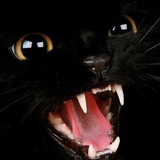
In Scotland and parts of the British Isles, we find The Devil’s Acre as a sort of offering to the Wild Adversary, called sometimes ‘The Gudeman’s Croft’ or ‘Cloutie’s Croft’. This is where a good piece of the pasture is left wild, given as an offering to the Devil, out of respect and fear. This piece of ground was not ventured onto nor put into any sort of production, as it was left in the Devil’s service. Ulstermen from Ireland called this ‘The Devil’s Half Acre’ or ‘The Lone Acre’. A name from England for it was ‘Jack’s Land’. Even from New England, it was spoke of as ‘leaving the tithe to nature’. One seed-planting incantation from nineteenth century Suffolk went: ‘Four seeds in a hole, One for the birds, One for the mice, and One for the Master’.
Another from Ashe County, North Carolina simply goes: ‘This is for me, This is for my neighbor, This is for the Devil’. This notion that the Devil must have his share of the bounty of the land is no doubt a remnant from ancient times, where offerings to local land spirits were part of planting and harvesting practices. The power of the Old One, similar to the denizens of the Faerie realm, having the supernatural ability to bestow a blessing or curse upon the land, was taken seriously in times past. Regular offerings and acknowledgement were in order.
Corinne Boyer - Plants of the Devil
Another from Ashe County, North Carolina simply goes: ‘This is for me, This is for my neighbor, This is for the Devil’. This notion that the Devil must have his share of the bounty of the land is no doubt a remnant from ancient times, where offerings to local land spirits were part of planting and harvesting practices. The power of the Old One, similar to the denizens of the Faerie realm, having the supernatural ability to bestow a blessing or curse upon the land, was taken seriously in times past. Regular offerings and acknowledgement were in order.
Corinne Boyer - Plants of the Devil
We continually restructure ourselves, feeding and maintaining evolving combinations in ways that ultimately permit a certain continuity: a form of life that is not in one-way, linear motion but, despite surprising jolts and changes of direction, composes a pattern. The protean nature of the self stems from its permeability to inner and outer influences, which are never fully separable from one another. We are shaped by a complex interweaving of external events and inner experiences, which become indistinguishable. What ‘actually happened’ in some past event in our life is inextricably tied to the phenomenological meaning we ascribe—that is, to our experience of the event. And this meaning changes as we continually respond to the blending of external and internal forces that make up our ongoing experience—as we revise and reshape the story of our lives.
Lisa Capps and Elinor Ochs, Constructing Panic: The Discourse of Agoraphobia
Lisa Capps and Elinor Ochs, Constructing Panic: The Discourse of Agoraphobia
❤2