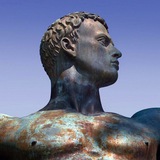
Spartacus, for most people today, has a face. It is the face of Kirk Douglas. Stanley K brick's 50-year-old screen epic still has its place in the collective memory at the beginning of the 21st century. But who was the historical Spartacus? And what do we know of him?
The film "Spartacus" is based on a novel by Howard Fast, an American writer and screenwriter who - having joined the U.S. Communist Party in 1943 - found himself in the crosshairs of Joseph McCarthy's Committee on Un-American Activities in 1950. The author, who like Kirk Douglas came from a family of Eastern European Jews, was sentenced to three months in prison. While behind bars, he pressed ahead with his project for a Spartacus novel. Hardly finished, the work promptly landed on the blacklist of American publishers. So Fast self-published his book. The novel had become a plea for the exploited and disenfranchised of this world, hardly surprising given the background of its genesis. Despite the adverse circumstances, it became a bestseller. And Kubrick's film, made in the late 1950s, became a turning point for the victims of McCarthyism, ushering in their swift rehabilitation.
"Spartacus" is the story of an imperialism victim who refuses to submit to oppression and becomes the leader of a revolt that shakes mighty Rome. A sense of justice, loyalty and - of course! - love drive the slave turned gladiator into resistance against the world power. The film stylizes Spartacus as a visionary who, with his fight, stands up for a Rome without slavery. The viewer witnesses the monumental battles typical of the genre; he feels for the gladiators when they meet death in the arena; and he looks into the abysses of decadence and corruption as he follows the machinations of those who steer Rome's destiny. Rome is everywhere. Slavery is everywhere. But solidarity in the face of injustice and oppression is also everywhere. This is the subtext of the film "Spartacus".
The film "Spartacus" is based on a novel by Howard Fast, an American writer and screenwriter who - having joined the U.S. Communist Party in 1943 - found himself in the crosshairs of Joseph McCarthy's Committee on Un-American Activities in 1950. The author, who like Kirk Douglas came from a family of Eastern European Jews, was sentenced to three months in prison. While behind bars, he pressed ahead with his project for a Spartacus novel. Hardly finished, the work promptly landed on the blacklist of American publishers. So Fast self-published his book. The novel had become a plea for the exploited and disenfranchised of this world, hardly surprising given the background of its genesis. Despite the adverse circumstances, it became a bestseller. And Kubrick's film, made in the late 1950s, became a turning point for the victims of McCarthyism, ushering in their swift rehabilitation.
"Spartacus" is the story of an imperialism victim who refuses to submit to oppression and becomes the leader of a revolt that shakes mighty Rome. A sense of justice, loyalty and - of course! - love drive the slave turned gladiator into resistance against the world power. The film stylizes Spartacus as a visionary who, with his fight, stands up for a Rome without slavery. The viewer witnesses the monumental battles typical of the genre; he feels for the gladiators when they meet death in the arena; and he looks into the abysses of decadence and corruption as he follows the machinations of those who steer Rome's destiny. Rome is everywhere. Slavery is everywhere. But solidarity in the face of injustice and oppression is also everywhere. This is the subtext of the film "Spartacus".
Fast and Kubrick, as is to be expected in a monumental film, subordinated the historical facts to the higher goals of exciting plot and concise message. But from where does research draw its knowledge about Spartacus? And what do the ancient sources report about the rebel who disavowed quite a few top Roman officials and an entire consular army?
"At the same time, Spartacus, a Thracian by birth who had once fought as a soldier with the Romans but had then been captured, sold as a gladiator, and trained in the gladiatorial school at Capua, persuaded about 70 of his comrades to fight for their freedom rather than for the amusement of spectators." With these words Appian , author of several historical works, introduces the rebel leader to his readership in his "Civil Wars". For Plutarch , the learned biographer and author of parallel histories of famous Greeks and Romans, Spartacus was "a Thracian of nomadic origin, who not only boasted great boldness and strength, but was also sharp of mind and extensively educated, more than befitted his destiny." He was thus, sums up the Greek Plutarch in his biography of Crassus, "more Hellene than Thracian".
Campania was a center of gladiatorial activity during the Roman Republic. In the schools, the ludi, of Capua and Pompeii, the young men prepared themselves for gladiatorial careers under the strict eyes of the instructors: The men were trained here to become true fighting machines, who had to kill in order to escape death themselves. The regulations in the ludi corresponded to military discipline: The gladiators were barracked and practiced, day in and day out, with heavy wooden weapons the serious case in the arena. The school of Capua, where Spartacus learned the art of killing together with dozens of other men, mostly from Gaul and Thrace, was privately owned. A certain Lentulus Batiatus had kept them there like prisoners and rented them out to the organizers of gladiator fights, Plutarch notes.
In 73 BC, 200 gladiators planned to break out of Batiatus' asylum, but were betrayed. A group of 70 men armed themselves with kitchen utensils and fought their way out of the school. They captured equipment from gladiators and defeated a small militia unit that had moved out to pursue the gladiators. Thus, as Plutarch puts it, the rebels were in "possession of real weapons of war." The group, now marauding through Campania, immediately received an influx of fugitive slaves from the region; the Gauls Crixus and Oenomaus and the Thracian Spartacus were designated as leaders. It was decided to retreat first to Mount Vesuvius, where defensive positions were established.
Much about the accounts of Spartacus and the events immediately following the revolt is confused, even contradictory. Whether Spartacus came from Thrace, as Appian claims, or whether he was simply a gladiator fighting as a thraex, a "Thracian" (i.e., wearing heavy armor and a short, sickle-like sword), eludes us. Also his prehistory is lost in the darkness. Was Spartacus, as Appian implies, an auxiliary soldier provided by the Roman confederates or even a legionary, that is, a Roman citizen? Or had he become a Roman prisoner of war and thus a gladiator? We will never know. Our ancient informants - apart from Plutarch and Appian, there are a handful of scattered textual testimonies - almost all wrote from a considerable temporal distance. Finally, the voice of the victor speaks in the sources, of course, for whom the insurgents were nothing but a gang of runaway criminals and slaves - even if especially in Plutarch's report respect for Spartacus as a person and military leader clearly shines through...
"At the same time, Spartacus, a Thracian by birth who had once fought as a soldier with the Romans but had then been captured, sold as a gladiator, and trained in the gladiatorial school at Capua, persuaded about 70 of his comrades to fight for their freedom rather than for the amusement of spectators." With these words Appian , author of several historical works, introduces the rebel leader to his readership in his "Civil Wars". For Plutarch , the learned biographer and author of parallel histories of famous Greeks and Romans, Spartacus was "a Thracian of nomadic origin, who not only boasted great boldness and strength, but was also sharp of mind and extensively educated, more than befitted his destiny." He was thus, sums up the Greek Plutarch in his biography of Crassus, "more Hellene than Thracian".
Campania was a center of gladiatorial activity during the Roman Republic. In the schools, the ludi, of Capua and Pompeii, the young men prepared themselves for gladiatorial careers under the strict eyes of the instructors: The men were trained here to become true fighting machines, who had to kill in order to escape death themselves. The regulations in the ludi corresponded to military discipline: The gladiators were barracked and practiced, day in and day out, with heavy wooden weapons the serious case in the arena. The school of Capua, where Spartacus learned the art of killing together with dozens of other men, mostly from Gaul and Thrace, was privately owned. A certain Lentulus Batiatus had kept them there like prisoners and rented them out to the organizers of gladiator fights, Plutarch notes.
In 73 BC, 200 gladiators planned to break out of Batiatus' asylum, but were betrayed. A group of 70 men armed themselves with kitchen utensils and fought their way out of the school. They captured equipment from gladiators and defeated a small militia unit that had moved out to pursue the gladiators. Thus, as Plutarch puts it, the rebels were in "possession of real weapons of war." The group, now marauding through Campania, immediately received an influx of fugitive slaves from the region; the Gauls Crixus and Oenomaus and the Thracian Spartacus were designated as leaders. It was decided to retreat first to Mount Vesuvius, where defensive positions were established.
Much about the accounts of Spartacus and the events immediately following the revolt is confused, even contradictory. Whether Spartacus came from Thrace, as Appian claims, or whether he was simply a gladiator fighting as a thraex, a "Thracian" (i.e., wearing heavy armor and a short, sickle-like sword), eludes us. Also his prehistory is lost in the darkness. Was Spartacus, as Appian implies, an auxiliary soldier provided by the Roman confederates or even a legionary, that is, a Roman citizen? Or had he become a Roman prisoner of war and thus a gladiator? We will never know. Our ancient informants - apart from Plutarch and Appian, there are a handful of scattered textual testimonies - almost all wrote from a considerable temporal distance. Finally, the voice of the victor speaks in the sources, of course, for whom the insurgents were nothing but a gang of runaway criminals and slaves - even if especially in Plutarch's report respect for Spartacus as a person and military leader clearly shines through...
animation.gif
19 KB
Ulrich von Jungingen (1360 – 15 July 1410) was the 26th Grand Master of the Teutonic Knights, serving from 1407 to 1410. His policy of confrontation with the Grand Duchy of Lithuania and the Kingdom of Poland would spark the Polish–Lithuanian–Teutonic War and lead to disaster for his Order, and his own death, at the Battle of Grunwald.
The Siege of Marienburg was an unsuccessful two-month siege of the castle in Marienburg (Malbork), the capital of the monastic state of the Teutonic Knights. The joint Polish and Lithuanian forces, under command of King Władysław II Jagiełło and Grand Duke Vytautas, besieged the castle between 26 July and 19 September 1410 in a bid of complete conquest of Prussia after the great victory in the Battle of Grunwald (Tannenberg). However, the castle withstood the siege and the Knights conceded only to minor territorial losses in the Peace of Thorn (1411). Marienburg defender Heinrich von Plauen is credited as the savior of the Knights from complete annihilation.
Heinrich von Plauen (the Elder) (ca. 1370–1429) was the 27th Grand Master of the Teutonic Knights, serving from November 1410 to October 1413. He was a stern proponent of prolonging the war with Poland. Because all male members of his family were baptized as Heinrich (Henry), he is sometimes known as Heinrich von Plauen the Elder to differentiate from his relative, Heinrich von Plauen the Younger (died ca. 1441).