Media is too big
VIEW IN TELEGRAM
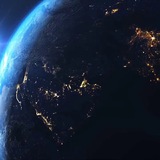
What's it like to dive into Earth's atmosphere?
Experience it with the Orion spacecraft, which returned from its lunar flyby on December 11, 2022 🔥
Experience it with the Orion spacecraft, which returned from its lunar flyby on December 11, 2022 🔥
🔥7🤔2❤1
This media is not supported in your browser
VIEW IN TELEGRAM
A simple model of the solar system. Here, 1 year is compressed into 2 seconds (a total of about 30 years).
❤4👍4🆒1
Media is too big
VIEW IN TELEGRAM
The analemma is the annual apparent motion of the Sun across the celestial sphere. Its shape and tilt are determined by the tilt of the Earth's axis, its orientation, and the ellipticity of the Earth's orbit. The highest and lowest points correspond to the summer and winter solstices.
❤3👍2
This media is not supported in your browser
VIEW IN TELEGRAM
The largest planet in the Universe
HD 100546 b, the largest known exoplanet, was discovered using the Very Large Telescope in Chile. It is located 337 light‑years away from the Solar System.
HD 100546 b, the largest known exoplanet, was discovered using the Very Large Telescope in Chile. It is located 337 light‑years away from the Solar System.
👍8🆒3
This media is not supported in your browser
VIEW IN TELEGRAM
We’re not so round after all: please welcome the Earth’s geoid — a theoretical surface.
It shows the level of the world’s oceans beneath the continents, which is affected only by the force of gravity — without taking into account tides, currents, and atmospheric pressure.
The model was created by NASA based on 15 years of observations from 19 satellites.
It shows the level of the world’s oceans beneath the continents, which is affected only by the force of gravity — without taking into account tides, currents, and atmospheric pressure.
The model was created by NASA based on 15 years of observations from 19 satellites.
👍6🆒2❤1
This media is not supported in your browser
VIEW IN TELEGRAM
Scientists from the United States obtained the most detailed images of the Sun’s surface — and for the first time, they spotted moving feather‑like patterns in them. Initially, the images were taken to adjust the Inouye telescope at the observatory in Hawaii. However, after studying the images, astronomers realized that they had managed to capture the Sun with record‑level detail. The researchers stated that these structures are traces of instability waves on the Sun’s surface. They arise due to the movement of flows of magnetized plasma at different speeds. Scientists compared this process to waves on the water caused by gusts of wind.
🔥6❤2
😮On August 12, a rare astronomical show awaits us — three bright celestial events will coincide on the same day: a solar eclipse, a planetary parade, and the peak of the Perseid meteor shower.
Astronomers call this coincidence extremely rare:
• Before dawn, you can observe a parade of six planets: Jupiter, Mars, Mercury, Saturn, Uranus, and Neptune.
• In the evening, there will be a solar eclipse: in some regions, it will be total, and in most, it will be partial.
• The Perseid meteor shower will peak at night, and in good weather, up to 120 meteors per hour can be seen.
Astronomers call this coincidence extremely rare:
• Before dawn, you can observe a parade of six planets: Jupiter, Mars, Mercury, Saturn, Uranus, and Neptune.
• In the evening, there will be a solar eclipse: in some regions, it will be total, and in most, it will be partial.
• The Perseid meteor shower will peak at night, and in good weather, up to 120 meteors per hour can be seen.
🔥10❤1