
Cut K8s costs with Karpenter
If you're like most companies running Kubernetes, you've likely seen your infrastructure costs balloon over the past year. Between supply chain disruptions, the rise in cloud prices, and increased app usage, those pesky cloud bills keep getting bigger and bigger.
It's enough to give any CTO heartburn. After all, you implemented Kubernetes and containers to increase efficiency and reduce costs! Yet somehow, it feels like you've lost control of your spend.
The problem often comes down to the limitations of your legacy cluster autoscaler. Tools like the Kubernetes cluster autoscaler were great when Kubernetes was new. But let's face it - their capabilities are limited compared to today's workloads. Relying on rigid auto-scaling groups and similarly sized nodes just doesn't cut it anymore.
The result? You end up with inefficient overprovisioning, idle capacity, and nodes that don't properly align with workload needs. And those inefficient nodes drive up your cloud spend exponentially.
Fortunately, there's a better way. Karpenter - the new open source node provisioning tool purpose built for Kubernetes.
Karpenter takes a workload-centric approach to right-sizing nodes on the fly based on actual resource requests. It also automatically consolidates workloads onto fewer nodes to minimize waste. Engineers who have made the switch cite 40% cost reductions or more!
Read how here https://www.perfectscale.io/blog/getting-the-most-out-of-karpenter-with-perfectscale
https://redd.it/1d1sc5l
@r_devops
If you're like most companies running Kubernetes, you've likely seen your infrastructure costs balloon over the past year. Between supply chain disruptions, the rise in cloud prices, and increased app usage, those pesky cloud bills keep getting bigger and bigger.
It's enough to give any CTO heartburn. After all, you implemented Kubernetes and containers to increase efficiency and reduce costs! Yet somehow, it feels like you've lost control of your spend.
The problem often comes down to the limitations of your legacy cluster autoscaler. Tools like the Kubernetes cluster autoscaler were great when Kubernetes was new. But let's face it - their capabilities are limited compared to today's workloads. Relying on rigid auto-scaling groups and similarly sized nodes just doesn't cut it anymore.
The result? You end up with inefficient overprovisioning, idle capacity, and nodes that don't properly align with workload needs. And those inefficient nodes drive up your cloud spend exponentially.
Fortunately, there's a better way. Karpenter - the new open source node provisioning tool purpose built for Kubernetes.
Karpenter takes a workload-centric approach to right-sizing nodes on the fly based on actual resource requests. It also automatically consolidates workloads onto fewer nodes to minimize waste. Engineers who have made the switch cite 40% cost reductions or more!
Read how here https://www.perfectscale.io/blog/getting-the-most-out-of-karpenter-with-perfectscale
https://redd.it/1d1sc5l
@r_devops
www.perfectscale.io
Getting the most out of Karpenter with PerfectScale
Learn how PerfectScale plus Karpenter can provide and additional 30 to 50% in cost reductions on top of what can achieved with Karpenter alone.
From your source code to zero-downtime, high availability, and secure production deployment in no time (v5.0.1)
* With your project and its sole Dockerfile, Docker-Blue-Green-Runner manages the remainder of the Continuous Deployment (CD) process with [wait-for-it](https://github.com/vishnubob/wait-for-it), [consul-template](https://github.com/hashicorp/consul-template) and [Nginx](https://github.com/nginx/nginx).
* Examples in PHP, Java, and Node.js
* [https://github.com/Andrew-Kang-G/docker-blue-green-runner](https://github.com/Andrew-Kang-G/docker-blue-green-runner)
https://redd.it/1d1vbw4
@r_devops
* With your project and its sole Dockerfile, Docker-Blue-Green-Runner manages the remainder of the Continuous Deployment (CD) process with [wait-for-it](https://github.com/vishnubob/wait-for-it), [consul-template](https://github.com/hashicorp/consul-template) and [Nginx](https://github.com/nginx/nginx).
* Examples in PHP, Java, and Node.js
* [https://github.com/Andrew-Kang-G/docker-blue-green-runner](https://github.com/Andrew-Kang-G/docker-blue-green-runner)
https://redd.it/1d1vbw4
@r_devops
GitHub
GitHub - vishnubob/wait-for-it: Pure bash script to test and wait on the availability of a TCP host and port
Pure bash script to test and wait on the availability of a TCP host and port - vishnubob/wait-for-it
Client wants to start storing data regionally
We have a client who sells services to other companies. We originally a NextJS application with PostgreSQL database in AWS Canada region.
They are looking to partner with a company in the US who seems to think they need user data stored in the US. But the current user data needs to also stay in Canada.
This presents many issues as the application was never designed to store multi-regional data like this.
One option is that we can deploy the tech stack in another AWS region, but then we essentially have two totally separate systems operating that don't talk to each other.
I've come across some service such as CockroachDB which has some features to store row level data in different regions but changing the database system at this point would be quite a bit of work. I'm not sure if something similar can be accomplished with RDS PostgreSQL.
I'm wondering if anyone has had to deal with a request like this before and hoping to get some ideas as to where to start.
https://redd.it/1d1xbbd
@r_devops
We have a client who sells services to other companies. We originally a NextJS application with PostgreSQL database in AWS Canada region.
They are looking to partner with a company in the US who seems to think they need user data stored in the US. But the current user data needs to also stay in Canada.
This presents many issues as the application was never designed to store multi-regional data like this.
One option is that we can deploy the tech stack in another AWS region, but then we essentially have two totally separate systems operating that don't talk to each other.
I've come across some service such as CockroachDB which has some features to store row level data in different regions but changing the database system at this point would be quite a bit of work. I'm not sure if something similar can be accomplished with RDS PostgreSQL.
I'm wondering if anyone has had to deal with a request like this before and hoping to get some ideas as to where to start.
https://redd.it/1d1xbbd
@r_devops
Reddit
From the devops community on Reddit
Explore this post and more from the devops community
Are all CI/CD Tools similar?
So I started an intern position in a devops/IT role and am using Jenkins for the first time. Looking online, it looks like Jenkins gets a bad rep and it's alternatives are usually preferred.
So my question: are Jenkins and all the other tools similar in understanding concepts and usage? If I learn how to use Jenkins, would it be easy to use other tools?
I am mainly curious because I am hoping to learn as much as I can from this internship, and I hope that learning Jenkins means I understand how to use other tools to some degree.
https://redd.it/1d20ach
@r_devops
So I started an intern position in a devops/IT role and am using Jenkins for the first time. Looking online, it looks like Jenkins gets a bad rep and it's alternatives are usually preferred.
So my question: are Jenkins and all the other tools similar in understanding concepts and usage? If I learn how to use Jenkins, would it be easy to use other tools?
I am mainly curious because I am hoping to learn as much as I can from this internship, and I hope that learning Jenkins means I understand how to use other tools to some degree.
https://redd.it/1d20ach
@r_devops
Reddit
From the devops community on Reddit
Explore this post and more from the devops community
Preferred Dev/Deploy stack for basic python database app?
Retired devops guy here, almost a decade out of date. To update my skillset, I’d like to write a web/database app for a non-profit org I volunteer for.
My favored language is python. I’d like to do all-the-things as code, including provisioning, deployment, and database structure. I’d like to host it in the cloud, preferably free/cheap tier (it won’t get much traffic).
I’m starting the research phase, and thought y’all could help me focus in on what might be appropriate to look at.
https://redd.it/1d2cmj5
@r_devops
Retired devops guy here, almost a decade out of date. To update my skillset, I’d like to write a web/database app for a non-profit org I volunteer for.
My favored language is python. I’d like to do all-the-things as code, including provisioning, deployment, and database structure. I’d like to host it in the cloud, preferably free/cheap tier (it won’t get much traffic).
I’m starting the research phase, and thought y’all could help me focus in on what might be appropriate to look at.
https://redd.it/1d2cmj5
@r_devops
Reddit
From the devops community on Reddit
Explore this post and more from the devops community
Ever Struggled with SSL/TLS Certificate Chains? Check This Out!
Hey everyone 👋,
I've just published a simple guide on SSL/TLS certificate chains on GitHub. This is my own notes I have kept in for a long time and I thought I shared to everyone and I'm curious to know what you think? I made it very simple enough to understand, breaking down what certificate chains are, how they work, and gave a real world example.
If you find it useful, please star or watch my repo. If not, any feedback to make it better and simple?
Check it out and let me know: GitHub - Understanding Certificate Chains: A Simple Guide
Thanks in advance!
https://redd.it/1d2dk01
@r_devops
Hey everyone 👋,
I've just published a simple guide on SSL/TLS certificate chains on GitHub. This is my own notes I have kept in for a long time and I thought I shared to everyone and I'm curious to know what you think? I made it very simple enough to understand, breaking down what certificate chains are, how they work, and gave a real world example.
If you find it useful, please star or watch my repo. If not, any feedback to make it better and simple?
Check it out and let me know: GitHub - Understanding Certificate Chains: A Simple Guide
Thanks in advance!
https://redd.it/1d2dk01
@r_devops
GitHub
GitHub - nicanorflavier/ssl-certificate-chain-guide: Certificate chains are a key part of internet security. But what are they…
Certificate chains are a key part of internet security. But what are they, and how do they work? This guide will explain it all in simple terms to make the concept clearer. - nicanorflavier/ssl-cer...
Eraser AI
I found a useful tool today after I sifted through a post here from several months ago via my technical diagram query. I’ve worked in the Fortune 100 space for the last several years and diagramming tools have not been easy or fun. I don’t think the AI feature of Eraser was out several months ago when this product was discussed, but I think it deserves another discussion.
For those with other AI-powered technical visual/design tool experience, does Eraser AI detail a complex architecture better than the others, LucidCharts beta AI for example
? I tried diagramming with ChatGPT 3.5 in the beginning and wasn’t impressed. But models have clearly improved since then, and watching Eraser AI diagram my two year project in less than a minute with < 200 words was satisfying.
https://redd.it/1d2bzms
@r_devops
I found a useful tool today after I sifted through a post here from several months ago via my technical diagram query. I’ve worked in the Fortune 100 space for the last several years and diagramming tools have not been easy or fun. I don’t think the AI feature of Eraser was out several months ago when this product was discussed, but I think it deserves another discussion.
For those with other AI-powered technical visual/design tool experience, does Eraser AI detail a complex architecture better than the others, LucidCharts beta AI for example
? I tried diagramming with ChatGPT 3.5 in the beginning and wasn’t impressed. But models have clearly improved since then, and watching Eraser AI diagram my two year project in less than a minute with < 200 words was satisfying.
https://redd.it/1d2bzms
@r_devops
Reddit
From the devops community on Reddit
Explore this post and more from the devops community
Begin for DevOps team
Hi all,
I'am a (m, 43y) I just finish some courses and have certificates. I'am from the Netherlands and want to start working in a DevOps team. But first i need to get alot of experience is my feeling. Could u give me some advice to start with. My experience is homecomputers and home networks, installing hardware, software and build computersystems.
Eager to start...
https://redd.it/1d2ewl1
@r_devops
Hi all,
I'am a (m, 43y) I just finish some courses and have certificates. I'am from the Netherlands and want to start working in a DevOps team. But first i need to get alot of experience is my feeling. Could u give me some advice to start with. My experience is homecomputers and home networks, installing hardware, software and build computersystems.
Eager to start...
https://redd.it/1d2ewl1
@r_devops
Reddit
From the devops community on Reddit
Explore this post and more from the devops community
I need 1000 concurrent iOS builds via Jenkins
We have a special requirement where we'll need 1000+ builds. All building concurrently.
Now, our main CI is Jenkins hosted in GCP.
What would be the best way to have this running?
1. AWS - Not very straightforward. But is it possible via ASG?
2. MacStadium - Seems the best option here since it's plugin has dynamic provisioning.
3. Anything else?
https://redd.it/1d2j9iy
@r_devops
We have a special requirement where we'll need 1000+ builds. All building concurrently.
Now, our main CI is Jenkins hosted in GCP.
What would be the best way to have this running?
1. AWS - Not very straightforward. But is it possible via ASG?
2. MacStadium - Seems the best option here since it's plugin has dynamic provisioning.
3. Anything else?
https://redd.it/1d2j9iy
@r_devops
Reddit
From the devops community on Reddit
Explore this post and more from the devops community
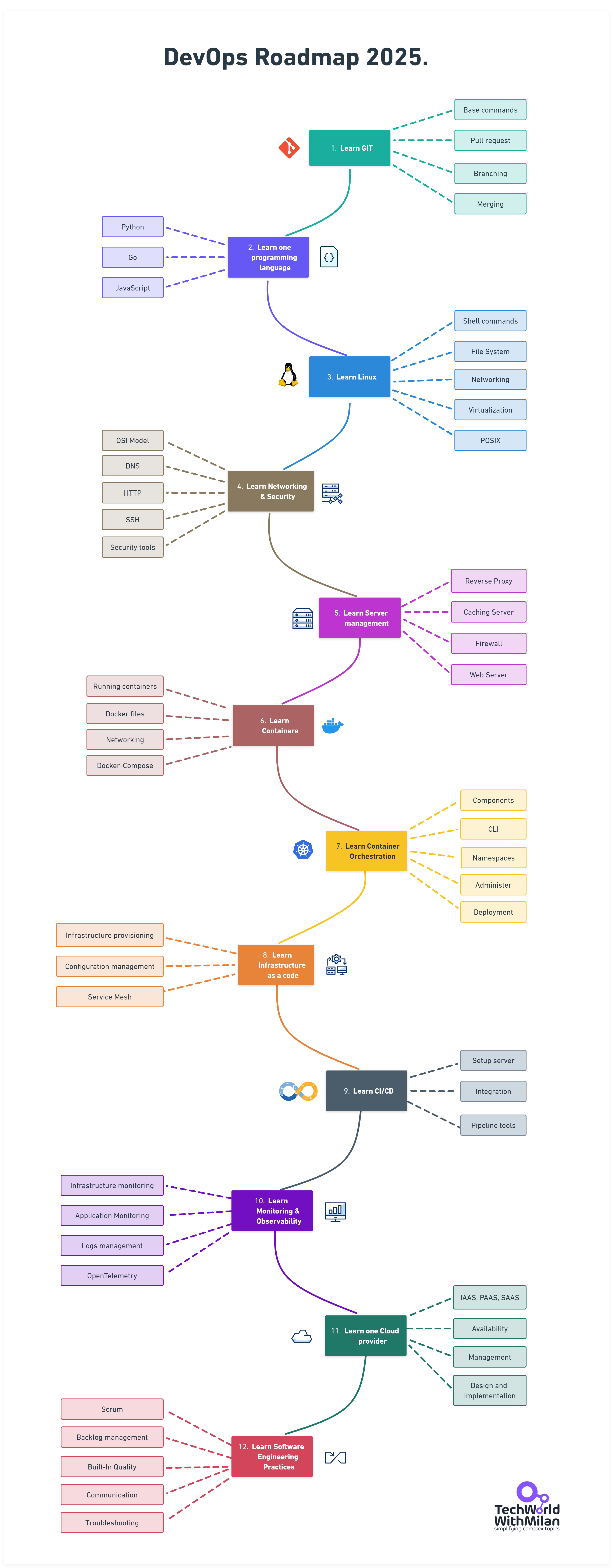
What does everyone think of this recommended path I shared below?
https://raw.githubusercontent.com/milanm/DevOps-Roadmap/master/DevOps%20Roadmap.png
I found this roadmap today and wanted to hear some opinions about it. I have some fair knowledge about Git, JS development, Linux, and networking.
If I can dedicate at least 2 hours a day for this journey if not more, how long should I take on average to learn more about each topic? Of course there won't be an accurate figure. But from everyone's experience, on average, how long does it usually take? And how many projects should I involve myself with?
https://redd.it/1d2k6az
@r_devops
https://raw.githubusercontent.com/milanm/DevOps-Roadmap/master/DevOps%20Roadmap.png
I found this roadmap today and wanted to hear some opinions about it. I have some fair knowledge about Git, JS development, Linux, and networking.
If I can dedicate at least 2 hours a day for this journey if not more, how long should I take on average to learn more about each topic? Of course there won't be an accurate figure. But from everyone's experience, on average, how long does it usually take? And how many projects should I involve myself with?
https://redd.it/1d2k6az
@r_devops
Landed first pure DevOps Engineer job
Just got the offer after 2 interview round. Super happy, can’t wait to start, been browsing this sub for a while, and now I can finally say
oneofyouoneofyouoneofyou
https://redd.it/1d2lvmh
@r_devops
Just got the offer after 2 interview round. Super happy, can’t wait to start, been browsing this sub for a while, and now I can finally say
oneofyouoneofyouoneofyou
https://redd.it/1d2lvmh
@r_devops
Reddit
From the devops community on Reddit
Explore this post and more from the devops community
Installing sentry on kubernetes
Hello, I have been struggling with installing Sentry on Kubernetes.
I am using ArgoCD, so basically, I want to pass it a helm chart.
The challenge is I have not found any good helm chart. These ones I found do not appear to install sentry, and I am not clear as to the purpose of the charts.
https://github.com/sentry-kubernetes/charts/tree/develop/sentry
https://github.com/sentry-kubernetes/charts/tree/develop/sentry-kubernetes
Can someone please help point in the right direction?
https://redd.it/1d2n471
@r_devops
Hello, I have been struggling with installing Sentry on Kubernetes.
I am using ArgoCD, so basically, I want to pass it a helm chart.
The challenge is I have not found any good helm chart. These ones I found do not appear to install sentry, and I am not clear as to the purpose of the charts.
https://github.com/sentry-kubernetes/charts/tree/develop/sentry
https://github.com/sentry-kubernetes/charts/tree/develop/sentry-kubernetes
Can someone please help point in the right direction?
https://redd.it/1d2n471
@r_devops
Managing Ephemeral Storage in EKS with Bottlerocket Nodes
Hi everyone,
I have a question about ephemeral storage in EKS. I'm using version 1.29 and Bottlerocket images for the nodes. I deployed the cluster with Terraform. I noticed that the nodes have two volumes: a 2GB volume for the OS and a 20GB volume for data, which is the ephemeral volume.
Sometimes I encounter disk pressure issues, causing pods to be evicted. Before increasing the 20GB volume, which I understand is the default value, I want to understand how EKS manages this volume. Specifically, does EKS always maintain the volume at 80% usage? It seems to consistently hover around that capacity, leaving little room to handle these disk pressure incidents. I want to ensure that if I increase the volume to 40GB, it won't always remain at 80% usage.
Can anyone provide insights or share their experiences with managing ephemeral storage in EKS?Thanks!
https://redd.it/1d2oa31
@r_devops
Hi everyone,
I have a question about ephemeral storage in EKS. I'm using version 1.29 and Bottlerocket images for the nodes. I deployed the cluster with Terraform. I noticed that the nodes have two volumes: a 2GB volume for the OS and a 20GB volume for data, which is the ephemeral volume.
Sometimes I encounter disk pressure issues, causing pods to be evicted. Before increasing the 20GB volume, which I understand is the default value, I want to understand how EKS manages this volume. Specifically, does EKS always maintain the volume at 80% usage? It seems to consistently hover around that capacity, leaving little room to handle these disk pressure incidents. I want to ensure that if I increase the volume to 40GB, it won't always remain at 80% usage.
Can anyone provide insights or share their experiences with managing ephemeral storage in EKS?Thanks!
https://redd.it/1d2oa31
@r_devops
Reddit
From the devops community on Reddit
Explore this post and more from the devops community
Anyone has already read SonarQube code smell report to generate dashboard in Grafana OSS
I'd like to show the applications that had more issues in SonarQube. Is there a plugin for it? Or maybe a service for be used with Infinity Plugin on Grafana?
https://redd.it/1d2q1hf
@r_devops
I'd like to show the applications that had more issues in SonarQube. Is there a plugin for it? Or maybe a service for be used with Infinity Plugin on Grafana?
https://redd.it/1d2q1hf
@r_devops
Reddit
From the devops community on Reddit
Explore this post and more from the devops community
Peer Code Review Tool
Hi,
We’re currently using GitLab with Atlassian Crucible for our peer code reviewing. GitLab doesn’t look like they’ll ever support a single code review for multiple projects.
Crucible is now in ‘basic maintenance’ mode therefore we’d ideally want to move to an alternative tool which is actively maintained.
Is there anything out there that does this as a standalone product or is the solution to find a tool like BitBucket which handles the repositories and the code reviewing?
Thanks
https://redd.it/1d2qqz7
@r_devops
Hi,
We’re currently using GitLab with Atlassian Crucible for our peer code reviewing. GitLab doesn’t look like they’ll ever support a single code review for multiple projects.
Crucible is now in ‘basic maintenance’ mode therefore we’d ideally want to move to an alternative tool which is actively maintained.
Is there anything out there that does this as a standalone product or is the solution to find a tool like BitBucket which handles the repositories and the code reviewing?
Thanks
https://redd.it/1d2qqz7
@r_devops
Reddit
From the devops community on Reddit
Explore this post and more from the devops community
What do you use at your org? Azure DevOps or GitHub Team?
I am working with a team of devs and we have been using GitHub teams for some time. In the beginning it was pretty good. But now it is not enough anymore.
The team is not happy with the project management tools provided by GitHub.
Resources for GitHub actions are not enough, we are exclusively using self-hosted runners.
We are worried about GitHub packages and the storage limit set for it.
Basically we are paying 4 USD per user just for version controlling.
To all the devs working in organizations, what has your experience been like? Would you prefer working with Azure DevOps instead?
Oh and if it helps, we use Azure for all our resource requirements.
Thanks for your time!
https://redd.it/1d2s336
@r_devops
I am working with a team of devs and we have been using GitHub teams for some time. In the beginning it was pretty good. But now it is not enough anymore.
The team is not happy with the project management tools provided by GitHub.
Resources for GitHub actions are not enough, we are exclusively using self-hosted runners.
We are worried about GitHub packages and the storage limit set for it.
Basically we are paying 4 USD per user just for version controlling.
To all the devs working in organizations, what has your experience been like? Would you prefer working with Azure DevOps instead?
Oh and if it helps, we use Azure for all our resource requirements.
Thanks for your time!
https://redd.it/1d2s336
@r_devops
Reddit
From the devops community on Reddit
Explore this post and more from the devops community
Platform as a Product 101
So, we wrote up an intro/overview of what the platform as a product strategy looks like in practice since that concept has taken off in the past few months. But is anyone on here actually utilizing PaaP in their own organization that's not one of the big tech companies? Any examples you can share of how you're utilizing it in your own org?
Or is it all cap/irrelevant? Would love thoughts from both individual devs and those who maybe are in charge of leading full dev teams. :)
Check it out, thanks!
https://thenewstack.io/platform-as-a-product-101/
https://redd.it/1d2pr82
@r_devops
So, we wrote up an intro/overview of what the platform as a product strategy looks like in practice since that concept has taken off in the past few months. But is anyone on here actually utilizing PaaP in their own organization that's not one of the big tech companies? Any examples you can share of how you're utilizing it in your own org?
Or is it all cap/irrelevant? Would love thoughts from both individual devs and those who maybe are in charge of leading full dev teams. :)
Check it out, thanks!
https://thenewstack.io/platform-as-a-product-101/
https://redd.it/1d2pr82
@r_devops
The New Stack
Platform as a Product 101
By providing a foundation for collaboration, platforms can create network effects, where the value of the platform increases as more participants join.
Elastic search question
Hi 👋 I am not a developer (or anything technical). I am a bootstrap founder looking for solutions for e-commerce and retail in my vertical using tech.
I discovered Elastic today. I uploaded a csv of products (skus) to test and can query the index with their example console to search for, as an example, a product with “cane sugar” in the ingredients. I’d like to know:
1) what code do I put in the php console to ask the index to show products that “do not contain cane sugar” for example (sort of an “if then” query)
2) how do I make a query that reads the ingredients or attributes in a product and then spits out (matches it to) their description (stored in the csv)? As in if a customer wanted to scan a product to read the ingredients attributes?
3) (I’m a total rookie I know) but how do I “export” what I’ve built and make it look pretty on the front end for customers to use on our website (integrate it) or app?
I know I’m totally out of my league here and feel quite dumb but this has been bothering me and I know there’s a simple solution, I just don’t have the skill yet would like to try. Also, if you don’t ask you’ll never know.
https://redd.it/1d2vhip
@r_devops
Hi 👋 I am not a developer (or anything technical). I am a bootstrap founder looking for solutions for e-commerce and retail in my vertical using tech.
I discovered Elastic today. I uploaded a csv of products (skus) to test and can query the index with their example console to search for, as an example, a product with “cane sugar” in the ingredients. I’d like to know:
1) what code do I put in the php console to ask the index to show products that “do not contain cane sugar” for example (sort of an “if then” query)
2) how do I make a query that reads the ingredients or attributes in a product and then spits out (matches it to) their description (stored in the csv)? As in if a customer wanted to scan a product to read the ingredients attributes?
3) (I’m a total rookie I know) but how do I “export” what I’ve built and make it look pretty on the front end for customers to use on our website (integrate it) or app?
I know I’m totally out of my league here and feel quite dumb but this has been bothering me and I know there’s a simple solution, I just don’t have the skill yet would like to try. Also, if you don’t ask you’ll never know.
https://redd.it/1d2vhip
@r_devops
Reddit
From the devops community on Reddit
Explore this post and more from the devops community
Terraform does not respect `depends_on`?
Hey Terraform gurus.
It seems that `depends_on` does not affect order in which Terraform creates resources. A minimal example:
resource "null_resource" "foo" {
provisioner "local-exec" {
command = "./foo"
}
}
resource "null_resource" "bar" {
depends_on = [null_resource.foo]
provisioner "local-exec" {
command = "./bar"
}
}
Output of `terraform plan`:
Terraform used the selected providers to generate the following execution plan. Resource actions are indicated with the following symbols:
+ create
Terraform will perform the following actions:
# null_resource.bar will be created
+ resource "null_resource" "bar" {
+ id = (known after apply)
}
# null_resource.foo will be created
+ resource "null_resource" "foo" {
+ id = (known after apply)
}
Plan: 2 to add, 0 to change, 0 to destroy.
Why is `bar` goes before `foo`? Am I missing something?
Update: when I do `apply`, order is correct. So, I can't trust `plan`?
My version:
Terraform v1.8.3
on linux_386
+ provider registry.terraform.io/hashicorp/null v3.2.2
https://redd.it/1d2wknx
@r_devops
Hey Terraform gurus.
It seems that `depends_on` does not affect order in which Terraform creates resources. A minimal example:
resource "null_resource" "foo" {
provisioner "local-exec" {
command = "./foo"
}
}
resource "null_resource" "bar" {
depends_on = [null_resource.foo]
provisioner "local-exec" {
command = "./bar"
}
}
Output of `terraform plan`:
Terraform used the selected providers to generate the following execution plan. Resource actions are indicated with the following symbols:
+ create
Terraform will perform the following actions:
# null_resource.bar will be created
+ resource "null_resource" "bar" {
+ id = (known after apply)
}
# null_resource.foo will be created
+ resource "null_resource" "foo" {
+ id = (known after apply)
}
Plan: 2 to add, 0 to change, 0 to destroy.
Why is `bar` goes before `foo`? Am I missing something?
Update: when I do `apply`, order is correct. So, I can't trust `plan`?
My version:
Terraform v1.8.3
on linux_386
+ provider registry.terraform.io/hashicorp/null v3.2.2
https://redd.it/1d2wknx
@r_devops
Reddit
From the devops community on Reddit
Explore this post and more from the devops community
How are elevateduser and elevatedpassword used in a Packer template?
I had assumed that the user defined in the Packer `winrm_username` setting was logging in as an admin and could perform tasks as such. It seems there is some nuance to that. One of the things that it fails to do is run `Enable-WindowsOptionalFeature` in a Powershell provisioner with "Access is denied".
I'm concluding that the error is because the user isn't actually logged in as an admin and therefore must invoke a new Powershell environment with elevated privileges. This means using the `elevated_username` and `elevated_password` settings.
The Packer documentation doesn't often make it clear how to use a setting. For the `elevated_` settings, my guess is that I can use the automatically generated password used by the `winrm_username` user. I'm using HCL2 so this is `${build.Password}`. Does this mean `elevated_username` would be the same as `winrm_username` or would I use Administrator with it having the same password?
Do I need to do anything to inform Packer that a command should be executed in an elevated environment or does it automatically do that when it sees that the `elevated_` settings are configured?
https://redd.it/1d2mjeu
@r_devops
I had assumed that the user defined in the Packer `winrm_username` setting was logging in as an admin and could perform tasks as such. It seems there is some nuance to that. One of the things that it fails to do is run `Enable-WindowsOptionalFeature` in a Powershell provisioner with "Access is denied".
I'm concluding that the error is because the user isn't actually logged in as an admin and therefore must invoke a new Powershell environment with elevated privileges. This means using the `elevated_username` and `elevated_password` settings.
The Packer documentation doesn't often make it clear how to use a setting. For the `elevated_` settings, my guess is that I can use the automatically generated password used by the `winrm_username` user. I'm using HCL2 so this is `${build.Password}`. Does this mean `elevated_username` would be the same as `winrm_username` or would I use Administrator with it having the same password?
Do I need to do anything to inform Packer that a command should be executed in an elevated environment or does it automatically do that when it sees that the `elevated_` settings are configured?
https://redd.it/1d2mjeu
@r_devops
Reddit
From the devops community on Reddit
Explore this post and more from the devops community
Article: Stop running your tests with you CI/CD tool
Would love to hear peoples thoughts on this - agree? disagree? how are you solving test execution in a complex CI/CD environment? what problems are you facing in this context? how have you solved them?
https://thenewstack.io/stop-running-tests-with-your-ci-cd-tool/
thanks in advance!
/Ole
https://redd.it/1d37wdk
@r_devops
Would love to hear peoples thoughts on this - agree? disagree? how are you solving test execution in a complex CI/CD environment? what problems are you facing in this context? how have you solved them?
https://thenewstack.io/stop-running-tests-with-your-ci-cd-tool/
thanks in advance!
/Ole
https://redd.it/1d37wdk
@r_devops
The New Stack
Stop Running Tests With Your CI/CD Tool
A look at six specific needs of a successful test-automation strategy and how relying on CI/CD tools can send you into the testing swamp of no return.