fresh out of college graduate recently hired at a company. i've always used source control, CI/CD and have been interested in SCM. I'm trying to encourage my workplace to use these tools and I never thought I'd have to deal with culture change from a dev perspective.
I've recently started working as a junior developer at a company - dream job and all.
However, I've noticed that there's absolutely no structure within the dev department. Everyone codes like spaghetti - nobody follows coding conventions and everyone just pushes all their change into one branch without a code review process.
Their reasoning was that most projects, devs work alone so there's no need to implement these standards or tools. Note the emphasis on "most" and that they still do collaborative work, but it is rare and I reckon it has to do with the fact that each dev is doing their own thing.
I tried to give suggestions and because I'm a junior, my suggestions often get shut down by devs with more seniority. At the same time, I don't want to impose myself on them (hiring for devs is quite hard as it is).
It seems that the philosophy with this company's devs is that they're here to deliver products that look nice on the front end fast, but it's pretty clear that because there's no standards that it's taking more time than it should to develop because every dev ends up working solo and no one can help each other.
Has anyone had experience with culture change in dev department? Any advice to give to a junior? Could I be approaching this the wrong way and that all this push from having more standardized source control processes to even applying design patterns isn't necessary?
https://redd.it/q1nyqn
@r_devops
I've recently started working as a junior developer at a company - dream job and all.
However, I've noticed that there's absolutely no structure within the dev department. Everyone codes like spaghetti - nobody follows coding conventions and everyone just pushes all their change into one branch without a code review process.
Their reasoning was that most projects, devs work alone so there's no need to implement these standards or tools. Note the emphasis on "most" and that they still do collaborative work, but it is rare and I reckon it has to do with the fact that each dev is doing their own thing.
I tried to give suggestions and because I'm a junior, my suggestions often get shut down by devs with more seniority. At the same time, I don't want to impose myself on them (hiring for devs is quite hard as it is).
It seems that the philosophy with this company's devs is that they're here to deliver products that look nice on the front end fast, but it's pretty clear that because there's no standards that it's taking more time than it should to develop because every dev ends up working solo and no one can help each other.
Has anyone had experience with culture change in dev department? Any advice to give to a junior? Could I be approaching this the wrong way and that all this push from having more standardized source control processes to even applying design patterns isn't necessary?
https://redd.it/q1nyqn
@r_devops
reddit
fresh out of college graduate recently hired at a company. i've...
I've recently started working as a junior developer at a company - dream job and all. However, I've noticed that there's absolutely no structure...
Certified Kubernetes Application Developer (CKAD) Study Guide ebook
Developers with the ability to operate, troubleshoot, and monitor applications in Kubernetes are in high demand today. To meet this need, the Cloud Native Computing Foundation created a certification exam to establish a developer's credibility and value in the job market to work in a Kubernetes environment
The Certified Kubernetes Application Developer (CKAD) ebook is different from the typical multiple-choice format of other certifications. Instead, the CKAD is a performance-based exam that requires deep knowledge of the tasks under immense time pressure.
Certified Kubernetes Application Developer (CKAD) Study Guide ebook
https://redd.it/q1nuyd
@r_devops
Developers with the ability to operate, troubleshoot, and monitor applications in Kubernetes are in high demand today. To meet this need, the Cloud Native Computing Foundation created a certification exam to establish a developer's credibility and value in the job market to work in a Kubernetes environment
The Certified Kubernetes Application Developer (CKAD) ebook is different from the typical multiple-choice format of other certifications. Instead, the CKAD is a performance-based exam that requires deep knowledge of the tasks under immense time pressure.
Certified Kubernetes Application Developer (CKAD) Study Guide ebook
https://redd.it/q1nuyd
@r_devops
Lunaticai
Certified Kubernetes Application Developer (CKAD) Study Guide PDF Github
Certified Kubernetes Application Developer (CKAD) Study Guide PDF Download for Free. This o'reilly free pdf github is written by Benjamin Muschko.
HowTheySRE is accepting #hacktoberfest2021 contributions
https://github.com/upgundecha/howtheysre
HowTheySRE repo hosts applied SRE & DevOps practices curated from over 70 organizations and 14 amazing contributors. Help this repo grow more with your #hacktoberfest contributions and get recognition.
https://redd.it/q1ujkz
@r_devops
https://github.com/upgundecha/howtheysre
HowTheySRE repo hosts applied SRE & DevOps practices curated from over 70 organizations and 14 amazing contributors. Help this repo grow more with your #hacktoberfest contributions and get recognition.
https://redd.it/q1ujkz
@r_devops
GitHub
GitHub - upgundecha/howtheysre: A curated collection of publicly available resources on how technology and tech-savvy organizations…
A curated collection of publicly available resources on how technology and tech-savvy organizations around the world practice Site Reliability Engineering (SRE) - upgundecha/howtheysre
DevOps Master Class Part 8 - Monitoring and Feedback is up!
Final (part 8 ) lesson of the DevOps Master Class is up, Monitoring & Feedback! Been quite a journey over the past 2 months!
https://youtu.be/ypT4S17kiJw
YouTube Playlist for the whole course - https://www.youtube.com/playlist?list=PLlVtbbG169nFr8RzQ4GIxUEznpNR53ERq
GitHub Repo - https://github.com/johnthebrit/DevOpsMC
https://redd.it/q1wv2s
@r_devops
Final (part 8 ) lesson of the DevOps Master Class is up, Monitoring & Feedback! Been quite a journey over the past 2 months!
https://youtu.be/ypT4S17kiJw
YouTube Playlist for the whole course - https://www.youtube.com/playlist?list=PLlVtbbG169nFr8RzQ4GIxUEznpNR53ERq
GitHub Repo - https://github.com/johnthebrit/DevOpsMC
https://redd.it/q1wv2s
@r_devops
YouTube
DevOps Master Class - Part 8 - Monitoring & Feedback
The final part in our DevOps Master Class, monitoring and feedback.
#devops #johnsavillstechnicaltraining #onboardtoazure
▬▬▬▬▬▬ T I M E S T A M P S ⏰ ▬▬▬▬▬▬
0:00 - Intro
0:23 - Refresh of DevOps cycle
2:58 - Why we need feedback
5:45 - Potential areas…
#devops #johnsavillstechnicaltraining #onboardtoazure
▬▬▬▬▬▬ T I M E S T A M P S ⏰ ▬▬▬▬▬▬
0:00 - Intro
0:23 - Refresh of DevOps cycle
2:58 - Why we need feedback
5:45 - Potential areas…
Which tool(s) should I use to deploy containers?
Nobody in my team has any experience with Containers (Docker, Kubernetes etc.). I'm responsible for introducing them as we will like to use containers and everything that comes with it, such as Orchestration. Only Docker is set so far.
Our scenario is basically to set up multiple containers (at the moment 5 per client), which need to communicate internally as well as externally through APIs. My first POC includes Docker only, where I make use of Docker Compose. For every client I can simply run the docker-compose file and everything is set up automatically (as of now, we have a single server, that runs every container) in a few seconds.
The number of containers will grow during the next years and therefore I was questioning myself, whether we need an orchestration tool, such as k8s, or not?
Some more questions:
1. How do we monitor these containers (e.g. uptime/availability or container specific logs such as database monitoring)? Do orchestration tools provide these features or would we need external software?
2. What about fault tolerance/uptime)? Are orchestration tools better in this context (all I know is that I can advise Docker in the docker-compose file to restart a container when it isn't running)
3. As we don't need to scale (and likely won't need in the future), might an orchestration tool add to much overhead?
Are there more lightweight orchestration tools? Kubernetes seems to add to much overhead and complexity. We don't have large clusters running and we don't need to scale. Can you recommend Docker Swarm? Alternatives? Would a combination of Docker Compose and Portainer be sufficient?
As I'm fairly new to this as well, feel free to point out what I will probably need from an orchestration tool, but I didn't mention above.
https://redd.it/q1uxjf
@r_devops
Nobody in my team has any experience with Containers (Docker, Kubernetes etc.). I'm responsible for introducing them as we will like to use containers and everything that comes with it, such as Orchestration. Only Docker is set so far.
Our scenario is basically to set up multiple containers (at the moment 5 per client), which need to communicate internally as well as externally through APIs. My first POC includes Docker only, where I make use of Docker Compose. For every client I can simply run the docker-compose file and everything is set up automatically (as of now, we have a single server, that runs every container) in a few seconds.
The number of containers will grow during the next years and therefore I was questioning myself, whether we need an orchestration tool, such as k8s, or not?
Some more questions:
1. How do we monitor these containers (e.g. uptime/availability or container specific logs such as database monitoring)? Do orchestration tools provide these features or would we need external software?
2. What about fault tolerance/uptime)? Are orchestration tools better in this context (all I know is that I can advise Docker in the docker-compose file to restart a container when it isn't running)
3. As we don't need to scale (and likely won't need in the future), might an orchestration tool add to much overhead?
Are there more lightweight orchestration tools? Kubernetes seems to add to much overhead and complexity. We don't have large clusters running and we don't need to scale. Can you recommend Docker Swarm? Alternatives? Would a combination of Docker Compose and Portainer be sufficient?
As I'm fairly new to this as well, feel free to point out what I will probably need from an orchestration tool, but I didn't mention above.
https://redd.it/q1uxjf
@r_devops
reddit
Which tool(s) should I use to deploy containers?
Nobody in my team has any experience with Containers (Docker, Kubernetes etc.). I'm responsible for introducing them as we will like to use...
AWS Cost Optimization by sharing resources: Is this relevant to you, and for which use cases?
We're currently exploring ways in which we could lower our cost on AWS per application environment.
We run a relatively high number of apps in a 3-tier ALB-ECS-RDS architecture. When it comes to staging environments & PR preview deployments, we must ensure these are deployed in a way that doesn't burn 50$ per environment a month.
The most well-known cost saving advice is reserving capacity on AWS (i.e. Reserved Instances). I've written a post about another method we're implementing, which is making sure we use every bit of the resources we provision on AWS. We have done similar things for RDS databases (where low workload deployments share an instance) and for NAT instances (which you need to make reliable yourself, but then they're way more cost-efficient than a NAT gateway).
I'm interested if this is something that can be considered standard/good practice, and if you have other use cases for sharing in mind.
https://redd.it/q1uqv7
@r_devops
We're currently exploring ways in which we could lower our cost on AWS per application environment.
We run a relatively high number of apps in a 3-tier ALB-ECS-RDS architecture. When it comes to staging environments & PR preview deployments, we must ensure these are deployed in a way that doesn't burn 50$ per environment a month.
The most well-known cost saving advice is reserving capacity on AWS (i.e. Reserved Instances). I've written a post about another method we're implementing, which is making sure we use every bit of the resources we provision on AWS. We have done similar things for RDS databases (where low workload deployments share an instance) and for NAT instances (which you need to make reliable yourself, but then they're way more cost-efficient than a NAT gateway).
I'm interested if this is something that can be considered standard/good practice, and if you have other use cases for sharing in mind.
https://redd.it/q1uqv7
@r_devops
www.setops.co
AWS Communism – Part 1: How we cut our Load Balancing cost by more than 96% | SetOps
In this series of posts, we provide you with fresh ideas on better utilizing your AWS resources and saving money. Much effort went into finding a cloud-native architecture, and we want to share our insights with you.
What used to seem difficult and is now trivial
Hello,
More of a just an informal survey, but what was something that seemed daunting when you first started working DevOps and now seems trivial?
https://redd.it/q1vl6h
@r_devops
Hello,
More of a just an informal survey, but what was something that seemed daunting when you first started working DevOps and now seems trivial?
https://redd.it/q1vl6h
@r_devops
reddit
What used to seem difficult and is now trivial
Hello, More of a just an informal survey, but what was something that seemed daunting when you first started working DevOps and now seems trivial?
Hiring: Are we doing it wrong?
So our micro organization (\~20 employees total, tech team of 4) is looking to hire our first DevOps role. Up until now we've had a programmer (me) filling the space but you can imagine slogging through it is taking away valuable programming time. Not to mention not having the experience to get it right as quickly.
Anyhow we're finding it really difficult to bring folks on. I understand it's a very hot market and I think many of our candidates are simply getting snatched up by larger organizations. We can only control so much and I want to make sure I'm doing everything I can to make the process fair, useful, and ultimately find a good fit for both parties.
Our product manager is starting with a quick phone call to make sure they're understanding the general role, a bit about us, and feel out if they're a good personality match. Then we move on to a technical interview in which my canned request is:
>Hey there $FirstName we would like to schedule a technical interview this week. We will chat about your background, DevOps in general, and I can tell you the technical details of our setup. We will end with me answering any questions you might have. A small technical competence project will follow our discussion that you are free to do at your leisure. I wouldn’t ask you to spend any more than an hour on that portion.
>
>How does $DateTime work for you? Happy to reschedule off hours or on the weekend if you’ve got things going on during the day.
Our 1h call is a fairly surface discussion about their experience, what we're dealing with here at a technical level (showing our TeamCity, Octopus Deploy, and CDK steps), and just talking shop. I am showing our architecture* diagram and mentioning I'd like them to implement it and I'll send details after the call.
My email after the call is this, with the diagram included*:
>Hey there $FirstName thanks for joining the call. As discussed there’s a short exercise we’d like you to complete. This is a real problem we have and would like to evaluate your approach on it. To be clear we have already solved this – we are not looking to benefit from your work. Also we are not asking you to spend a whole lot of time on it – maybe just see what can be done within an hour. If your solution is a working one that is a bonus, but having it in a runnable state is not a requirement.
>
>Given this diagram below, in a platform of your choosing (TerraForm, CDK, CloudFormation, bash scripts, etc), we need to stand up and tear down these components within AWS in a repeatable way. Obviously you haven’t got access to the application files or any domain knowledge so we are only looking for the very basics of these components (a CloudFormation construct, a database, EC2 instances, etc). If it helps to pick a subset of the diagram then do that.
>
>You can simply respond to this mail with your solution, and feel free to ask for any clarification. There is no time limit – feel free to do it at your leisure.
Out of seven candidates that have reached this stage only one has responded. They withdrew their candidacy the next day. Are we the problem? Would love to hear your honest feedback.
Thanks!
* - unfortunately I can't share the architecture diagram but it consists of CloudFront, ALB, AutoScaling, ElasticSearch, and RDS.
https://redd.it/q22mgl
@r_devops
So our micro organization (\~20 employees total, tech team of 4) is looking to hire our first DevOps role. Up until now we've had a programmer (me) filling the space but you can imagine slogging through it is taking away valuable programming time. Not to mention not having the experience to get it right as quickly.
Anyhow we're finding it really difficult to bring folks on. I understand it's a very hot market and I think many of our candidates are simply getting snatched up by larger organizations. We can only control so much and I want to make sure I'm doing everything I can to make the process fair, useful, and ultimately find a good fit for both parties.
Our product manager is starting with a quick phone call to make sure they're understanding the general role, a bit about us, and feel out if they're a good personality match. Then we move on to a technical interview in which my canned request is:
>Hey there $FirstName we would like to schedule a technical interview this week. We will chat about your background, DevOps in general, and I can tell you the technical details of our setup. We will end with me answering any questions you might have. A small technical competence project will follow our discussion that you are free to do at your leisure. I wouldn’t ask you to spend any more than an hour on that portion.
>
>How does $DateTime work for you? Happy to reschedule off hours or on the weekend if you’ve got things going on during the day.
Our 1h call is a fairly surface discussion about their experience, what we're dealing with here at a technical level (showing our TeamCity, Octopus Deploy, and CDK steps), and just talking shop. I am showing our architecture* diagram and mentioning I'd like them to implement it and I'll send details after the call.
My email after the call is this, with the diagram included*:
>Hey there $FirstName thanks for joining the call. As discussed there’s a short exercise we’d like you to complete. This is a real problem we have and would like to evaluate your approach on it. To be clear we have already solved this – we are not looking to benefit from your work. Also we are not asking you to spend a whole lot of time on it – maybe just see what can be done within an hour. If your solution is a working one that is a bonus, but having it in a runnable state is not a requirement.
>
>Given this diagram below, in a platform of your choosing (TerraForm, CDK, CloudFormation, bash scripts, etc), we need to stand up and tear down these components within AWS in a repeatable way. Obviously you haven’t got access to the application files or any domain knowledge so we are only looking for the very basics of these components (a CloudFormation construct, a database, EC2 instances, etc). If it helps to pick a subset of the diagram then do that.
>
>You can simply respond to this mail with your solution, and feel free to ask for any clarification. There is no time limit – feel free to do it at your leisure.
Out of seven candidates that have reached this stage only one has responded. They withdrew their candidacy the next day. Are we the problem? Would love to hear your honest feedback.
Thanks!
* - unfortunately I can't share the architecture diagram but it consists of CloudFront, ALB, AutoScaling, ElasticSearch, and RDS.
https://redd.it/q22mgl
@r_devops
reddit
Hiring: Are we doing it wrong?
So our micro organization (\~20 employees total, tech team of 4) is looking to hire our first DevOps role. Up until now we've had a programmer...
What level of knowledge is needed in each area?
As someone with very broad interests who always worked best in a jack-of-all-trades role, DevOps is an incredibly exciting possibility to me. While I'm sure it would be great for a DevOps pro to be a networking SME and a security SME (etc etc), I also know that it's not realistic to specialize in everything. So I'm curious, what levels of learning in each respective area do DevOps professionals need at their entry, mid, and expert levels?
For example(s): Is CCNA all you need to get started? Should a Sr. level DevOps pro have CCIE level knowledge of networking, or is that overkill? Does Security+ give you what you need to manage, or would CySA+ and PenTest+ level knowledge be more appropriate? Would a Jr DevOps pro benefit from getting the CCNP or would things like Terraform, Ansible, Kubernetes be better to focus on at that point?
(I know that certs are not the end-all, be-all, but it's also an easier way to get the idea across. Please feel free to use specific topics or learning areas if you'd like)
​
EDIT: Mods, if this question is too broad, please let me know and I will happily pare it down.
https://redd.it/q241a9
@r_devops
As someone with very broad interests who always worked best in a jack-of-all-trades role, DevOps is an incredibly exciting possibility to me. While I'm sure it would be great for a DevOps pro to be a networking SME and a security SME (etc etc), I also know that it's not realistic to specialize in everything. So I'm curious, what levels of learning in each respective area do DevOps professionals need at their entry, mid, and expert levels?
For example(s): Is CCNA all you need to get started? Should a Sr. level DevOps pro have CCIE level knowledge of networking, or is that overkill? Does Security+ give you what you need to manage, or would CySA+ and PenTest+ level knowledge be more appropriate? Would a Jr DevOps pro benefit from getting the CCNP or would things like Terraform, Ansible, Kubernetes be better to focus on at that point?
(I know that certs are not the end-all, be-all, but it's also an easier way to get the idea across. Please feel free to use specific topics or learning areas if you'd like)
​
EDIT: Mods, if this question is too broad, please let me know and I will happily pare it down.
https://redd.it/q241a9
@r_devops
reddit
What level of knowledge is needed in each area?
As someone with very broad interests who always worked best in a jack-of-all-trades role, DevOps is an incredibly exciting possibility to me....
Ansible CrowdStrike only run as Playbook but need role
I'm struggling and would be super appreciative for any advice. I installed CrowdStrikes Falcon sensor using a playbook and it works great.
I'm supposed to make a playbook that prompts users for entry. Their input chooses which role gets started.
I've got roles that run patches, place files, ETC.
This Falcon sensor install can't be run as a role. I googled, "make one playbook start another." This isn't advisable I understand.
Is there a somewhat respectable workaround to what I'm looking to do?
Things I've looked into:
Trying to run script quietly that starts another playbook. - The shell doesn't allow nohup & tricks.
Adding a cron job that runs a script to start a playbook. - I need the playbook to run 5 seconds from now/after the current playbook ends.
https://redd.it/q24lol
@r_devops
I'm struggling and would be super appreciative for any advice. I installed CrowdStrikes Falcon sensor using a playbook and it works great.
I'm supposed to make a playbook that prompts users for entry. Their input chooses which role gets started.
I've got roles that run patches, place files, ETC.
This Falcon sensor install can't be run as a role. I googled, "make one playbook start another." This isn't advisable I understand.
Is there a somewhat respectable workaround to what I'm looking to do?
Things I've looked into:
Trying to run script quietly that starts another playbook. - The shell doesn't allow nohup & tricks.
Adding a cron job that runs a script to start a playbook. - I need the playbook to run 5 seconds from now/after the current playbook ends.
https://redd.it/q24lol
@r_devops
reddit
Ansible CrowdStrike only run as Playbook but need role
I'm struggling and would be super appreciative for any advice. I installed CrowdStrikes Falcon sensor using a playbook and it works great. I'm...
Zero downtime deployments with Auto Swap and Deployment Slots Azure
https://youtu.be/RvK-VfzdzPE
https://redd.it/q2b5cc
@r_devops
https://youtu.be/RvK-VfzdzPE
https://redd.it/q2b5cc
@r_devops
YouTube
Azure Deployment Slots Auto Swap | Zero Cold Starts and Zero Downtime
Auto swap streamlines Azure DevOps scenarios where you want to deploy your app continuously with zero cold starts and zero downtime for customers of the app. When auto swap is enabled from a slot into production, every time you push your code changes to that…
Please help me understand
So, I've wanted to switch my career from full stack development to devOps. I started doing a bit of research on devOps and it is very overwhelming. It's like things are all over the place. I need proper clarifications on few things.
How are these titles different?
\-DevOps Engineer
\-DevSecOps
\-SRE
\-Cloud Engineer
\-Infra as code
\-Infra Ops
\-Sys Admin
\-..... (I would like to know more titles)
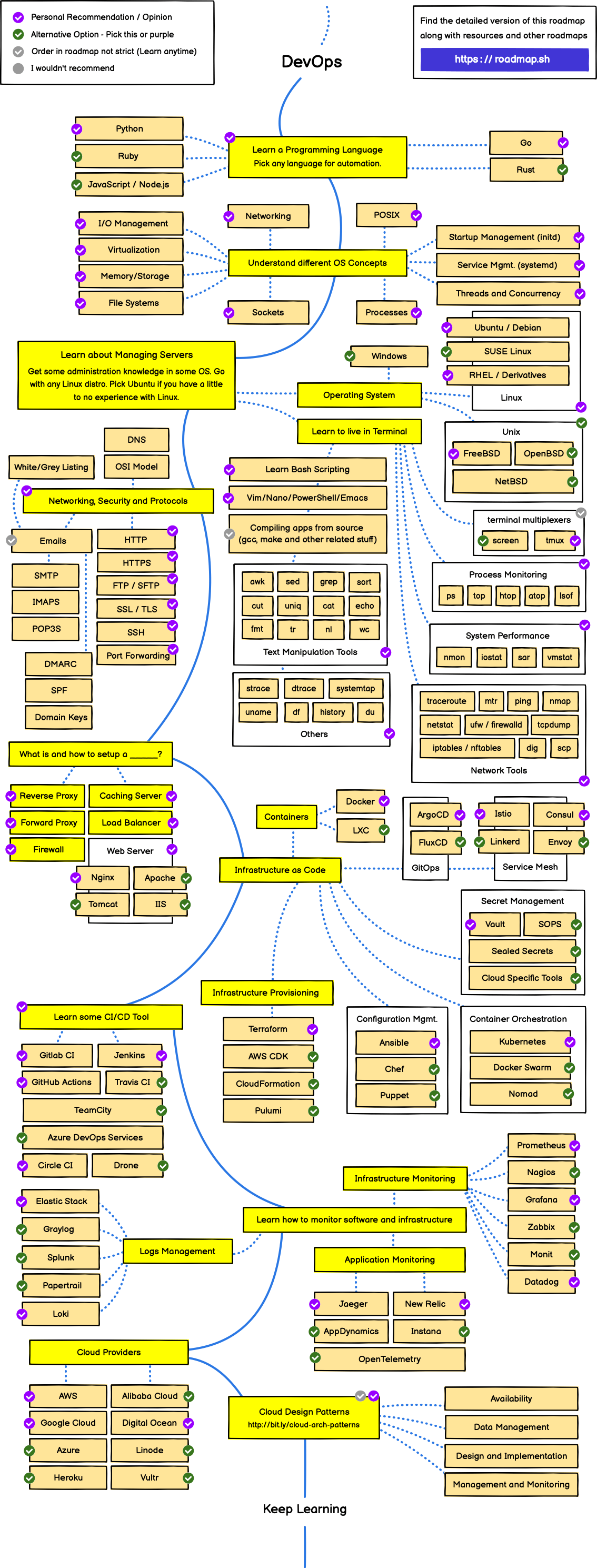
After researching I came across a roadmap. Now I want your help knowing what careers can I pursue from this roadmap (Based on the titles mentioned above).
I would also like to know of any websites where I can get started with it directly (preferably video lectures).
And as for any career, I would love some insights on landing jobs as well (Role, salary and all that stuff).
Please bear with me and thanks for your patience and the help.
Adding the roadmap here (once again):
Roadmap
https://redd.it/q1yzi0
@r_devops
So, I've wanted to switch my career from full stack development to devOps. I started doing a bit of research on devOps and it is very overwhelming. It's like things are all over the place. I need proper clarifications on few things.
How are these titles different?
\-DevOps Engineer
\-DevSecOps
\-SRE
\-Cloud Engineer
\-Infra as code
\-Infra Ops
\-Sys Admin
\-..... (I would like to know more titles)
After researching I came across a roadmap. Now I want your help knowing what careers can I pursue from this roadmap (Based on the titles mentioned above).
I would also like to know of any websites where I can get started with it directly (preferably video lectures).
And as for any career, I would love some insights on landing jobs as well (Role, salary and all that stuff).
Please bear with me and thanks for your patience and the help.
Adding the roadmap here (once again):
Roadmap
https://redd.it/q1yzi0
@r_devops
Help Improve security
Hello guys, the current infrastructure I got doesn't seems to be secure so I decided to secure it step by step.
As I am still learning I would like to know, what could I implement to improve the security ? Where should I start ?
I searched a bit and discovered some ways (correct me if I am wrong) :
a VPN can help me secure access to my servers
an IDS can tell me what is happening to know where to enforce security
a log parser can help me find anomalies backdoors
a firewall can detect malwares and intrusions, filter and reroute trafic protecting and helping the server who doesn't need to do all the authentications by itself
I really summarized what these can do.
​
I am open to any suggestion.
https://redd.it/q1zacu
@r_devops
Hello guys, the current infrastructure I got doesn't seems to be secure so I decided to secure it step by step.
As I am still learning I would like to know, what could I implement to improve the security ? Where should I start ?
I searched a bit and discovered some ways (correct me if I am wrong) :
a VPN can help me secure access to my servers
an IDS can tell me what is happening to know where to enforce security
a log parser can help me find anomalies backdoors
a firewall can detect malwares and intrusions, filter and reroute trafic protecting and helping the server who doesn't need to do all the authentications by itself
I really summarized what these can do.
​
I am open to any suggestion.
https://redd.it/q1zacu
@r_devops
reddit
[Help] Improve security
Hello guys, the current infrastructure I got doesn't seems to be secure so I decided to secure it step by step. As I am still learning I would...
Automation QA to Devops
I’m currently a Junior QA Engineer and I would like to shift to Devops (Preferably land an internship). I have learned everything required for my job as a QA by doing internships and self learning and I do not have a degree in CS or anything related. I would be extremely grateful if anyone could give me tips on how I can make the switch and land a Devops internship and also, is QA experience valuable for becoming a Devops? Thank you very much.
https://redd.it/q1tejf
@r_devops
I’m currently a Junior QA Engineer and I would like to shift to Devops (Preferably land an internship). I have learned everything required for my job as a QA by doing internships and self learning and I do not have a degree in CS or anything related. I would be extremely grateful if anyone could give me tips on how I can make the switch and land a Devops internship and also, is QA experience valuable for becoming a Devops? Thank you very much.
https://redd.it/q1tejf
@r_devops
reddit
Automation QA to Devops
I’m currently a Junior QA Engineer and I would like to shift to Devops (Preferably land an internship). I have learned everything required for my...
Would you consider low-code for devops?
https://www.youtube.com/watch?v=jcMnQ7EVmYo
https://redd.it/q2fvwq
@r_devops
https://www.youtube.com/watch?v=jcMnQ7EVmYo
https://redd.it/q2fvwq
@r_devops
YouTube
Dzone Low Code Show. Using Low code for Devops.
Dawie Botes, Customer Success Head at Linx, talks low code with the team at Dzone. Dawie provides an insight into how we use low-code in our DevOps processes, including the building and maintenance of several tasks - from the creation of cloud servers…
What is behind FB outage? DNS?
What is behind FB outage? DNS?
System is too fragile, even "best" engineers had hard time to mitigate an issue timely.
https://redd.it/q1pby7
@r_devops
What is behind FB outage? DNS?
System is too fragile, even "best" engineers had hard time to mitigate an issue timely.
https://redd.it/q1pby7
@r_devops
reddit
What is behind FB outage? DNS?
What is behind FB outage? DNS? System is too fragile, even "best" engineers had hard time to mitigate an issue timely.
Is a CNAME visible for web server?
I am bit too lazy to test that out
If I set a CNAME foo.baz.com for aux.baz.com will the webserver see the referer / source as foo.baz.com, or it will always be a aux.baz.com?
Specifically in nginx there is a `server_name` config parameter and I am not sure if I should handle it as both foo.baz.com and aux.baz.com, or aux.baz.com is enough
https://redd.it/q2i3bg
@r_devops
I am bit too lazy to test that out
If I set a CNAME foo.baz.com for aux.baz.com will the webserver see the referer / source as foo.baz.com, or it will always be a aux.baz.com?
Specifically in nginx there is a `server_name` config parameter and I am not sure if I should handle it as both foo.baz.com and aux.baz.com, or aux.baz.com is enough
https://redd.it/q2i3bg
@r_devops
I built an API management tool that would log every request, automatically generate documentation, provide API health analytics and test your API in real-time.
Hey community!
For the past 10 years i have been running a development and design company. We’ve completed 100+ projects and most of them involved developing a mobile app or website with an API in the background. While developing APIs we noticed that a lot of time is “wasted” on non development related tasks like: writing and maintaining documentation, providing support to other developers, debugging user reports, trying to recreate user steps and similar. We also noticed that our clients never fully understood what APIs were, how they work, how they are being used and what data is being sent back and forth. When we would give our API to a third-party for integration no matter how good we prepare the documentation or try to make everything bulletproof they would still have questions, we would still have to provide support, they would still be confused. Recently we saw a huge increase in webhook popularity where we simply had no way of debugging or even seeing what data we received from the webhook itself.
Because of this we started developing Treblle. To solve our own problems. We simply could not find a solution that would allow us to do what we wanted and needed(please correct me if i’m wrong). There were a plethora of tools that log code based errors or tools that do automated periodical monitoring but nothing that would log every request, generate documentation, provide analytics and insights and similar.
I would really appreciate your feedback on our tool. If anyone is interested in giving it a go please let me know i can hook you up with the biggest package.
https://redd.it/q2j0bg
@r_devops
Hey community!
For the past 10 years i have been running a development and design company. We’ve completed 100+ projects and most of them involved developing a mobile app or website with an API in the background. While developing APIs we noticed that a lot of time is “wasted” on non development related tasks like: writing and maintaining documentation, providing support to other developers, debugging user reports, trying to recreate user steps and similar. We also noticed that our clients never fully understood what APIs were, how they work, how they are being used and what data is being sent back and forth. When we would give our API to a third-party for integration no matter how good we prepare the documentation or try to make everything bulletproof they would still have questions, we would still have to provide support, they would still be confused. Recently we saw a huge increase in webhook popularity where we simply had no way of debugging or even seeing what data we received from the webhook itself.
Because of this we started developing Treblle. To solve our own problems. We simply could not find a solution that would allow us to do what we wanted and needed(please correct me if i’m wrong). There were a plethora of tools that log code based errors or tools that do automated periodical monitoring but nothing that would log every request, generate documentation, provide analytics and insights and similar.
I would really appreciate your feedback on our tool. If anyone is interested in giving it a go please let me know i can hook you up with the biggest package.
https://redd.it/q2j0bg
@r_devops
Treblle
API Intelligence Platform - Treblle - Treblle
Treblle helps engineering and product teams build, ship, and understand their REST APIs with ease. Achieve full observability and elevate your API operations with powerful API intelligence in a single, intuitive platform
Started my first Devops job, but feel a bit overwhelmed 😅
Hello!
I started a few days ago as a Junior DevOps engineer.
For years and years I’ve been an application support engineer, but I dealt with AWS on a daily basis and knew programming specifically python and PHP rather well.
I do have experience with Terraform and deploying to a Ci/CD stream but it’s very limited, hence why I’m at a junior level.
My new company everyone has been super nice and helpful to me, but I’m still feeling a bit overwhelmed with everything.
Almost everyone in the company is at a senior level and there’s so much to learn!
I haven’t yet really been tasked with anything major, but I am a bit concerned I could be dropped in the deep end a bit! I’ve gone from being the most senior person technically in my last company to being the least technical here and just worried I won’t be good enough and that could even potentially lead to me losing the role.
I’ve been learning via cloud guru and various other services when I get free time to try and learn as much as I can!
Has anyone else felt like they have been in this position before and any tips or tricks to help?
https://redd.it/q2kouf
@r_devops
Hello!
I started a few days ago as a Junior DevOps engineer.
For years and years I’ve been an application support engineer, but I dealt with AWS on a daily basis and knew programming specifically python and PHP rather well.
I do have experience with Terraform and deploying to a Ci/CD stream but it’s very limited, hence why I’m at a junior level.
My new company everyone has been super nice and helpful to me, but I’m still feeling a bit overwhelmed with everything.
Almost everyone in the company is at a senior level and there’s so much to learn!
I haven’t yet really been tasked with anything major, but I am a bit concerned I could be dropped in the deep end a bit! I’ve gone from being the most senior person technically in my last company to being the least technical here and just worried I won’t be good enough and that could even potentially lead to me losing the role.
I’ve been learning via cloud guru and various other services when I get free time to try and learn as much as I can!
Has anyone else felt like they have been in this position before and any tips or tricks to help?
https://redd.it/q2kouf
@r_devops
reddit
Started my first Devops job, but feel a bit overwhelmed 😅
Hello! I started a few days ago as a Junior DevOps engineer. For years and years I’ve been an application support engineer, but I dealt with...
seeking to be developer rather than support production engineer
I'm currently working as support production engineer, my responsibility is implementing the software, and customer support for productions issues.
The technology that i use , are below : git , linux operation and have basics knowledge of database administration, also we are simply working with kubernetes and docker, one of my responsibility to prepare pipeline for the software , but its not what you think at all as we copying and pasting staffs😂.
We can say that i work as junior devops with more OPS as we don't write codes. I feel that the devops is a culture not a role
I have been graduating since one year before , and this is my first job, i feel that like dev things more than supporting, i don't want to be stacked as support , i think that the future is development, i talked to my manager that i would like to go to the dev teams but he doesn't like the idea , he said that he preferred me to stay as support engineer as it better than development.
My question, do you advise me to switch to dev, considering that I may leave the company, btw im afraid to leave because i don't have skills to be a developer ,now im learning now some staff related to dev.
Im really tired of thinking about this, and i need advises , or a roadmap developer that helps me to proceed and success 🙌.
Thanks all.
https://redd.it/q2li5p
@r_devops
I'm currently working as support production engineer, my responsibility is implementing the software, and customer support for productions issues.
The technology that i use , are below : git , linux operation and have basics knowledge of database administration, also we are simply working with kubernetes and docker, one of my responsibility to prepare pipeline for the software , but its not what you think at all as we copying and pasting staffs😂.
We can say that i work as junior devops with more OPS as we don't write codes. I feel that the devops is a culture not a role
I have been graduating since one year before , and this is my first job, i feel that like dev things more than supporting, i don't want to be stacked as support , i think that the future is development, i talked to my manager that i would like to go to the dev teams but he doesn't like the idea , he said that he preferred me to stay as support engineer as it better than development.
My question, do you advise me to switch to dev, considering that I may leave the company, btw im afraid to leave because i don't have skills to be a developer ,now im learning now some staff related to dev.
Im really tired of thinking about this, and i need advises , or a roadmap developer that helps me to proceed and success 🙌.
Thanks all.
https://redd.it/q2li5p
@r_devops
reddit
seeking to be developer rather than support production engineer
I'm currently working as support production engineer, my responsibility is implementing the software, and customer support for productions...
Help with Rails app GitHub action.
Hello everyone, I’m noobie trying to write a GitHub action for a Rails app, I’m following different internet tutorial but nothing is working for me. The idea is make a self hosted app on a Droplet using GitHub action. The app is a basic Rails project with PG as database. I’m getting many errors on the way but now I’m stuck on this “FATAL: password authentication failed for user "postgres"”. I don’t know how to set the password on the action because in my local is working fine.
My current action:
name: Deploy
on:
push:
branches: [ main ]
jobs:
test:
runs-on: ubuntu-latest
services:
postgres:
image: postgres
env:
POSTGRES_USER: postgres
POSTGRES_PASSWORD: postgres
options: >-
--health-cmd pg_isready
--health-interval 10s
--health-timeout 5s
--health-retries 5
ports:
- 5432:5432
strategy:
matrix:
ruby-version: ['2.7.2']
steps:
- uses: actions/checkout@v2
- name: Set up Ruby
uses: ruby/setup-ruby@473e4d8fe5dd94ee328fdfca9f8c9c7afc9dae5e
with:
ruby-version: ${{ matrix.ruby-version }}
bundler-cache: true # runs 'bundle install' and caches installed gems automatically
- name: Install PostgreSQL client
run: |
sudo apt-get -yqq install libpq-dev
- name: Build App
env:
PGHOST: localhost
POSTGRES_USER: postgres
POSTGRES_PASSWORD: postgres
RAILS_ENV: test
run: |
bin/rails db:setup
- name: Run tests
env:
PGHOST: localhost
PGUSER: postgres
PGPASSWORD: postgres
RAILS_ENV: test
run: bundle exec rake
I appreciate your help. Thank you.
https://redd.it/q2p2ux
@r_devops
Hello everyone, I’m noobie trying to write a GitHub action for a Rails app, I’m following different internet tutorial but nothing is working for me. The idea is make a self hosted app on a Droplet using GitHub action. The app is a basic Rails project with PG as database. I’m getting many errors on the way but now I’m stuck on this “FATAL: password authentication failed for user "postgres"”. I don’t know how to set the password on the action because in my local is working fine.
My current action:
name: Deploy
on:
push:
branches: [ main ]
jobs:
test:
runs-on: ubuntu-latest
services:
postgres:
image: postgres
env:
POSTGRES_USER: postgres
POSTGRES_PASSWORD: postgres
options: >-
--health-cmd pg_isready
--health-interval 10s
--health-timeout 5s
--health-retries 5
ports:
- 5432:5432
strategy:
matrix:
ruby-version: ['2.7.2']
steps:
- uses: actions/checkout@v2
- name: Set up Ruby
uses: ruby/setup-ruby@473e4d8fe5dd94ee328fdfca9f8c9c7afc9dae5e
with:
ruby-version: ${{ matrix.ruby-version }}
bundler-cache: true # runs 'bundle install' and caches installed gems automatically
- name: Install PostgreSQL client
run: |
sudo apt-get -yqq install libpq-dev
- name: Build App
env:
PGHOST: localhost
POSTGRES_USER: postgres
POSTGRES_PASSWORD: postgres
RAILS_ENV: test
run: |
bin/rails db:setup
- name: Run tests
env:
PGHOST: localhost
PGUSER: postgres
PGPASSWORD: postgres
RAILS_ENV: test
run: bundle exec rake
I appreciate your help. Thank you.
https://redd.it/q2p2ux
@r_devops
reddit
Help with Rails app GitHub action.
Hello everyone, I’m noobie trying to write a GitHub action for a Rails app, I’m following different internet tutorial but nothing is working for...