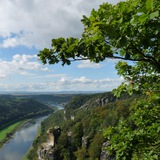
The legend of the Sibyl's Hole (Sibyllenloch)
Deep down in a cave at the foot of the Teckfelsen (Teck Rock) once lived a woman, called the Sibyl; she helped many who came to her for advice, for she knew everything and foresaw the future.
She kept many treasures of gold and precious stones hidden in her castle in the depths, but she was charitable: many a poor man in his distress did not climb the steep path to her for nothing.
But the three sons of the Sibyl were of a different kind. They built their own castles behind the Teck up the valley, one on the Rauber, the other on Diepoldsburg Castle and the third on Wielandstein. From these castles they plagued the farmers and looted the merchants; in short, as much as the good Sibyl had done good, her sons did evil.
Therefore the good mother was ashamed of her wayward sons and did not want to stay near them any longer. One evening she rode in a fiery chariot pulled by two wild cats from her cave through the air; her hair was seen flying like a flame in the evening sun.
But where she went nobody knows.
Only in the places where her chariot cut a track on the ground does the grass turn green sooner, does the grain grow more abundant and fruits are sweeter than elsewhere - the last blessing that the disappeared woman leaves to mankind.
Deep down in a cave at the foot of the Teckfelsen (Teck Rock) once lived a woman, called the Sibyl; she helped many who came to her for advice, for she knew everything and foresaw the future.
She kept many treasures of gold and precious stones hidden in her castle in the depths, but she was charitable: many a poor man in his distress did not climb the steep path to her for nothing.
But the three sons of the Sibyl were of a different kind. They built their own castles behind the Teck up the valley, one on the Rauber, the other on Diepoldsburg Castle and the third on Wielandstein. From these castles they plagued the farmers and looted the merchants; in short, as much as the good Sibyl had done good, her sons did evil.
Therefore the good mother was ashamed of her wayward sons and did not want to stay near them any longer. One evening she rode in a fiery chariot pulled by two wild cats from her cave through the air; her hair was seen flying like a flame in the evening sun.
But where she went nobody knows.
Only in the places where her chariot cut a track on the ground does the grass turn green sooner, does the grain grow more abundant and fruits are sweeter than elsewhere - the last blessing that the disappeared woman leaves to mankind.
Castle Teck with the Sibyl's Hole underneath.
Castle Teck was first mentioned in the year 1152 in a contract between Emperor Frederic Barbarossa and Duke Konrad of Zähringen, Rector of Burgundy.
The castle was destroyed in the year 1525 during the German Peasant's War
Duke Karl Alexander of Württemberg planned to rebuild the castle as a fortress, beginning 1736. But he died 1737 and his successors did not continue the effort.
In 1889 a lookout tower with an attached refuge was built on the foundations of the keep and inaugurated on 1 September 1889. In 1933 an event hall was built next to the Teckturm and named "Mörikehalle". Since June 6, 1941, the complex has been owned by the Swabian Albverein, which in 1954/1955 converted the Mörikehalle into a hiking home with a restaurant and dormitories.
In May 2010, a tower stump from the Staufer period fell, which was secured in 2013, but was not rebuilt in its original form.
Castle Teck was first mentioned in the year 1152 in a contract between Emperor Frederic Barbarossa and Duke Konrad of Zähringen, Rector of Burgundy.
The castle was destroyed in the year 1525 during the German Peasant's War
Duke Karl Alexander of Württemberg planned to rebuild the castle as a fortress, beginning 1736. But he died 1737 and his successors did not continue the effort.
In 1889 a lookout tower with an attached refuge was built on the foundations of the keep and inaugurated on 1 September 1889. In 1933 an event hall was built next to the Teckturm and named "Mörikehalle". Since June 6, 1941, the complex has been owned by the Swabian Albverein, which in 1954/1955 converted the Mörikehalle into a hiking home with a restaurant and dormitories.
In May 2010, a tower stump from the Staufer period fell, which was secured in 2013, but was not rebuilt in its original form.
Forwarded from Eichengeflüster
Walpurgisnacht
Waluburg is a name inscribed on a clay shard found on the egyptian island Elephantine. The inscription says in Old Greek:
"Waluburg, Sibyll of the Semnoni"
A Sybill is the general description for a Greek Seeress inspired by the Gods.
So we can assume Waluburg was a Seeress of the Teutonic tribe of the Semnoni, a Shaman.
At the same time, her name seems to imply a relationship with the teutonic Shamangod Wotan, since in the Edda he is also called "Wal-father"
The name Waluburg also has an intriguing resemblance to the infamous German "Walpurgis Night" on the Blocksberg, the Brocken.
Coincidence? Or is the so called "Witch Sabbath" really a heathen Shaman gathering?
While almost all shamanic traditions of the northern hemisphere know the World Tree, some also know a World Mountain, sometimes additionally to the tree.
It is possible then, that the Brocken is the mountain of the Shamans of the Teutonic tribes of the wider region.
Waluburg could be a general term, like the greek Sybill, for all the Witches traveling to the Shaman gathering there.
The root walu- can be traced back to germanic *waluz for "staff / wand".
The word -burg originally meant a "fortified height", which is easy to connect to "mountain" linguistically.
So Waluburg is "the one that flies to the mountain on her wand".
The picture of flying witches is not pure superstition. It is shamanic practice par exelance. Shamans around the world tell us how they leave their body in shamanic trance, mostly in the form of the animal whose skin they wear.
So the flight of a witch is not a physical flight, but a flight of the soul. The broom of the witch that she uses to fly is really the magic wand of the Seeress, a shamanic ritual object.
Waluburg is a name inscribed on a clay shard found on the egyptian island Elephantine. The inscription says in Old Greek:
"Waluburg, Sibyll of the Semnoni"
A Sybill is the general description for a Greek Seeress inspired by the Gods.
So we can assume Waluburg was a Seeress of the Teutonic tribe of the Semnoni, a Shaman.
At the same time, her name seems to imply a relationship with the teutonic Shamangod Wotan, since in the Edda he is also called "Wal-father"
The name Waluburg also has an intriguing resemblance to the infamous German "Walpurgis Night" on the Blocksberg, the Brocken.
Coincidence? Or is the so called "Witch Sabbath" really a heathen Shaman gathering?
While almost all shamanic traditions of the northern hemisphere know the World Tree, some also know a World Mountain, sometimes additionally to the tree.
It is possible then, that the Brocken is the mountain of the Shamans of the Teutonic tribes of the wider region.
Waluburg could be a general term, like the greek Sybill, for all the Witches traveling to the Shaman gathering there.
The root walu- can be traced back to germanic *waluz for "staff / wand".
The word -burg originally meant a "fortified height", which is easy to connect to "mountain" linguistically.
So Waluburg is "the one that flies to the mountain on her wand".
The picture of flying witches is not pure superstition. It is shamanic practice par exelance. Shamans around the world tell us how they leave their body in shamanic trance, mostly in the form of the animal whose skin they wear.
So the flight of a witch is not a physical flight, but a flight of the soul. The broom of the witch that she uses to fly is really the magic wand of the Seeress, a shamanic ritual object.
Forwarded from The Winlandish Folk (᛬ᚻᚢᚾᛞᚹᚣᚾ᛬)
The most costly thing in all the worlds is ignorance. Hone yourself, hone your tribe.
Forwarded from French Folk Culture
Traditional French summer solstice festivities are linked to Saint Jean (John the Baptist), celebrated on the 24th of June. Customs declined in the 20th century but are still alive in some places. Fires lit on the occasion may have their origin in bringing prosperous harvests.
Bonfires are lit, with dances sometimes going on all night long. Specifics depend on the area but it's customary to jump above the fire, especially for young people, the celebration being linked to youth and life.
There are references to ashes from the bonfires being used to enrich the soil. A charcoal taken from such a fire and placed inside the house is told to keep it safe from lightning and fire.
Certain flowers are picked on the 24th. John's wort is the typical plant associated with that feast but other plants with healing properties are gathered. They are said to be most potent when picked at this time when the sun shines the longest, and to keep their potency all year long. Bouquets are also left to dry and protect the house.
Bonfires are lit, with dances sometimes going on all night long. Specifics depend on the area but it's customary to jump above the fire, especially for young people, the celebration being linked to youth and life.
There are references to ashes from the bonfires being used to enrich the soil. A charcoal taken from such a fire and placed inside the house is told to keep it safe from lightning and fire.
Certain flowers are picked on the 24th. John's wort is the typical plant associated with that feast but other plants with healing properties are gathered. They are said to be most potent when picked at this time when the sun shines the longest, and to keep their potency all year long. Bouquets are also left to dry and protect the house.
How do we find back to our roots?
Short clip of German ethno-botanist and author Wolf-Dieter Storl where he talks about the importance of ancestors and the influence of a specific environment on a culture or people.
When he talks about "forest people" he specifically means Teutonic, Celtic, Slavic and Baltic tribes, amongst others, regarding the northern hemisphere. He writes about that in his books.
You can activate English subtitles in the video options.
https://www.youtube.com/watch?v=aqsegDcFWtM
Short clip of German ethno-botanist and author Wolf-Dieter Storl where he talks about the importance of ancestors and the influence of a specific environment on a culture or people.
When he talks about "forest people" he specifically means Teutonic, Celtic, Slavic and Baltic tribes, amongst others, regarding the northern hemisphere. He writes about that in his books.
You can activate English subtitles in the video options.
https://www.youtube.com/watch?v=aqsegDcFWtM
YouTube
Wie finden wir zu unseren Wurzeln zurück?
Über die Vorstellungen und das Verständnis der Welt der ersten Menschen können wir Schlüsse ziehen aus dem, wie die Naturmenschen, also die naturnahen Völker es erleben.
Die letzten Jäger und Sammler. Sie sind so nah mit dem Naturgeschehen verwoben, dass…
Die letzten Jäger und Sammler. Sie sind so nah mit dem Naturgeschehen verwoben, dass…
Forwarded from 🌻🌷Oakwood Forest 🌳 🦌
We know for a fact from accounts like the Anglo-Saxon Acerbot ritual that Teutonic people worshiped Mother Earth. Germanic culture was life affirming, not life denying. We were animists in the fullest sense. We interacted with spirits of the land as well as ancestors and deities.
There is a “Judeo-Norse” (🤣) trend trying to trick people new to paganism into believing that the things we believed in in the past are bad. They’re calling animism materialism. It’s a Kabbalistic shapeshifting inversion. To believe we are spirit beings and the physical world doesn’t matter, that is materialism because it renders the physical earth inanimate. Spirit matters, biology also matters. Both things go together.
Honor the Earth as a mother to us all, just as our ancestors always did. You will find this emphasized also in the Slavic tradition where Makosh the mother goddess is called “moist mother earth.” Another scheister in the scene preaching pagan Catholicism basically made a propaganda video on Slavic paganism and would leave you to believe they worshipped an all male trinity 🙄🤦🏼♀️ Makosh is one of the most important Slavic deities and she was completely ignored.
More people are seeing this every day and beginning to understand that they knee-jerked and judged me unfairly. Literally every few days, someone reaches out to me to pour their heart out about how they have seen horrible things in the right as much as the left and my strength to stand all alone opposing it has given them the strength. And many of them are apologetic for not getting what I was saying before.
I was right to criticize the right wing pagan scene and fully separate from it because it is pushing a warped form of paganism laced with agenda - just like the left is. We had to walk away to focus and build something new untainted by actual subversives and the dimwits parroting the subversives.
Come into the Oakwood forest and learn what real indigenous ethno-faith of Europeans is all about. This shamanic teacher is spot on about respect and reverence for the Earth. Our own historical practices verify.
https://youtu.be/gP_1QS_Spho
There is a “Judeo-Norse” (🤣) trend trying to trick people new to paganism into believing that the things we believed in in the past are bad. They’re calling animism materialism. It’s a Kabbalistic shapeshifting inversion. To believe we are spirit beings and the physical world doesn’t matter, that is materialism because it renders the physical earth inanimate. Spirit matters, biology also matters. Both things go together.
Honor the Earth as a mother to us all, just as our ancestors always did. You will find this emphasized also in the Slavic tradition where Makosh the mother goddess is called “moist mother earth.” Another scheister in the scene preaching pagan Catholicism basically made a propaganda video on Slavic paganism and would leave you to believe they worshipped an all male trinity 🙄🤦🏼♀️ Makosh is one of the most important Slavic deities and she was completely ignored.
More people are seeing this every day and beginning to understand that they knee-jerked and judged me unfairly. Literally every few days, someone reaches out to me to pour their heart out about how they have seen horrible things in the right as much as the left and my strength to stand all alone opposing it has given them the strength. And many of them are apologetic for not getting what I was saying before.
I was right to criticize the right wing pagan scene and fully separate from it because it is pushing a warped form of paganism laced with agenda - just like the left is. We had to walk away to focus and build something new untainted by actual subversives and the dimwits parroting the subversives.
Come into the Oakwood forest and learn what real indigenous ethno-faith of Europeans is all about. This shamanic teacher is spot on about respect and reverence for the Earth. Our own historical practices verify.
https://youtu.be/gP_1QS_Spho
YouTube
Bringing Shamanism To LIFE: Loving Mother Earth
Gerry Starnes, M.Ed. is a best-selling author, teacher, and practitioner in Austin, Texas. In this presentation, he discusses the crucial relationship between shamans, shamanism, and Mother Earth.
Are you interested in living an authentic, heart-centered…
Are you interested in living an authentic, heart-centered…
Forwarded from 🌻🌷Oakwood Forest 🌳 🦌
They’re continuing to go for our fairy tales. (Thanks Cigar for the share).
https://www.theguardian.com/world/2020/jul/03/copenhagens-little-mermaid-branded-racist-fish-in-graffiti-attack
https://www.theguardian.com/world/2020/jul/03/copenhagens-little-mermaid-branded-racist-fish-in-graffiti-attack
the Guardian
Copenhagen's Little Mermaid branded 'racist fish' in graffiti attack
Expert on Hans Christian Andersen says it is ‘hard to see what is racist’ about fairytale
Forwarded from THE OLD WAYS (Velesa37)
If you do not see mother earth as divine, then in my opinion, you do not know your indigenous pagan ancestors.
If you don’t see your native land as sacred, and you don’t understand that you don’t need to look outside of this material/physical reality to find spirituality, then in my opinion, you still don’t understand your indigenous pagan European, Slavic ancestors.
If you do not feel deep, profound love, empathy, care, and respect for the earth at large, but especially for your native ancestral landscape, ecosystem, your native ecology/environment, in my opinion you still have much to learn about your ethnic pagan European/ Slavic ancestors.
If you don’t see your native land as sacred, and you don’t understand that you don’t need to look outside of this material/physical reality to find spirituality, then in my opinion, you still don’t understand your indigenous pagan European, Slavic ancestors.
If you do not feel deep, profound love, empathy, care, and respect for the earth at large, but especially for your native ancestral landscape, ecosystem, your native ecology/environment, in my opinion you still have much to learn about your ethnic pagan European/ Slavic ancestors.