Wanna read some statistics or linear algebra books, but running out of money? No big deal, introducing my personal life hack - open source science books on many topics, a fully open sourced library: https://open.umn.edu/opentextbooks/
How to use it - just select preferred topic from the search line or select topic from the main page.
How to use it - just select preferred topic from the search line or select topic from the main page.
Hi, 1touch.io is looking for a data scientist to join our data analysis team!
Company: 1touch.io
Location: Kyiv, Ukraine (for now we’re attending the office once a week)
Salary: $1300-$2000 (can be discussed depending on experience)
We are looking for an ambitious highly motivated data scientist, who’s willing to participate in the development of a variety of AI modules, which are responsible for end-to-end processing of any kind of text/image data, which comes to the application.
Responsibilities:
- research of latest advances in the sphere of ML to continuously deliver new approaches and support existing pipelines;
- ability to take responsibility over any piece of standard ML cycle: - feature engineering, model development, model training, model evaluation and prediction, containers integration and deployment;
- integration testing, unit testing and benchmarking of the code;
- performing all of the data preprocessing/data engineering steps: - data fetching, data preprocessing, data labeling and cleaning;
- dockerization of ML components of the system;
- creation of basic documentation for the repo.
Requirement & skills:
- 2+ years of experience at the similar role;
- proficiency with Python 3.x;
- knowledge of tensorflow/pytorch, gensim, scikit-learn, keras, spacy, numpy, and similar ML libraries;
- basic understanding of how message brokers, CI pipelines, shell scripting work;
- understanding of statistics and probability theory;
- understanding and experience of implementation of ML approaches;
- strong understanding of business requirements;
- desire to participate in end-to-end delivery cycle;
experience with deep learning.
Nice to have:
- experience with Docker containers and services;
- advanced English knowledge.
Benefits:
- comfortable office in city center;
- friendly and highly professional atmosphere, laptop or workstation, corporate events;
- benefits package including competitive salary, medical insurance, bonuses and annual salary reviews;
- paid 14 sick leaves, 20 vacations and national holidays;
- great opportunities for professional growth and advancement;
- reimbursement for transportation expenses for out of town employers, parking place as an option;
- comfortable office facilities (kitchens, coffee/tea points, etc.).
Please write in Telegram to @vrcntr if you feel like you're interested!
Company: 1touch.io
Location: Kyiv, Ukraine (for now we’re attending the office once a week)
Salary: $1300-$2000 (can be discussed depending on experience)
We are looking for an ambitious highly motivated data scientist, who’s willing to participate in the development of a variety of AI modules, which are responsible for end-to-end processing of any kind of text/image data, which comes to the application.
Responsibilities:
- research of latest advances in the sphere of ML to continuously deliver new approaches and support existing pipelines;
- ability to take responsibility over any piece of standard ML cycle: - feature engineering, model development, model training, model evaluation and prediction, containers integration and deployment;
- integration testing, unit testing and benchmarking of the code;
- performing all of the data preprocessing/data engineering steps: - data fetching, data preprocessing, data labeling and cleaning;
- dockerization of ML components of the system;
- creation of basic documentation for the repo.
Requirement & skills:
- 2+ years of experience at the similar role;
- proficiency with Python 3.x;
- knowledge of tensorflow/pytorch, gensim, scikit-learn, keras, spacy, numpy, and similar ML libraries;
- basic understanding of how message brokers, CI pipelines, shell scripting work;
- understanding of statistics and probability theory;
- understanding and experience of implementation of ML approaches;
- strong understanding of business requirements;
- desire to participate in end-to-end delivery cycle;
experience with deep learning.
Nice to have:
- experience with Docker containers and services;
- advanced English knowledge.
Benefits:
- comfortable office in city center;
- friendly and highly professional atmosphere, laptop or workstation, corporate events;
- benefits package including competitive salary, medical insurance, bonuses and annual salary reviews;
- paid 14 sick leaves, 20 vacations and national holidays;
- great opportunities for professional growth and advancement;
- reimbursement for transportation expenses for out of town employers, parking place as an option;
- comfortable office facilities (kitchens, coffee/tea points, etc.).
Please write in Telegram to @vrcntr if you feel like you're interested!
Forwarded from Vladislav 🇺🇸🚜
Current Time Series Anomaly Detection Benchmarks are Flawed and are Creating the Illusion of Progress https://arxiv.org/abs/2009.13807
Forwarded from Ivan Begtin (Ivan Begtin)
Kostas Stathoulopoulos, стажёр в Фонде Mozilla создал [1] инструмент с открытым кодом Orion [2] в котором с помощью машинного обучения производится поиск перспективных научных направлений и областей научных знаний с большими пробелами.
Подробнее о разработке в блоге автора [3].
Основным источником материалов был BioArxiv, поэтому большой акцент на биологии, но авторы обещают что проиндексировать могут любые статьи, так что, видимо, проект ещё будет развиваться.
Ссылки:
[1] https://foundation.mozilla.org/en/blog/open-source-tool-accelerate-scientific-knowledge-discovery/
[2] https://www.orion-search.org/
[3] https://medium.com/@kstathou/a-walkthrough-of-orions-backend-data-and-design-decisions-f60c01b507aa
[4] https://www.biorxiv.org/
#openscience #opendata
Подробнее о разработке в блоге автора [3].
Основным источником материалов был BioArxiv, поэтому большой акцент на биологии, но авторы обещают что проиндексировать могут любые статьи, так что, видимо, проект ещё будет развиваться.
Ссылки:
[1] https://foundation.mozilla.org/en/blog/open-source-tool-accelerate-scientific-knowledge-discovery/
[2] https://www.orion-search.org/
[3] https://medium.com/@kstathou/a-walkthrough-of-orions-backend-data-and-design-decisions-f60c01b507aa
[4] https://www.biorxiv.org/
#openscience #opendata
По просьбе абитуриентов и студентов первых курсов палю свою годноту по матанализу. Простыми словами о сложном и подробно. Трехтомник Кудрявцева 🥰 #матан #кудрявцев
https://youtu.be/2Bw5f4vYL98 Physical simulations all done by AI? 5 minutes paper will explain how it works and show the results. What an incredible tool😍😍😍 no more sleepless nights with tons of differential equations to perform a single simulation.
Просто нет слов насколько качественно и доступно в этом блоге написаны посты)
https://lilianweng.github.io/lil-log/
https://lilianweng.github.io/lil-log/
Forwarded from VolodymyrGavrysh
Теорія ймовірностей 2.2 - Підготовчі курси на програму «Науки про дані» 2020. - YouTube
https://www.youtube.com/watch?v=B9rkQ-wMXQg&list=PLr1w0qwTp9lB5NohQd3sA1SVxEEp8mjYv
https://www.youtube.com/watch?v=B9rkQ-wMXQg&list=PLr1w0qwTp9lB5NohQd3sA1SVxEEp8mjYv
YouTube
Теорія ймовірностей 2.2 - Підготовчі курси на програму «Науки про дані» 2020.
Enjoy the videos and music you love, upload original content, and share it all with friends, family, and the world on YouTube.
Am awesome tutorial on Time Series machine learning and digital signal processing:
Feature engineering with Autocorrelation, Fast Fourier Transform , Power Spectral Density functions and Random Forest Classifier as the model. https://ataspinar.com/2018/04/04/machine-learning-with-signal-processing-techniques/
Feature engineering with Autocorrelation, Fast Fourier Transform , Power Spectral Density functions and Random Forest Classifier as the model. https://ataspinar.com/2018/04/04/machine-learning-with-signal-processing-techniques/
A guide for using the Wavelet Transform in Machine Learning
https://ataspinar.com/2018/12/21/a-guide-for-using-the-wavelet-transform-in-machine-learning/
https://ataspinar.com/2018/12/21/a-guide-for-using-the-wavelet-transform-in-machine-learning/
Happy New Year, folks!
while not Singularity:https://www.youtube.com/watch?v=HL7DEkXV_60
year += 1
YouTube
2020's Biggest Breakthroughs in Math and Computer Science
For mathematicians and computer scientists, 2020 was full of discipline-spanning discoveries and celebrations of creativity. We'd like to take a moment to recognize some of these achievements.
1. A landmark proof simply titled “MIP* = RE" establishes that…
1. A landmark proof simply titled “MIP* = RE" establishes that…
https://arxiv.org/abs/2006.00712 - My favorite SOTA Neural Network now is able to compute the Holographic Quantum Chromodynamic)
The neural ordinary differential equation (Neural ODE) is a novel machine learning architecture whose weights are smooth functions of the continuous depth. We apply the Neural ODE to holographic QCD by regarding the weight functions as a bulk metric, and train the machine with lattice QCD data of chiral condensate at finite temperature. The machine finds consistent bulk geometry at various values of temperature and discovers the emergent black hole horizon in the holographic bulk automatically. The holographic Wilson loops calculated with the emergent machine-learned bulk spacetime have consistent temperature dependence of confinement and Debye-screening behavior. In machine learning models with physically interpretable weights, the Neural ODE frees us from discretization artifact leading to difficult ingenuity of hyperparameters, and improves numerical accuracy to make the model more trustworthy.
https://arxiv.org/abs/2011.05364 - Gaussian ODE😍😍😍❤️ Learning ODE Models with Qualitative Structure Using Gaussian Processes
Recent advances in learning techniques have enabled the modelling of dynamical systems for scientific and engineering applications directly from data. However, in many contexts, explicit data collection is expensive and learning algorithms must be data-efficient to be feasible. This suggests using additional qualitative information about the system, which is often available from prior experiments or domain knowledge. In this paper, we propose an approach to learning the vector field of differential equations using sparse Gaussian Processes that allows us to combine data and additional structural information, like Lie Group symmetries and fixed points, as well as known input transformations. We show that this combination improves extrapolation performance and long-term behaviour significantly, while also reducing the computational cost.
Applying GANs for the Time Sereies forecasting problem? Why not: https://ieeexplore.ieee.org/stamp/stamp.jsp?tp=&arnumber=8717640 https://git.opendfki.de/koochali/forgan
GitLab
Alireza Koochali / ForGAN · GitLab
GitLab Community Edition
Forwarded from ✙ Fatum ✙
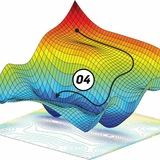
ICLR 2019 | ‘Fast as Adam & Good as SGD’ — New Optimizer Has Both | by Synced | SyncedReview | Medium
https://medium.com/syncedreview/iclr-2019-fast-as-adam-good-as-sgd-new-optimizer-has-both-78e37e8f9a34
https://medium.com/syncedreview/iclr-2019-fast-as-adam-good-as-sgd-new-optimizer-has-both-78e37e8f9a34
Medium
ICLR 2019 | ‘Fast as Adam & Good as SGD’ — New Optimizer Has Both
The optimization algorithm (or optimizer) is the main approach used today for training a machine learning model to minimize its error rate…
https://github.com/Luolc/AdaBound - a nice and neat pytorch extension for AdaBound Oprimizer
GitHub
GitHub - Luolc/AdaBound: An optimizer that trains as fast as Adam and as good as SGD.
An optimizer that trains as fast as Adam and as good as SGD. - Luolc/AdaBound