
GraphML News (Dec 9th) - NeurIPS’23, MatterGen, new blogs, PygHO
🎷 NeurIPS’23 starts on Sunday in jazzy New Orleans including tons of Graph ML papers and workshops that we covered in the previous articles (search by “NeurIPS workshop”). Find Michael (jetlagged from Dagstuhl) in the unique meme-designed t-shirt at two poster sessions (one, two) to chat about papers, graphs, or relay your POV on the diffusion vs flow matching feud of the year.
⚛️ Following the announcements of UniMat and GNoME from DeepMind, MSR AI 4 Science announced MatterGen, a new generative model for inorganic materials design. Practically, unconditional MatterGen is a diffusion model based on the GemNet backbone with both continuous and discrete diffusion components, ie, continuous diffusion is applied to lattice parameters and fractional coordinates, discrete diffusion (absorbing state with the MASK token) is applied to atom compositions. A pre-trained MatterGen can then be steered in many directions with classifier-free guidance, and the authors report conditioning on target chemistry, energy, magnetic properties, and on a practical use-case of designing magnets. Seems like big labs are picking up on materials science and it will be a key topic of generative models in 2024 along with molecules and proteins.
Meanwhile, a few new blog posts have arrived:
- Cooperative GNNs by Ben Finkelshtein, Ismail Ceylan, Xingyue Huang, and Michael Bronstein on the recently proposed GNN architecture;
- Equivariant CNNs and steerable kernels - part 3 of the series based off the monumental book Equivariant CNN by Maurice Weiler
Xiyuan Wang and Muhan Zhang published PyTorch Geometric Higher Order (PygHO), a library that implements a collection of primitives to create higher-order GNNs (like subgraph GNNs, PPGN, Nested GNNs) and data wrappers with proper graph transformations.
Weekend reading:
MatterGen: a generative model for inorganic materials design by Zeni et al. - the MatterGen paper
Expressive Sign Equivariant Networks for Spectral Geometric Learning (NeurIPS’23) by Derek Lim, Joshua Robinson, Stefanie Jegelka, and Haggai Maron - extension of invariant SignNet to sign equivariance
Recurrent Distance-Encoding Neural Networks for Graph Representation Learning by Yuhui Ding et al. - Linear Recurrent Units (LRUs) straight from NLP arrived to GNNs
Variational Annealing on Graphs for Combinatorial Optimization by Sebastian Sanokowski feat. Sepp Hochreiter
🎷 NeurIPS’23 starts on Sunday in jazzy New Orleans including tons of Graph ML papers and workshops that we covered in the previous articles (search by “NeurIPS workshop”). Find Michael (jetlagged from Dagstuhl) in the unique meme-designed t-shirt at two poster sessions (one, two) to chat about papers, graphs, or relay your POV on the diffusion vs flow matching feud of the year.
⚛️ Following the announcements of UniMat and GNoME from DeepMind, MSR AI 4 Science announced MatterGen, a new generative model for inorganic materials design. Practically, unconditional MatterGen is a diffusion model based on the GemNet backbone with both continuous and discrete diffusion components, ie, continuous diffusion is applied to lattice parameters and fractional coordinates, discrete diffusion (absorbing state with the MASK token) is applied to atom compositions. A pre-trained MatterGen can then be steered in many directions with classifier-free guidance, and the authors report conditioning on target chemistry, energy, magnetic properties, and on a practical use-case of designing magnets. Seems like big labs are picking up on materials science and it will be a key topic of generative models in 2024 along with molecules and proteins.
Meanwhile, a few new blog posts have arrived:
- Cooperative GNNs by Ben Finkelshtein, Ismail Ceylan, Xingyue Huang, and Michael Bronstein on the recently proposed GNN architecture;
- Equivariant CNNs and steerable kernels - part 3 of the series based off the monumental book Equivariant CNN by Maurice Weiler
Xiyuan Wang and Muhan Zhang published PyTorch Geometric Higher Order (PygHO), a library that implements a collection of primitives to create higher-order GNNs (like subgraph GNNs, PPGN, Nested GNNs) and data wrappers with proper graph transformations.
Weekend reading:
MatterGen: a generative model for inorganic materials design by Zeni et al. - the MatterGen paper
Expressive Sign Equivariant Networks for Spectral Geometric Learning (NeurIPS’23) by Derek Lim, Joshua Robinson, Stefanie Jegelka, and Haggai Maron - extension of invariant SignNet to sign equivariance
Recurrent Distance-Encoding Neural Networks for Graph Representation Learning by Yuhui Ding et al. - Linear Recurrent Units (LRUs) straight from NLP arrived to GNNs
Variational Annealing on Graphs for Combinatorial Optimization by Sebastian Sanokowski feat. Sepp Hochreiter
A team including folks from Mila and Cambridge just released a “Hitchhiker’s Guide” for getting started with GNNs for 3D structural biology & chemistry -- we think it will be useful for newcomers to start their learning journey on the core architectures powering recent breakthroughs of graph ML in protein design, material discovery, molecular simulations, and more!
A Hitchhiker’s Guide to Geometric GNNs for 3D Atomic Systems
👥 Alexandre Duval, Simon V. Mathis, Chaitanya K. Joshi, Victor Schmidt, Santiago Miret, Fragkiskos Malliaros, Taco Cohen, Pietro Liò, Yoshua Bengio, and Michael Bronstein
📝 PDF: https://arxiv.org/abs/2312.07511
A Hitchhiker’s Guide to Geometric GNNs for 3D Atomic Systems
👥 Alexandre Duval, Simon V. Mathis, Chaitanya K. Joshi, Victor Schmidt, Santiago Miret, Fragkiskos Malliaros, Taco Cohen, Pietro Liò, Yoshua Bengio, and Michael Bronstein
📝 PDF: https://arxiv.org/abs/2312.07511
❤1🔥1
GraphML News (Dec 17th) - The NeurIPS edition, TGB and TpuGraphs
NeurIPS’23 happened this week in New Orleans with 3000+ papers, 50+ workshops and competitions, and 16000+ registered participants. The most important part of such enormous events is networking, and, based on my impressions, the Graph ML community is thriving with so many new ideas and projects (especially after attending the workshops).
We will be reflecting on the hot trends, ideas that fell out of favor / are solved, and update the predictions in the annual 2023-2024 post which is already in the works (so stay tuned).
PS > All the flow matching t-shirts found their owners 😉
New blogposts:
- Temporal Graph Benchmark by Andy Huang and Emanuele Rossi - introduces TGB, its design principles and supported tasks
- Advancements in ML for ML by Google on the new TpuGraphs dataset, Graph Segment Training for large graphs, and the recently finished Kaggle competition on the TpuGraphs dataset (GraphSAGE is in the most of the top winning solutions)
Weekend reading:
A Hitchhiker’s Guide to Geometric GNNs for 3D Atomic Systems by Alexandre Duval, Simon V. Mathis, Chaitanya K. Joshi, Victor Schmidt, et al - a handbook on geometric GNNs, see our previous post for more details
Are Graph Neural Networks Optimal Approximation Algorithms? by Morris Yau feat. Stefanie Jegelka - introduces OptGNN that performs very competitively on a bunch of combinatorial optimization tasks
TorchCFM, the main library for conditional flow matching, released a bunch of new tutorials in Jupyter notebooks - winter holidays are a perfect time to learn more about flow matching and optimal transport
NeurIPS’23 happened this week in New Orleans with 3000+ papers, 50+ workshops and competitions, and 16000+ registered participants. The most important part of such enormous events is networking, and, based on my impressions, the Graph ML community is thriving with so many new ideas and projects (especially after attending the workshops).
We will be reflecting on the hot trends, ideas that fell out of favor / are solved, and update the predictions in the annual 2023-2024 post which is already in the works (so stay tuned).
PS > All the flow matching t-shirts found their owners 😉
New blogposts:
- Temporal Graph Benchmark by Andy Huang and Emanuele Rossi - introduces TGB, its design principles and supported tasks
- Advancements in ML for ML by Google on the new TpuGraphs dataset, Graph Segment Training for large graphs, and the recently finished Kaggle competition on the TpuGraphs dataset (GraphSAGE is in the most of the top winning solutions)
Weekend reading:
A Hitchhiker’s Guide to Geometric GNNs for 3D Atomic Systems by Alexandre Duval, Simon V. Mathis, Chaitanya K. Joshi, Victor Schmidt, et al - a handbook on geometric GNNs, see our previous post for more details
Are Graph Neural Networks Optimal Approximation Algorithms? by Morris Yau feat. Stefanie Jegelka - introduces OptGNN that performs very competitively on a bunch of combinatorial optimization tasks
TorchCFM, the main library for conditional flow matching, released a bunch of new tutorials in Jupyter notebooks - winter holidays are a perfect time to learn more about flow matching and optimal transport
GraphML News (Dec 23rd) - Antibiotics discovered with GNNs, OpenCatalyst 23, TF GNN
A group of MIT and Harvard researchers reported (in the recent Nature paper) the discovery of a new class of antibiotics. The screening process was supported by ChemProp, a suite of GNNs for molecular property prediction. The authors trained an ensemble of 10 models to filter down the initial space of 11M compounds to 1.5K compounds. Most of those models are 5-layer MPNNs with hidden size of 1600. Pre-trained checkpoints and notebooks are available in the GitHub repo of the project. Exciting times for the field (and many bio startups)! 👏
The Open Catalyst project announced the winners of the recent OCP 23 challenge (aka AdsorbML) - the top approaches build around Equiformer V2 with the best model reaching 46% success rate. It is likely that the numbers can be bumped even further by training on even larger OCP splits as demonstrated by eSCN Large and Equiformer V2 in the paper.
Google released TensorFlow GNN v1.0, the library you can run in production on GPUs and TPUs. Heterogeneous graphs are of particular focus - have a look at the example notebooks to learn more.
We’ll probably take a break with the news the next week to enjoy the holiday season and get back in January with the massive year-review post. 🥂
Weekend reading:
Perspectives on the State and Future of Deep Learning - 2023 - opinions of prominent ML researchers (incl. Max Welling, Kyunghyun Cho, Andrew Gordon Wilson, and ChatGPT, lolz) on the current problems and challenges. High-quality holiday reading 👌
Graph Transformers for Large Graphs by Vijay Prakash Dwivedi feat. Xavier Bresson, Neil Shah. Scaling GTs to graphs of 100M nodes.
Harmonics of Learning: Universal Fourier Features Emerge in Invariant Networks by Giovanni Luca Marchetti et al. Turns out Fourier features do emerge in neural networks and help to identify symmetries. The nature of the Fourier kernels looks quite similar to the steerable kernels for irreducible representations
A group of MIT and Harvard researchers reported (in the recent Nature paper) the discovery of a new class of antibiotics. The screening process was supported by ChemProp, a suite of GNNs for molecular property prediction. The authors trained an ensemble of 10 models to filter down the initial space of 11M compounds to 1.5K compounds. Most of those models are 5-layer MPNNs with hidden size of 1600. Pre-trained checkpoints and notebooks are available in the GitHub repo of the project. Exciting times for the field (and many bio startups)! 👏
The Open Catalyst project announced the winners of the recent OCP 23 challenge (aka AdsorbML) - the top approaches build around Equiformer V2 with the best model reaching 46% success rate. It is likely that the numbers can be bumped even further by training on even larger OCP splits as demonstrated by eSCN Large and Equiformer V2 in the paper.
Google released TensorFlow GNN v1.0, the library you can run in production on GPUs and TPUs. Heterogeneous graphs are of particular focus - have a look at the example notebooks to learn more.
We’ll probably take a break with the news the next week to enjoy the holiday season and get back in January with the massive year-review post. 🥂
Weekend reading:
Perspectives on the State and Future of Deep Learning - 2023 - opinions of prominent ML researchers (incl. Max Welling, Kyunghyun Cho, Andrew Gordon Wilson, and ChatGPT, lolz) on the current problems and challenges. High-quality holiday reading 👌
Graph Transformers for Large Graphs by Vijay Prakash Dwivedi feat. Xavier Bresson, Neil Shah. Scaling GTs to graphs of 100M nodes.
Harmonics of Learning: Universal Fourier Features Emerge in Invariant Networks by Giovanni Luca Marchetti et al. Turns out Fourier features do emerge in neural networks and help to identify symmetries. The nature of the Fourier kernels looks quite similar to the steerable kernels for irreducible representations
Neural Algorithmic Reasoning Without Intermediate Supervision
Guest post by Gleb Rodionov
📝 Paper: https://openreview.net/forum?id=vBwSACOB3x (NeurIPS 2023)
🛠️ Code: in the supplementary on OpenReview
Algorithmic reasoning aims to capture computations with neural networks, imitating the execution of classical algorithms. Typically, the generalization abilities of such models are improved through various forms of intermediate supervision, which demonstrate a particular execution trajectory (a sequence of intermediate steps, called hints) that the model needs to follow.
However, progress can also be made on the other side of the spectrum, where models are trained only with input-output pairs. Such models are not tied to any particular execution trajectory and are free to converge to the optimal execution flow for their own architecture. We demonstrate that models without hints can be competitive with hint-based models or even outperform them:
1️⃣ We propose several architectural modifications for models trained without intermediate supervision, that are aimed at making the comparison versus hint-based models clearer and fairer.
2️⃣ We build a self-supervised objective that can regularize intermediate computations of the model without access to the algorithm trajectory.
We hope our work will encourage further investigation of neural algorithmic reasoners without intermediate supervision. For more details, see the blog post.
Guest post by Gleb Rodionov
📝 Paper: https://openreview.net/forum?id=vBwSACOB3x (NeurIPS 2023)
🛠️ Code: in the supplementary on OpenReview
Algorithmic reasoning aims to capture computations with neural networks, imitating the execution of classical algorithms. Typically, the generalization abilities of such models are improved through various forms of intermediate supervision, which demonstrate a particular execution trajectory (a sequence of intermediate steps, called hints) that the model needs to follow.
However, progress can also be made on the other side of the spectrum, where models are trained only with input-output pairs. Such models are not tied to any particular execution trajectory and are free to converge to the optimal execution flow for their own architecture. We demonstrate that models without hints can be competitive with hint-based models or even outperform them:
1️⃣ We propose several architectural modifications for models trained without intermediate supervision, that are aimed at making the comparison versus hint-based models clearer and fairer.
2️⃣ We build a self-supervised objective that can regularize intermediate computations of the model without access to the algorithm trajectory.
We hope our work will encourage further investigation of neural algorithmic reasoners without intermediate supervision. For more details, see the blog post.

Adaptive Message Passing: A General Framework to Mitigate Oversmoothing, Oversquashing, and Underreaching
Guest post by Federico Errica
📖 Blog post: link
⚗️ Paper: https://arxiv.org/abs/2312.16560
Long-range interactions are essential for the correct description of complex systems in many scientific fields. Recently, deep graph networks have been employed as efficient, data-driven surrogate models for predicting properties of complex systems represented as graphs. In practice, most deep graph networks cannot really model long-range dependencies due to the intrinsic limitations of (synchronous) message passing, namely oversmoothing, oversquashing, and underreaching.
Motivated by these observations, we propose Adaptive Message Passing (AMP) to let the DGN decide how many messages each node should send -up to infinity! - and when to send them. In other words:
1️⃣ We learn the depth of the network during training (addressing underreaching)
2️⃣ We apply a differentiable, soft filter on messages sent by nodes, which in principle can completely shut down the propagation of a message (addressing oversmoothing and oversquashing).
❗️ AMP can easily and automatically improve the performances of your favorite message passing architecture, e.g., GCN/GIN. ❗️
We believe AMP will foster exciting research opportunities in the graph machine learning field and find successful applications in the fields of physics, chemistry, and material sciences.
Guest post by Federico Errica
📖 Blog post: link
⚗️ Paper: https://arxiv.org/abs/2312.16560
Long-range interactions are essential for the correct description of complex systems in many scientific fields. Recently, deep graph networks have been employed as efficient, data-driven surrogate models for predicting properties of complex systems represented as graphs. In practice, most deep graph networks cannot really model long-range dependencies due to the intrinsic limitations of (synchronous) message passing, namely oversmoothing, oversquashing, and underreaching.
Motivated by these observations, we propose Adaptive Message Passing (AMP) to let the DGN decide how many messages each node should send -up to infinity! - and when to send them. In other words:
1️⃣ We learn the depth of the network during training (addressing underreaching)
2️⃣ We apply a differentiable, soft filter on messages sent by nodes, which in principle can completely shut down the propagation of a message (addressing oversmoothing and oversquashing).
❗️ AMP can easily and automatically improve the performances of your favorite message passing architecture, e.g., GCN/GIN. ❗️
We believe AMP will foster exciting research opportunities in the graph machine learning field and find successful applications in the fields of physics, chemistry, and material sciences.
Medium
Adaptive Message Passing: Learning to Mitigate Oversmoothing, Oversquashing, and Underreaching
This blog post summarizes the findings of our new contribution:
❤1
GraphML News (Jan 6th) - ICLR’24 workshops, new blog posts, MACE-MP-0 potential
We are getting back with the weekly news, hope you had a nice winter holiday!
🎤 ICLR’24 started announcing accepted workshops, the list is (so far) incomplete, but we might expect some graph and geometric learning here:
- AI for Differential Equations in Science
- Generative and Experimental Perspectives for Biomolecular Design
- Machine Learning for Genomics Explorations
📝 New blogposts!
▶️ Pat Walters started a massive series on AI in Drug Discovery in 2023: part 1 covers benchmarks, deep learning for docking, and AlphaFold for ligand discovery and design. Part 2 will focus on LLMs and generative models, Part 3 will be on review articles.
▶️ Zhaocheng Zhu, Michael Galkin, Abulhair Saparov, Shibo Hao, and Yihong Chen review the landscape of LLM reasoning approaches covering tool usage, retrieval, planning, and open reasoning problems. Lots of unsolved theoretical and practical problems to work on in 2024!
⚛️ Ilyes Batatia and a huge collab from Cambrige, Oxford, and EU universities announced MACE-MP-0: a foundational ML potentials model that can accurately approximate DFT calculations needed for molecular dynamics and atomistic simulations. The model is based on MACE (equivariant MPNN) and was trained on the Materials Project to predict forces, energy, and stress on 150k crystal structures for 200 epochs on 40-80 A100’s (definitely not a GPU-poor project, perhaps GPU-middle class). The authors ran about 30 experiments studying a single pre-trained model with different crystal structures and atomistic systems. The race for ML potentials has officially started 🏎️
Weekend reading:
Learning Scalable Structural Representations for Link Prediction with Bloom Signatures by Zhang et al. feat Pan Li - hashing-based link prediction now with Bloom filters
Scalable network reconstruction in subquadratic time by Tiago Peixoto (Mr. GraphTool) - present a O(N log^2 N) algorithm for network reconstruction
A foundation model for atomistic materials chemistry by Batatia et al - MACE-MP-0
We are getting back with the weekly news, hope you had a nice winter holiday!
🎤 ICLR’24 started announcing accepted workshops, the list is (so far) incomplete, but we might expect some graph and geometric learning here:
- AI for Differential Equations in Science
- Generative and Experimental Perspectives for Biomolecular Design
- Machine Learning for Genomics Explorations
📝 New blogposts!
▶️ Pat Walters started a massive series on AI in Drug Discovery in 2023: part 1 covers benchmarks, deep learning for docking, and AlphaFold for ligand discovery and design. Part 2 will focus on LLMs and generative models, Part 3 will be on review articles.
▶️ Zhaocheng Zhu, Michael Galkin, Abulhair Saparov, Shibo Hao, and Yihong Chen review the landscape of LLM reasoning approaches covering tool usage, retrieval, planning, and open reasoning problems. Lots of unsolved theoretical and practical problems to work on in 2024!
⚛️ Ilyes Batatia and a huge collab from Cambrige, Oxford, and EU universities announced MACE-MP-0: a foundational ML potentials model that can accurately approximate DFT calculations needed for molecular dynamics and atomistic simulations. The model is based on MACE (equivariant MPNN) and was trained on the Materials Project to predict forces, energy, and stress on 150k crystal structures for 200 epochs on 40-80 A100’s (definitely not a GPU-poor project, perhaps GPU-middle class). The authors ran about 30 experiments studying a single pre-trained model with different crystal structures and atomistic systems. The race for ML potentials has officially started 🏎️
Weekend reading:
Learning Scalable Structural Representations for Link Prediction with Bloom Signatures by Zhang et al. feat Pan Li - hashing-based link prediction now with Bloom filters
Scalable network reconstruction in subquadratic time by Tiago Peixoto (Mr. GraphTool) - present a O(N log^2 N) algorithm for network reconstruction
A foundation model for atomistic materials chemistry by Batatia et al - MACE-MP-0
GraphML News (Jan 13th) - New material discovered by geometric models, LOWE
What time could be better than the time in between ICLR announcements (Jan 15th) and the ICML deadline (Feb 1st) 🫠. As far as we know, the graph community is working on some huge blog posts - you can expect those coming in the next few days. The two big news from this week:
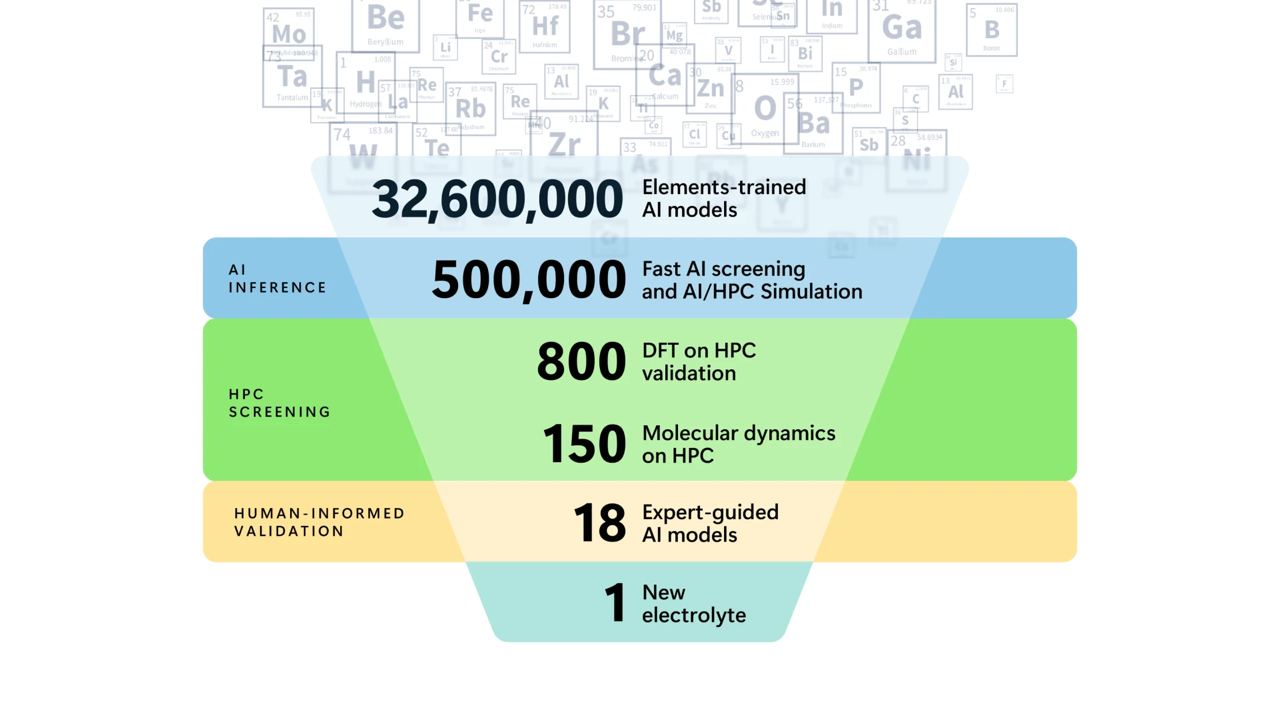
Microsoft Azure Quantum together with Pacific Northwest National Lab announced successful synthesis and validation of a potentially new electrolyte candidate suitable for solid-state batteries. The fresh accompanying paper describes the pipeline from generating 32M candidates and stepwise filtering of those down to 500K, 800, 18, and 1 final candidate. The main bulk of the job of filtering millions of candidates was done by the geometric ML potential model M3GNet (published in 2022 in Nature Computational Science) while later stages with a dozen candidates included HPC simulations of molecular dynamics. Geometric DL for materials discovery is rising! 🚀
Valence & Recursion announced LOWE (LLM-orchestrated Workflow Engine). LOWE is an LLM agent that strives to do all things around drug discovery - from screening and running geometric generative models to the procurement of materials. Was ChemCrow 🐦⬛ the inspiration for LOWE?
Weekend reading:
Accelerating computational materials discovery with artificial intelligence and cloud high-performance computing: from large-scale screening to experimental validation by Chen, Nguyen, et al - the paper behind the newly discovered material by Azure Quantum and PNNL.
MACE-OFF23: Transferable Machine Learning Force Fields for Organic Molecules by Kovács, Moore, et al - similarly to MACE-MP-0 from the last week, MACE-OFF23 is a transferable ML potential for organic molecules but smaller - Medium and Large models were trained on a single A100 for 10/14 days.
Improved motif-scaffolding with SE(3) flow matching by Yim et al - the improved version of FrameFlow (based on trendy flow matching), originally for protein backbone generation, to motif-scaffolding. On some benchmarks, new FrameFlow is on par or better than mighty RFDiffusion 💪
What time could be better than the time in between ICLR announcements (Jan 15th) and the ICML deadline (Feb 1st) 🫠. As far as we know, the graph community is working on some huge blog posts - you can expect those coming in the next few days. The two big news from this week:
Microsoft Azure Quantum together with Pacific Northwest National Lab announced successful synthesis and validation of a potentially new electrolyte candidate suitable for solid-state batteries. The fresh accompanying paper describes the pipeline from generating 32M candidates and stepwise filtering of those down to 500K, 800, 18, and 1 final candidate. The main bulk of the job of filtering millions of candidates was done by the geometric ML potential model M3GNet (published in 2022 in Nature Computational Science) while later stages with a dozen candidates included HPC simulations of molecular dynamics. Geometric DL for materials discovery is rising! 🚀
Valence & Recursion announced LOWE (LLM-orchestrated Workflow Engine). LOWE is an LLM agent that strives to do all things around drug discovery - from screening and running geometric generative models to the procurement of materials. Was ChemCrow 🐦⬛ the inspiration for LOWE?
Weekend reading:
Accelerating computational materials discovery with artificial intelligence and cloud high-performance computing: from large-scale screening to experimental validation by Chen, Nguyen, et al - the paper behind the newly discovered material by Azure Quantum and PNNL.
MACE-OFF23: Transferable Machine Learning Force Fields for Organic Molecules by Kovács, Moore, et al - similarly to MACE-MP-0 from the last week, MACE-OFF23 is a transferable ML potential for organic molecules but smaller - Medium and Large models were trained on a single A100 for 10/14 days.
Improved motif-scaffolding with SE(3) flow matching by Yim et al - the improved version of FrameFlow (based on trendy flow matching), originally for protein backbone generation, to motif-scaffolding. On some benchmarks, new FrameFlow is on par or better than mighty RFDiffusion 💪
Graph & Geometric ML in 2024: Where We Are and What’s Next
📣 Two new blog posts - a comprehensive review of Graph and Geometric ML in 2023 with predictions for 2024. Together with Michael Bronstein, we asked 30 academic and industrial experts about the most important things happened in their areas and open challenges to be solved.
1️⃣ Part I: https://towardsdatascience.com/graph-geometric-ml-in-2024-where-we-are-and-whats-next-part-i-theory-architectures-3af5d38376e1
2️⃣ Part II: https://medium.com/towards-data-science/graph-geometric-ml-in-2024-where-we-are-and-whats-next-part-ii-applications-1ed786f7bf63
Part I covers: theory of GNNs, new and exotic message passing, going beyong graphs (with Topology, Geometric Algebras, and PDEs), robustness, graph transformers, new datasets, community events, and, of course, top memes of 2023 (that’s what you are here for, right).
Part II covers applications in structural biology, materials science, Molecular Dynamics and ML potentials, geometric generative models on manifolds, Very Large Graphs, algorithmic reasoning, knowledge graph reasoning, LLMs + Graphs, cool GNN applications, and The Geometric Wall Street Bulletin 💸
New things this year:
- the industrial perspective on important problems in structural biology that are often overlooked by researchers;
- The Geometric Wall Street Bulletin prepared with Nathan Benaich, the author of the State of AI report
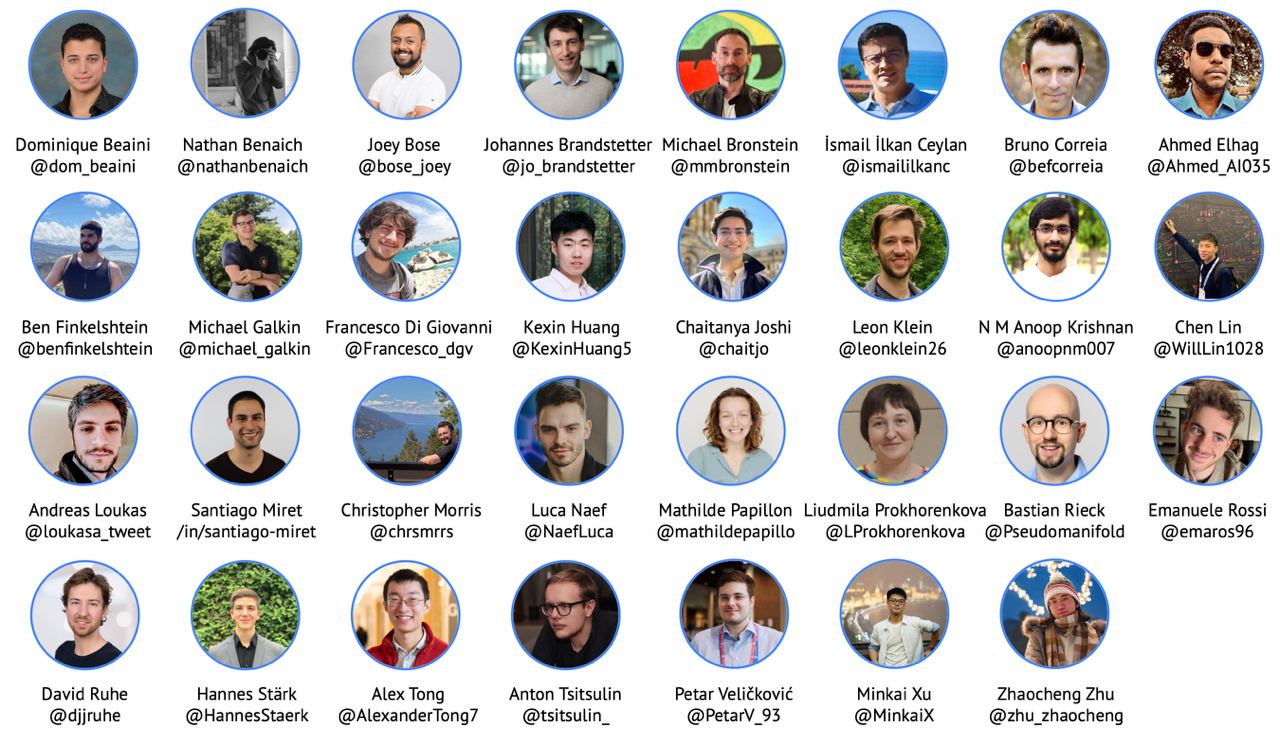
It was a huge community effort and we are very grateful to all our experts for their availability around winter holidays. Here is the slide with all the contributors, the best “thank you” would be to follow all of them on Twitter!
📣 Two new blog posts - a comprehensive review of Graph and Geometric ML in 2023 with predictions for 2024. Together with Michael Bronstein, we asked 30 academic and industrial experts about the most important things happened in their areas and open challenges to be solved.
1️⃣ Part I: https://towardsdatascience.com/graph-geometric-ml-in-2024-where-we-are-and-whats-next-part-i-theory-architectures-3af5d38376e1
2️⃣ Part II: https://medium.com/towards-data-science/graph-geometric-ml-in-2024-where-we-are-and-whats-next-part-ii-applications-1ed786f7bf63
Part I covers: theory of GNNs, new and exotic message passing, going beyong graphs (with Topology, Geometric Algebras, and PDEs), robustness, graph transformers, new datasets, community events, and, of course, top memes of 2023 (that’s what you are here for, right).
Part II covers applications in structural biology, materials science, Molecular Dynamics and ML potentials, geometric generative models on manifolds, Very Large Graphs, algorithmic reasoning, knowledge graph reasoning, LLMs + Graphs, cool GNN applications, and The Geometric Wall Street Bulletin 💸
New things this year:
- the industrial perspective on important problems in structural biology that are often overlooked by researchers;
- The Geometric Wall Street Bulletin prepared with Nathan Benaich, the author of the State of AI report
It was a huge community effort and we are very grateful to all our experts for their availability around winter holidays. Here is the slide with all the contributors, the best “thank you” would be to follow all of them on Twitter!
GraphML News (Jan 20th) - More Blogs, MACE pre-trained potentials, AlphaFold 🤝 Psychedelics
ICLR 2024 announced the accepted papers together with orals and spotlights — we’ll probably make a rundown on the coolest papers but meanwhile you can check one-line tl;dr’s by the famous Compressor by Vitaly Kurin. See you in Vienna in May!
📝 In addition to the megapost on the state of affairs in Graph & Geometric ML, the community delivered two more reviews:
- On Temporal Graph Learning by Shenyang Huang, Emanuele Rossi, Michael Galkin, Andrea Cini, Ingo Scholtes.
- On AI 4 Science by the organizers of the AI for Science workshops (that you see at all major ML venues) including Sherry Lixue Cheng, Yuanqi Du, Chenru Duan, Ada Fang, Tianfan Fu, Wenhao Gao, Kexin Huang, Ziming Liu, Di Luo, and Lijing Wang
⚛️ The MACE team released two foundational ML potential checkpoints: MP for inorganic crystals from the Materials Project and OFF for organic materials and molecular liquids. We covered those in the previous posts — now you can run some MD simulations with them on a laptop.
🍭 AlphaFold discovers potentially new psychedelic molecules (thousands of candidates!) - practically, those can be new antidepressants (would some researchers be willing to try some just for the sake of science and scientific method?)
Besides, the article mentions some works that apply AlphaFold to target G-protein-coupled receptors (GPCR). Apart from having its own Wiki page, GPCR was the main subject of the 2012 Nobel Prize in chemistry. The Nobel Prize for AlphaFold seems even closer?
Weekend reading:
You want to say you finished all those blogposts? 😉
ICLR 2024 announced the accepted papers together with orals and spotlights — we’ll probably make a rundown on the coolest papers but meanwhile you can check one-line tl;dr’s by the famous Compressor by Vitaly Kurin. See you in Vienna in May!
📝 In addition to the megapost on the state of affairs in Graph & Geometric ML, the community delivered two more reviews:
- On Temporal Graph Learning by Shenyang Huang, Emanuele Rossi, Michael Galkin, Andrea Cini, Ingo Scholtes.
- On AI 4 Science by the organizers of the AI for Science workshops (that you see at all major ML venues) including Sherry Lixue Cheng, Yuanqi Du, Chenru Duan, Ada Fang, Tianfan Fu, Wenhao Gao, Kexin Huang, Ziming Liu, Di Luo, and Lijing Wang
⚛️ The MACE team released two foundational ML potential checkpoints: MP for inorganic crystals from the Materials Project and OFF for organic materials and molecular liquids. We covered those in the previous posts — now you can run some MD simulations with them on a laptop.
🍭 AlphaFold discovers potentially new psychedelic molecules (thousands of candidates!) - practically, those can be new antidepressants (would some researchers be willing to try some just for the sake of science and scientific method?)
Besides, the article mentions some works that apply AlphaFold to target G-protein-coupled receptors (GPCR). Apart from having its own Wiki page, GPCR was the main subject of the 2012 Nobel Prize in chemistry. The Nobel Prize for AlphaFold seems even closer?
Weekend reading:
You want to say you finished all those blogposts? 😉
Exploring the Power of Graph Neural Networks in Solving Linear Optimization Problems
guest post by Chendi Qian, Didier Chételat, Christopher Morris
📜 Paper: arxiv (accepted to AISTATS 2024)
🛠️ Code: https://github.com/chendiqian/IPM_MPNN
Recent research shows growing interest in training message-passing graph neural networks (MPNNs) to mimic classical algorithms, particularly for solving linear optimization problems (LPs). For example, in integer linear optimization, state-of-the-art solvers rely on the branch-and-bound algorithm, in which one must repeatedly select variables, subdividing the search space. The best-known heuristic for variable selection is known as strong branching which entails solving LPs to score the variables. This heuristic is too computationally expensive to use in practice. However, in recent years, a collection of works, e.g., Gasse et al. (2019), have proposed using MPNNs to imitate strong branching with impressive success. However, it remained to be seen why such approaches work.
Hence, our paper explores the intriguing possibility of MPNNs approximating general LPs by interpreting various interior-point methods (IPMs) as MPNNs with specific architectures and parameters. We prove that standard MPNN steps can emulate a single iteration of the IPM algorithm on the LP’s tripartite graph representation. This theoretical insight suggests that MPNNs may succeed in LP solving by effectively imitating IPMs.
Despite our theoretical model, our empirical results indicate that MPNNs with fewer layers can approximate the output of practical IPMs for LP solving. Empirically, our approach reduces solving times compared to a state-of-the-art LP solver and other neural network-based methods. Our study enhances the theoretical understanding of data-driven optimization using MPNNs and highlights the potential of MPNNs as efficient proxies for solving LPs.
guest post by Chendi Qian, Didier Chételat, Christopher Morris
📜 Paper: arxiv (accepted to AISTATS 2024)
🛠️ Code: https://github.com/chendiqian/IPM_MPNN
Recent research shows growing interest in training message-passing graph neural networks (MPNNs) to mimic classical algorithms, particularly for solving linear optimization problems (LPs). For example, in integer linear optimization, state-of-the-art solvers rely on the branch-and-bound algorithm, in which one must repeatedly select variables, subdividing the search space. The best-known heuristic for variable selection is known as strong branching which entails solving LPs to score the variables. This heuristic is too computationally expensive to use in practice. However, in recent years, a collection of works, e.g., Gasse et al. (2019), have proposed using MPNNs to imitate strong branching with impressive success. However, it remained to be seen why such approaches work.
Hence, our paper explores the intriguing possibility of MPNNs approximating general LPs by interpreting various interior-point methods (IPMs) as MPNNs with specific architectures and parameters. We prove that standard MPNN steps can emulate a single iteration of the IPM algorithm on the LP’s tripartite graph representation. This theoretical insight suggests that MPNNs may succeed in LP solving by effectively imitating IPMs.
Despite our theoretical model, our empirical results indicate that MPNNs with fewer layers can approximate the output of practical IPMs for LP solving. Empirically, our approach reduces solving times compared to a state-of-the-art LP solver and other neural network-based methods. Our study enhances the theoretical understanding of data-driven optimization using MPNNs and highlights the potential of MPNNs as efficient proxies for solving LPs.

GraphML News (Jan 27th) - New Blogs, LigandMPNN is available
Seems like everyone is grinding for the ICML’24 deadline next week so there isn’t much news those days. A few highlights:
Dimension Research published 2/3 parts of their ML x Bio review of NeurIPS’23: on Generative Protein Design, and on Generative Molecular Design, the last one is going to be about drug target interaction prediction.
The blog post on Exphormer by Ameya Velingker and Balaji Venkatachalam from Google Research on the neat ICML’23 sparse graph transformer architecture that scales to graphs much larger than molecules. Glad to see GraphGPS and Long Range Graph Benchmark mentioned a few times 🙂
LigandMPNN was released on GitHub this week after appearing as a module in several recent protein generation papers. LigandMPNN significantly improves over ProteinMPNN in modeling non-protein components like small molecules, metals, and nucleotides.
Weekend reading:
Equivariant Graph Neural Operator for Modeling 3D Dynamics by Minkai Xu, Jiaqi Han feat Jure Leskovec and Stefano Ermon: equivariant GNNs 🤝 neural operators, also provides a nice condensed intro to the topic
Towards Principled Graph Transformers by Luis Müller and Christopher Morris - study of the Edge Transformer with triangular attention applied to graph tasks. Edge Transformer has shown remarkable systematic generalization capabilities and it’s intriguing to see how it works on graphs (O(N^3) complexity for now though).
Tweets to Citations: Unveiling the Impact of Social Media Influencers on AI Research Visibility - turns out that papers shared on X / Twitter by AK and Aran Komatsuzaki have significantly more citations. Time to revive your old sci-Twitter account
Seems like everyone is grinding for the ICML’24 deadline next week so there isn’t much news those days. A few highlights:
Dimension Research published 2/3 parts of their ML x Bio review of NeurIPS’23: on Generative Protein Design, and on Generative Molecular Design, the last one is going to be about drug target interaction prediction.
The blog post on Exphormer by Ameya Velingker and Balaji Venkatachalam from Google Research on the neat ICML’23 sparse graph transformer architecture that scales to graphs much larger than molecules. Glad to see GraphGPS and Long Range Graph Benchmark mentioned a few times 🙂
LigandMPNN was released on GitHub this week after appearing as a module in several recent protein generation papers. LigandMPNN significantly improves over ProteinMPNN in modeling non-protein components like small molecules, metals, and nucleotides.
Weekend reading:
Equivariant Graph Neural Operator for Modeling 3D Dynamics by Minkai Xu, Jiaqi Han feat Jure Leskovec and Stefano Ermon: equivariant GNNs 🤝 neural operators, also provides a nice condensed intro to the topic
Towards Principled Graph Transformers by Luis Müller and Christopher Morris - study of the Edge Transformer with triangular attention applied to graph tasks. Edge Transformer has shown remarkable systematic generalization capabilities and it’s intriguing to see how it works on graphs (O(N^3) complexity for now though).
Tweets to Citations: Unveiling the Impact of Social Media Influencers on AI Research Visibility - turns out that papers shared on X / Twitter by AK and Aran Komatsuzaki have significantly more citations. Time to revive your old sci-Twitter account
GraphML News (Feb 3rd) - DGL 2.0 ⚡
All ICML deadlines have passed - congratulations to all who made it through the sleepless nights over the last week! We will start seeing some fresh submissions relatively soon on social media (among 10k submitted papers and ~220 position papers)
Meanwhile, DGL 2.0 was released featuring GraphBolt - a new tool for streaming data loading and sampling offering around 30% speedups in node classification and up to 400% in link prediction 🚀 Besides that, the new version includes utilities for building graph transformers and a handful of new datasets - LRGB and a recent suite of heterophilic datasets
The AppliedML Days @ EPFL will take place on March 25 and 26th - the call for the AI and Molecular world track is still open
Weekend reading:
Combinatorial prediction of therapeutic perturbations using causally-inspired neural networks by Guadalupe Gonzalez feat Michael Bronstein and Marinka Zitnik - introduces PDGrapher, a causally-inspired GNN model to predict therapeutically useful perturbagens
VC dimension of Graph Neural Networks with Pfaffian activation functions by D’Inverno et al - extension of the WL meets VC paper to new non-linearities like sigmoid and hyperbolic tangent
NetInfoF Framework: Measuring and Exploiting Network Usable Information (still anon by accepted to ICLR’24) - introduces the “network usable information” and a fingerpring-like approach to quantity the gains brought by a GNN model compared to a non-GNN baselne.
All ICML deadlines have passed - congratulations to all who made it through the sleepless nights over the last week! We will start seeing some fresh submissions relatively soon on social media (among 10k submitted papers and ~220 position papers)
Meanwhile, DGL 2.0 was released featuring GraphBolt - a new tool for streaming data loading and sampling offering around 30% speedups in node classification and up to 400% in link prediction 🚀 Besides that, the new version includes utilities for building graph transformers and a handful of new datasets - LRGB and a recent suite of heterophilic datasets
The AppliedML Days @ EPFL will take place on March 25 and 26th - the call for the AI and Molecular world track is still open
Weekend reading:
Combinatorial prediction of therapeutic perturbations using causally-inspired neural networks by Guadalupe Gonzalez feat Michael Bronstein and Marinka Zitnik - introduces PDGrapher, a causally-inspired GNN model to predict therapeutically useful perturbagens
VC dimension of Graph Neural Networks with Pfaffian activation functions by D’Inverno et al - extension of the WL meets VC paper to new non-linearities like sigmoid and hyperbolic tangent
NetInfoF Framework: Measuring and Exploiting Network Usable Information (still anon by accepted to ICLR’24) - introduces the “network usable information” and a fingerpring-like approach to quantity the gains brought by a GNN model compared to a non-GNN baselne.
GraphML News (Feb 10th) - TensorFlow GNN 1.0, New ICML submissions
🔧 The official release of TensforFlow-GNN 1.0 by Google (after several road show presentations from the team at ICML and NeurIPS) - production-level library for training GNNs on large graphs with the first-class citizen support for heterogeneous graphs. Check the blog post and github repo for more practical examples and documentation
⚛️ The Denoising force fields repository from Microsoft Research for diffusion models trained on coarse-grained protein dynamics data - you can use it for standard density modeling or extract force fields from coarse-grained structures to use in Langevin dynamics simulations. The repo contains several pre-trained models you can play around with.
The ICML deadline has passed and we saw a flurry of cool new preprints submitted to arxiv this week. Some notable mentions:
🐍 Graph-Mamba: Towards Long-Range Graph Sequence Modeling with Selective State Spaces by Chloe Wang et al: state space models like Mamba are all the rage those days in NLP and CV (although so far attention still rules), this is a nice adaptation of SSMs to graphs, tested on the LRGB!
🗣️ Let Your Graph Do the Talking: Encoding Structured Data for LLMs by Bryan Perozzi feat. Anton Tsitsulin present GraphToken (extension of Talk Like a Graph, ICLR 2024): using trainable set- or graph encoders to get soft prompt tokens improves the performance of frozen LLMs in answering natural language questions about basic graph properties. The last resort of hardcore graph mining teams jumps into LLMs 🗿
⏩ Link Prediction with Relational Hypergraphs by Xingyue Huang feat. Pablo Barcelo, Michael Bronstein, and Ismail Ceylan: extends conditional message passing models like NBFNet to relational hypergraphs (dubbed HC-MPNN) with nice theoretical guarantees and impressive inductive performance boosts.
📈 Neural Scaling Laws on Graphs by Jingzhe Liu feat. Neil Shah and Jilian Tang: one of the first systematic studies of scaling laws for graph models (GNNs and Graph Transformers) and data (mostly OGB datasets) where the number of edges is selected as the universal size metric. Basically, scaling does happen but with certain nuances as to model depth and architecture (transformers seem to scale more monotonically). The church of scaling laws opens its doors to the graph learning crowd ⛪
📚 On the Completeness of Invariant Geometric Deep Learning Models by Zian Li feat. Muhan Zhang: theoretical study of DimeNet, GemNet, and SphereNet with the proofs of their E(3)-completeness through the nested GNN extension (Nested GNNs from NeurIPS’21)
📚 On dimensionality of feature vectors in MPNNs by Cesar Bravo et al - turns out the WL-MPNN equivalence holds even for 1-dimensional node features when using non-polynomial activations like sigmoid.
Next time, we’ll look into some new position papers.
🔧 The official release of TensforFlow-GNN 1.0 by Google (after several road show presentations from the team at ICML and NeurIPS) - production-level library for training GNNs on large graphs with the first-class citizen support for heterogeneous graphs. Check the blog post and github repo for more practical examples and documentation
⚛️ The Denoising force fields repository from Microsoft Research for diffusion models trained on coarse-grained protein dynamics data - you can use it for standard density modeling or extract force fields from coarse-grained structures to use in Langevin dynamics simulations. The repo contains several pre-trained models you can play around with.
The ICML deadline has passed and we saw a flurry of cool new preprints submitted to arxiv this week. Some notable mentions:
🐍 Graph-Mamba: Towards Long-Range Graph Sequence Modeling with Selective State Spaces by Chloe Wang et al: state space models like Mamba are all the rage those days in NLP and CV (although so far attention still rules), this is a nice adaptation of SSMs to graphs, tested on the LRGB!
🗣️ Let Your Graph Do the Talking: Encoding Structured Data for LLMs by Bryan Perozzi feat. Anton Tsitsulin present GraphToken (extension of Talk Like a Graph, ICLR 2024): using trainable set- or graph encoders to get soft prompt tokens improves the performance of frozen LLMs in answering natural language questions about basic graph properties. The last resort of hardcore graph mining teams jumps into LLMs 🗿
⏩ Link Prediction with Relational Hypergraphs by Xingyue Huang feat. Pablo Barcelo, Michael Bronstein, and Ismail Ceylan: extends conditional message passing models like NBFNet to relational hypergraphs (dubbed HC-MPNN) with nice theoretical guarantees and impressive inductive performance boosts.
📈 Neural Scaling Laws on Graphs by Jingzhe Liu feat. Neil Shah and Jilian Tang: one of the first systematic studies of scaling laws for graph models (GNNs and Graph Transformers) and data (mostly OGB datasets) where the number of edges is selected as the universal size metric. Basically, scaling does happen but with certain nuances as to model depth and architecture (transformers seem to scale more monotonically). The church of scaling laws opens its doors to the graph learning crowd ⛪
📚 On the Completeness of Invariant Geometric Deep Learning Models by Zian Li feat. Muhan Zhang: theoretical study of DimeNet, GemNet, and SphereNet with the proofs of their E(3)-completeness through the nested GNN extension (Nested GNNs from NeurIPS’21)
📚 On dimensionality of feature vectors in MPNNs by Cesar Bravo et al - turns out the WL-MPNN equivalence holds even for 1-dimensional node features when using non-polynomial activations like sigmoid.
Next time, we’ll look into some new position papers.
The LoG meetup in New Jersey
The LoG meetup in the NYC area will happen on Feb 29th-March 1st at New Jersey Institute of Technology with invited speakers including Bryan Perozzi and Anton Tsitsulin (both Google Research), Ricky Chen (Meta AI), Jie Gao (Rutgers), and many others.
Come to NJIT@JerseyCity to learn from and connect with the local graph learning community!
Register here, check the Twitter announcement
The LoG meetup in the NYC area will happen on Feb 29th-March 1st at New Jersey Institute of Technology with invited speakers including Bryan Perozzi and Anton Tsitsulin (both Google Research), Ricky Chen (Meta AI), Jie Gao (Rutgers), and many others.
Come to NJIT@JerseyCity to learn from and connect with the local graph learning community!
Register here, check the Twitter announcement

GraphML News (Feb 17th) - PyG 2.5, VantAI deal, Discrete Flow Matching, Position papers
Sora and Gemini 1.5 took all the ML news feeds this week - let’s check what is there in graph learning beyond the main wave of AI anxiety and stress for grad students.
🔥 A fresh release PyG 2.5 features a new distributed training framework (co-authored by Intel engineers), RecSys support with easy retrieval techniques like MIPS over node embeddings, new Edge Index representation instead of sparse tensors, and rewritten Message Passing class for torch.compile. Lots of new cool stuff!
📚 Xavier Bresson (NUS Singapore) started publishing the slides and notebooks of his most recent 22/23 GraphML course - highly recommended to check it out. Hopefully, this initiative would encourage folks running Graph & Geometric DL courses at Oxbrige to publish their lectures as well 😉
💸 The $674M (in biobucks) deal was announced between VantAI and Bristol Myers Squibb for developing molecular glues. Besides publishing on generative models, VantAI runs open seminars on GenAI for drug discovery (the most recent talk on FoldFlow is already on YouTube).
📐 Two papers from the MIT team of Regina Barzilay and Tommi Jaakkola introduce flow matching for discrete variables (like atom types or DNA base pairs):
Dirichlet Flow Matching with Applications to DNA Sequence Design by Hannes Stärk, Bowen Jing, feat. Gabriele Corso - by defining flows on a simplex where the prior is a uniform Dirichlet distribution. Also supports classifier-free guidance and Consistency models-like distillation to perform generation in one forward pass.
Generative Flows on Discrete State-Spaces: Enabling Multimodal Flows with Applications to Protein Co-Design by Andrew Campbell, Jason Yim, et al - by using Continuous Time Markov Chains (CTMC) where the prior distribution is either a uniform or all-mask absorbed state (similar to discrete diffusion models). The resulting Multiflow model now has all necessary components of protein backbone generation implemented as flow matching (translation and rotation as continuous FM, and amino acids as discrete FM).
Position papers for the weekend reading:
Future Directions in Foundations of Graph Machine Learning by Chris Morris feat. Haggai Maron, Michael Bronstein, Stefanie Jegelka and others - on expressive power, generalization, and optimization of GNNs.
Position Paper: Challenges and Opportunities in Topological Deep Learning by Theodore Papamarkou feat. Bastian Rieck, Michael Schaub, Petar Veličković and a huge authors team - on theoretical and practical challenges of TDL.
Graph Foundation Models by Haitao Mao feat. Neil Shah, Michael Galkin, and Jilian Tang - finally, a non-LLM discussion on designing foundation models on graphs and for all kinds of graph tasks. The authors hypothesize what could be the transferable and invariant graph vocabulary given heterogeneity of graph structures and their features spaces, and how Graph FMs might benefit from scaling laws (namely, what should be scaled and where it doesn’t bring benefits)
Sora and Gemini 1.5 took all the ML news feeds this week - let’s check what is there in graph learning beyond the main wave of AI anxiety and stress for grad students.
🔥 A fresh release PyG 2.5 features a new distributed training framework (co-authored by Intel engineers), RecSys support with easy retrieval techniques like MIPS over node embeddings, new Edge Index representation instead of sparse tensors, and rewritten Message Passing class for torch.compile. Lots of new cool stuff!
📚 Xavier Bresson (NUS Singapore) started publishing the slides and notebooks of his most recent 22/23 GraphML course - highly recommended to check it out. Hopefully, this initiative would encourage folks running Graph & Geometric DL courses at Oxbrige to publish their lectures as well 😉
💸 The $674M (in biobucks) deal was announced between VantAI and Bristol Myers Squibb for developing molecular glues. Besides publishing on generative models, VantAI runs open seminars on GenAI for drug discovery (the most recent talk on FoldFlow is already on YouTube).
📐 Two papers from the MIT team of Regina Barzilay and Tommi Jaakkola introduce flow matching for discrete variables (like atom types or DNA base pairs):
Dirichlet Flow Matching with Applications to DNA Sequence Design by Hannes Stärk, Bowen Jing, feat. Gabriele Corso - by defining flows on a simplex where the prior is a uniform Dirichlet distribution. Also supports classifier-free guidance and Consistency models-like distillation to perform generation in one forward pass.
Generative Flows on Discrete State-Spaces: Enabling Multimodal Flows with Applications to Protein Co-Design by Andrew Campbell, Jason Yim, et al - by using Continuous Time Markov Chains (CTMC) where the prior distribution is either a uniform or all-mask absorbed state (similar to discrete diffusion models). The resulting Multiflow model now has all necessary components of protein backbone generation implemented as flow matching (translation and rotation as continuous FM, and amino acids as discrete FM).
Position papers for the weekend reading:
Future Directions in Foundations of Graph Machine Learning by Chris Morris feat. Haggai Maron, Michael Bronstein, Stefanie Jegelka and others - on expressive power, generalization, and optimization of GNNs.
Position Paper: Challenges and Opportunities in Topological Deep Learning by Theodore Papamarkou feat. Bastian Rieck, Michael Schaub, Petar Veličković and a huge authors team - on theoretical and practical challenges of TDL.
Graph Foundation Models by Haitao Mao feat. Neil Shah, Michael Galkin, and Jilian Tang - finally, a non-LLM discussion on designing foundation models on graphs and for all kinds of graph tasks. The authors hypothesize what could be the transferable and invariant graph vocabulary given heterogeneity of graph structures and their features spaces, and how Graph FMs might benefit from scaling laws (namely, what should be scaled and where it doesn’t bring benefits)
GraphML News (Feb 24th) - Orbital Materials Round, GNNs at LinkedIn, MLX-graphs
⚛️ Orbital Materials (founded by ex-DeepMind researchers) raised $16M Series A led by Radical Ventures and Toyota Ventures. OM focuses on materials science and shed some light on LINUS - the in-house 3D foundation model for material design (apparently, an ML potential and a generative model) with the ambition to become the AlphaFold of materials science. GNNs = 💸
🏋️♀️ LinkedIn published some details of their GNN architecture and GNN-powered services in the KDD’24 paper LiGNN: Graph Neural Networks at LinkedIn. The main graph is heterogeneous, multi-relational, and contains about 100B nodes and few hundred billion edges (rather sparse). The core GNN model is GraphSAGE is trained on linked prediction with various tweaks like temporal neighborhood sampling (from latest to older), PPR-based node sampling, and node ID embeddings. A few engineering tricks like multi-processing shared memory and smart node grouping allowed to speed up training from 24h down to 3 hours. LiGNN boosts recommendations and ads CTR. The bottom line: GNNs = 💸
🍏 Apple presented MLX-graphs: the GNN library for the MLX framework specifically optimized for Apple Silicon. Since the CPU/GPU memory is shared on M1/M2/M3, you don’t have to worry about moving tensors around and at the same time you can enjoy massive GPU memory of latest M2/M3 chips (64 GB MBPs and MacMinis are still much cheaper than A100 80 GB). For starters, MLX-graphs includes GCN, GAT, GIN, GraphSAGE, and MPNN models and a few standard datasets.
🧬 The OpenFold consortium announced SoloSeq and OpenFold-Multimer, open source and open weights analogues of ESMFold and AlphaFold-Multimer, respectively. The OpenFold repo already showed some signs of new modules, and now there is a public release.
👨🏫 Steven L Brunton (U Washington) released a new lecture video series on Physics Informed ML covering AI 4 Science applications enabled by (mostly geometric) deep learning that respect physical symmetries and invariances of the modeled system. This includes, for example, modeling fluid dynamics, PDEs, turbulence, and optimal control. A nice entrypoint into scientific applications!
Weekend reading:
Proteus: pioneering protein structure generation for enhanced designability and efficiency by Chentong Wang feat. Longxing Cao from Westlake - finally, a new protein generation model that seems to beat RFDiffusion and Chroma!
Universal Physics Transformers by Benedikt Alkin feat Johannes Brandstetter
Pard: Permutation-Invariant Autoregressive Diffusion for Graph Generation by Lingxiao Zhao, Xueying Ding, and Leman Akoglu (all CMU)
⚛️ Orbital Materials (founded by ex-DeepMind researchers) raised $16M Series A led by Radical Ventures and Toyota Ventures. OM focuses on materials science and shed some light on LINUS - the in-house 3D foundation model for material design (apparently, an ML potential and a generative model) with the ambition to become the AlphaFold of materials science. GNNs = 💸
🏋️♀️ LinkedIn published some details of their GNN architecture and GNN-powered services in the KDD’24 paper LiGNN: Graph Neural Networks at LinkedIn. The main graph is heterogeneous, multi-relational, and contains about 100B nodes and few hundred billion edges (rather sparse). The core GNN model is GraphSAGE is trained on linked prediction with various tweaks like temporal neighborhood sampling (from latest to older), PPR-based node sampling, and node ID embeddings. A few engineering tricks like multi-processing shared memory and smart node grouping allowed to speed up training from 24h down to 3 hours. LiGNN boosts recommendations and ads CTR. The bottom line: GNNs = 💸
🍏 Apple presented MLX-graphs: the GNN library for the MLX framework specifically optimized for Apple Silicon. Since the CPU/GPU memory is shared on M1/M2/M3, you don’t have to worry about moving tensors around and at the same time you can enjoy massive GPU memory of latest M2/M3 chips (64 GB MBPs and MacMinis are still much cheaper than A100 80 GB). For starters, MLX-graphs includes GCN, GAT, GIN, GraphSAGE, and MPNN models and a few standard datasets.
🧬 The OpenFold consortium announced SoloSeq and OpenFold-Multimer, open source and open weights analogues of ESMFold and AlphaFold-Multimer, respectively. The OpenFold repo already showed some signs of new modules, and now there is a public release.
👨🏫 Steven L Brunton (U Washington) released a new lecture video series on Physics Informed ML covering AI 4 Science applications enabled by (mostly geometric) deep learning that respect physical symmetries and invariances of the modeled system. This includes, for example, modeling fluid dynamics, PDEs, turbulence, and optimal control. A nice entrypoint into scientific applications!
Weekend reading:
Proteus: pioneering protein structure generation for enhanced designability and efficiency by Chentong Wang feat. Longxing Cao from Westlake - finally, a new protein generation model that seems to beat RFDiffusion and Chroma!
Universal Physics Transformers by Benedikt Alkin feat Johannes Brandstetter
Pard: Permutation-Invariant Autoregressive Diffusion for Graph Generation by Lingxiao Zhao, Xueying Ding, and Leman Akoglu (all CMU)
Learning on Graphs @ NYC meetup (Feb 29th - March 1st) online streaming
The 2-day LoG meetup taking place in Jersey City will be streamed online openly for everyone! The talks include the Google Research team (who will for sure talk like a graph), Ricky Chen and Brandon Amos from Meta AI, biotech presence with Matthew McPartlon, Luca Naef from VantAI and Samuel Stanton from Genentech, and many more (see the schedule attached).
The 2-day LoG meetup taking place in Jersey City will be streamed online openly for everyone! The talks include the Google Research team (who will for sure talk like a graph), Ricky Chen and Brandon Amos from Meta AI, biotech presence with Matthew McPartlon, Luca Naef from VantAI and Samuel Stanton from Genentech, and many more (see the schedule attached).

GraphML News (March 2nd) - Categorical Deep Learning, Evo, and NeuralPlexer 2
🔀 A fresh look on deep learning from the category theory perspective: Categorical Deep Learning: An Algebraic Theory of Architectures by Bruno Gavranović, Paul Lessard, Andrew Dudzik, featuing Petar Veličković. The position paper attempts to generalize Geometric Deep Learning even further - by the means of monad algebras that generalize invariance, equivariance, and symmetries (🍞 and 🧈 of GDL). The main part quickly ramps up to some advanced category theory concepts but the appendix covers the basics (still recommend Cats4AI as a pre-requisite though).
🧬 Evo - a foundation model by Arc Institute for RNA/DNA/protein sequences based on the StripedHyena architecture (state space models and convolutions) with the context length of 131K tokens. Some applications include zero-shot function prediction for ncRNA and regulatory DNA, CRISPR system generation, generating whole genome sequences, and many more. Adepts of the church of scaling laws might be interested in promising scaling capabilities of Evo that seems to outperform Transformers and recent Mamba
🪢 NeuralPlexer 2, a generative model for protein-ligand docking from Iambic, Caltech, and NVIDIA, challenges Alphafold-latest in several benchmarks: 75.4% RMSD <2Å on PoseBusters vs 73.6 of Alphafold-latest without site specification, and up to 93.8% with site specification, while being about 50x faster than AlphaFold. The race in comp bio intensifies, moats are challenged, and for us it means we’ll see more cool results - at the cost of more proprietary models and closed data though.
Weekend reading:
Graph Learning under Distribution Shifts: A Comprehensive Survey on Domain Adaptation, Out-of-distribution, and Continual Learning by Man Wu et al.
TorchMD-Net 2.0: Fast Neural Network Potentials for Molecular Simulations by Raul P. Pelaez, Guillem Simeon, et al - the next version of the popular ML potential package, now up to 10x faster thanks to torch compile! (from that perspective, a switch to JAX seems inevitable)
Weisfeiler-Leman at the margin: When more expressivity matters by Billy Franks, Chris Morris, Ameya Velingker, and Floris Geerts - a new study on expressivity and generalization of MPNNs that continues WL meet VC
🔀 A fresh look on deep learning from the category theory perspective: Categorical Deep Learning: An Algebraic Theory of Architectures by Bruno Gavranović, Paul Lessard, Andrew Dudzik, featuing Petar Veličković. The position paper attempts to generalize Geometric Deep Learning even further - by the means of monad algebras that generalize invariance, equivariance, and symmetries (🍞 and 🧈 of GDL). The main part quickly ramps up to some advanced category theory concepts but the appendix covers the basics (still recommend Cats4AI as a pre-requisite though).
🧬 Evo - a foundation model by Arc Institute for RNA/DNA/protein sequences based on the StripedHyena architecture (state space models and convolutions) with the context length of 131K tokens. Some applications include zero-shot function prediction for ncRNA and regulatory DNA, CRISPR system generation, generating whole genome sequences, and many more. Adepts of the church of scaling laws might be interested in promising scaling capabilities of Evo that seems to outperform Transformers and recent Mamba
🪢 NeuralPlexer 2, a generative model for protein-ligand docking from Iambic, Caltech, and NVIDIA, challenges Alphafold-latest in several benchmarks: 75.4% RMSD <2Å on PoseBusters vs 73.6 of Alphafold-latest without site specification, and up to 93.8% with site specification, while being about 50x faster than AlphaFold. The race in comp bio intensifies, moats are challenged, and for us it means we’ll see more cool results - at the cost of more proprietary models and closed data though.
Weekend reading:
Graph Learning under Distribution Shifts: A Comprehensive Survey on Domain Adaptation, Out-of-distribution, and Continual Learning by Man Wu et al.
TorchMD-Net 2.0: Fast Neural Network Potentials for Molecular Simulations by Raul P. Pelaez, Guillem Simeon, et al - the next version of the popular ML potential package, now up to 10x faster thanks to torch compile! (from that perspective, a switch to JAX seems inevitable)
Weisfeiler-Leman at the margin: When more expressivity matters by Billy Franks, Chris Morris, Ameya Velingker, and Floris Geerts - a new study on expressivity and generalization of MPNNs that continues WL meet VC
GraphML News (March 10th) - Protein Design Community Principles, RF All Atom weights, ICLR workshops
🤝 More than 100 prominent researchers in protein design, structural biology, and geometric deep learning committed to the principles of Responsible AI in Biodesign. Recognizing the increasing capabilities of deep learning models in designing functional biological molecules, the community came up with several core values and principles such as the benefit of society, safety and security, openness, equity, international collaboration, and responsibility. Particular commitments include more scrutiny towards hazardous biomolecules before their manufacturing, better evaluation and risk assessment of DL models. Good for the protein design community, let’s hope those would be practically implemented!
🧬 Committing to the newly introduced principles, Baker’s lab released RosettaFold All-Atom and RFDiffusion All-Atom together with their model weights and several inference examples. Folks on Twitter who interpret the principles as “closed-source AI taking over” are obviously wrong 😛
📚 ICLR 2024 workshops started posting accepted papers - so far we see the papers from AI 4 Differential Equations, Representational Alignment, and Time Series for Health. ICLR workshop papers are usually good proxies for ICML and NeurIPS submissions, so you might be interested to check those of your domain.
Weekend reading:
A Survey of Graph Neural Networks in Real world: Imbalance, Noise, Privacy and OOD Challenges by Wei Ju et al
Graph neural network outputs are almost surely asymptotically constant by Sam Adam-Day et al. feat. Ismail Ilkan Ceylan
Pairwise Alignment Improves Graph Domain Adaptation by Shikun Liu et al feat. Pan Li
Understanding Biology in the Age of Artificial Intelligence by Elsa Lawrence, Adham El-Shazly, Srijit Seal feat. our own Chaitanya K. Joshi
🤝 More than 100 prominent researchers in protein design, structural biology, and geometric deep learning committed to the principles of Responsible AI in Biodesign. Recognizing the increasing capabilities of deep learning models in designing functional biological molecules, the community came up with several core values and principles such as the benefit of society, safety and security, openness, equity, international collaboration, and responsibility. Particular commitments include more scrutiny towards hazardous biomolecules before their manufacturing, better evaluation and risk assessment of DL models. Good for the protein design community, let’s hope those would be practically implemented!
🧬 Committing to the newly introduced principles, Baker’s lab released RosettaFold All-Atom and RFDiffusion All-Atom together with their model weights and several inference examples. Folks on Twitter who interpret the principles as “closed-source AI taking over” are obviously wrong 😛
📚 ICLR 2024 workshops started posting accepted papers - so far we see the papers from AI 4 Differential Equations, Representational Alignment, and Time Series for Health. ICLR workshop papers are usually good proxies for ICML and NeurIPS submissions, so you might be interested to check those of your domain.
Weekend reading:
A Survey of Graph Neural Networks in Real world: Imbalance, Noise, Privacy and OOD Challenges by Wei Ju et al
Graph neural network outputs are almost surely asymptotically constant by Sam Adam-Day et al. feat. Ismail Ilkan Ceylan
Pairwise Alignment Improves Graph Domain Adaptation by Shikun Liu et al feat. Pan Li
Understanding Biology in the Age of Artificial Intelligence by Elsa Lawrence, Adham El-Shazly, Srijit Seal feat. our own Chaitanya K. Joshi
GraphML News (March 16th) - RelationRx round, Caduceus, Blogposts, WholeGraph
💸 Relation Therapeutics, the drug discovery company, raises $35M seed funding led by DCVC and NVentures (VC arm of NVIDIA) - making it $60M in total after factoring in the previous round in 2022. Relation is developing treatments for osteoporosis and other bone-related diseases.
⚕️The race between Mamba and Hyena-like architectures for long-context DNA modeling is heating up: Caduceus by Yair Schiff featuring Tri Dao and Albert Gu is the first bi-directional Mamba equivariant to the reverse complement (RC) symmetry of DNA. Similarly to the recent Evo, it supports sequence lengths up to 131k. In turn, a new blog post by Hazy Research on Evo hinted upon the new Mechanistic Architecture Design framework that employs synthetic probes to check long-range modeling capabilities.
💬 A new Medium blogpost by Xiaoxin He (NUS Singapore) on chatting with your graph - dedicated to the recent G-Retriever paper on graph-based RAG for question answering tasks. The post goes through the technical details (perhaps the most interesting part is prize-collecting Steiner Tree for subgraph retrieval) and positions the work in the flurry of recent Graph + LLM approaches including Talk Like a Graph (highlighted in the recent Google Research blogpost) and Let the Graph do the Talking. Fun fact: now we have 2 different datasets named GraphQA with completely different contents and tasks (one from G-Retriever, another one from the Google papers).
💽 The WholeGraph Storage by NVIDIA for PyG and DGL - a handy way for distributed setups to keep a single graph in the shared storage accessible by the workers. WholeGraph comes in three flavors: continuous, chunked, and distributed.
Weekend reading:
Personalized Audiobook Recommendations at Spotify Through Graph Neural Networks by Marco De Nadai, Francesco Fabbri, and the Spotify team - Heterogeneous GNNs + The Two (MLP) Towers for SOTA RecSys.
Universal Representation of Permutation-Invariant Functions on Vectors and Tensors by Puoya Tabaghi and Yusu Wang (UCSD) - when encoding sets of N elements of D-dimensional vectors, DeepSets require a latent dimension of N^D. This cool work reduces this bound to 2ND 👀.
Generalizing Denoising to Non-Equilibrium Structures Improves Equivariant Force Fields by Yi-Lun Liao, Tess Smidt, Abhishek Das - the success of a Noisy Nodes-like auxiliary denoising objective is extended to non-equilibrium structures thanks to encoding forces of non-equilibrium structures. Yields SOTA on OpenCatalyst (if you have 16-128 V100’s though).
💸 Relation Therapeutics, the drug discovery company, raises $35M seed funding led by DCVC and NVentures (VC arm of NVIDIA) - making it $60M in total after factoring in the previous round in 2022. Relation is developing treatments for osteoporosis and other bone-related diseases.
⚕️The race between Mamba and Hyena-like architectures for long-context DNA modeling is heating up: Caduceus by Yair Schiff featuring Tri Dao and Albert Gu is the first bi-directional Mamba equivariant to the reverse complement (RC) symmetry of DNA. Similarly to the recent Evo, it supports sequence lengths up to 131k. In turn, a new blog post by Hazy Research on Evo hinted upon the new Mechanistic Architecture Design framework that employs synthetic probes to check long-range modeling capabilities.
💬 A new Medium blogpost by Xiaoxin He (NUS Singapore) on chatting with your graph - dedicated to the recent G-Retriever paper on graph-based RAG for question answering tasks. The post goes through the technical details (perhaps the most interesting part is prize-collecting Steiner Tree for subgraph retrieval) and positions the work in the flurry of recent Graph + LLM approaches including Talk Like a Graph (highlighted in the recent Google Research blogpost) and Let the Graph do the Talking. Fun fact: now we have 2 different datasets named GraphQA with completely different contents and tasks (one from G-Retriever, another one from the Google papers).
💽 The WholeGraph Storage by NVIDIA for PyG and DGL - a handy way for distributed setups to keep a single graph in the shared storage accessible by the workers. WholeGraph comes in three flavors: continuous, chunked, and distributed.
Weekend reading:
Personalized Audiobook Recommendations at Spotify Through Graph Neural Networks by Marco De Nadai, Francesco Fabbri, and the Spotify team - Heterogeneous GNNs + The Two (MLP) Towers for SOTA RecSys.
Universal Representation of Permutation-Invariant Functions on Vectors and Tensors by Puoya Tabaghi and Yusu Wang (UCSD) - when encoding sets of N elements of D-dimensional vectors, DeepSets require a latent dimension of N^D. This cool work reduces this bound to 2ND 👀.
Generalizing Denoising to Non-Equilibrium Structures Improves Equivariant Force Fields by Yi-Lun Liao, Tess Smidt, Abhishek Das - the success of a Noisy Nodes-like auxiliary denoising objective is extended to non-equilibrium structures thanks to encoding forces of non-equilibrium structures. Yields SOTA on OpenCatalyst (if you have 16-128 V100’s though).