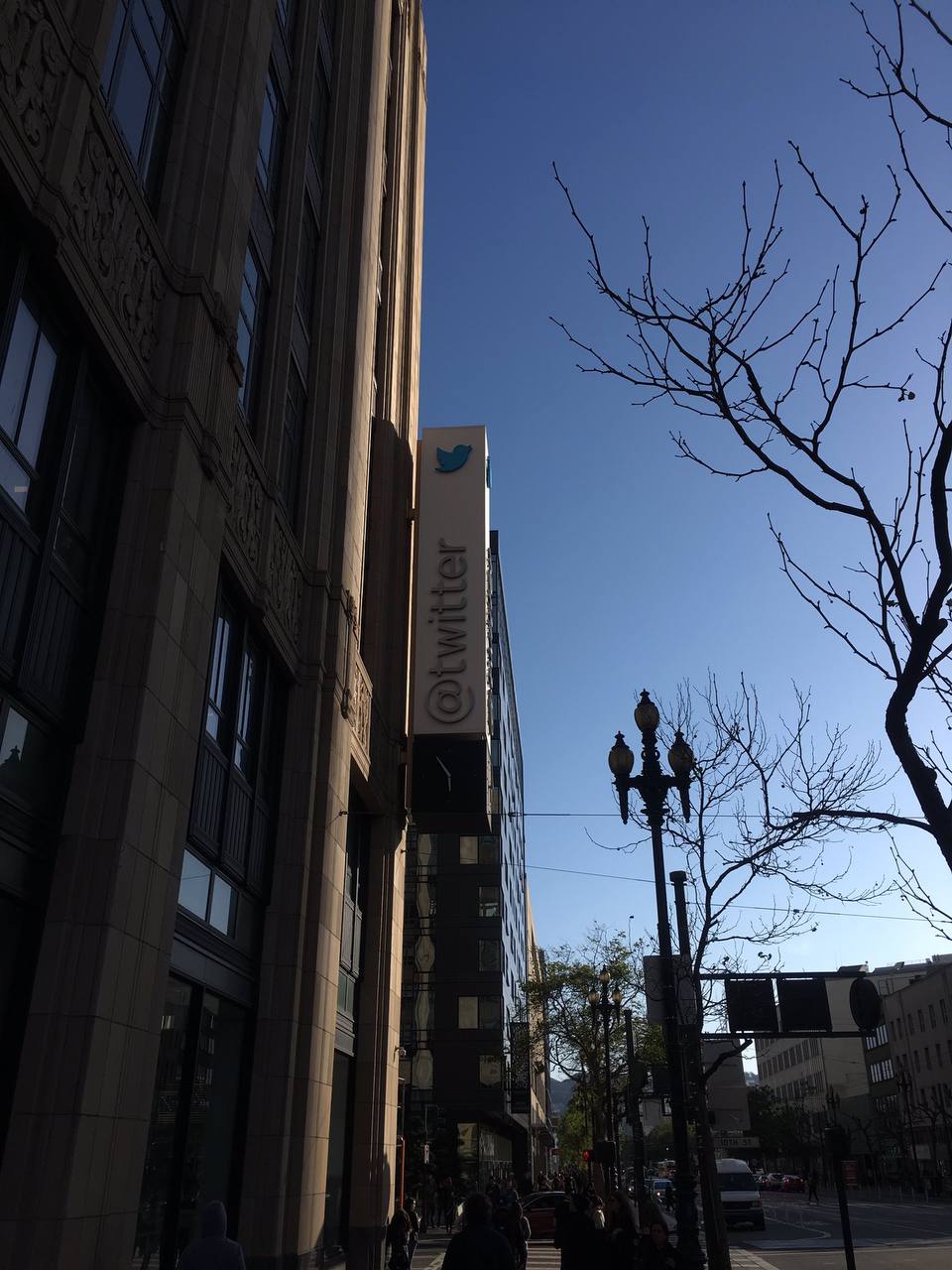
I remember being on a meetup in the Twitter HQ where people were talking about the success of Finagle and eventually presented an idea and some first versions of Linkerd.
It was in 2017 and now Linkerd is a graduated project of CNCF.
Congratulations!
These is an interesting part:
Linkerd is the first service mesh to rise to the level of graduation. But Linkerd has a long history of firsts: Linkerd was the first service mesh project and the one to coin the term itself. It was the first project to enter the CNCF’s inception (now sandbox) phase. It was the first CNCF project to adopt Rust
P.S. A nostalgic photo from the Twitter HQ
#networking
It was in 2017 and now Linkerd is a graduated project of CNCF.
Congratulations!
These is an interesting part:
Linkerd is the first service mesh to rise to the level of graduation. But Linkerd has a long history of firsts: Linkerd was the first service mesh project and the one to coin the term itself. It was the first project to enter the CNCF’s inception (now sandbox) phase. It was the first CNCF project to adopt Rust
P.S. A nostalgic photo from the Twitter HQ
#networking
Would be nice to get this for mobile devices as well.Anyways, this is a great feature and a huge step forward!
https://twitter.com/github/status/1425505817827151872?s=28
https://twitter.com/github/status/1425505817827151872?s=28
Twitter
GitHub
🤫 New shortcut: Press . on any GitHub repo.
Welcome the new ultimate versioning convention for modern projects - 0ver!
.
.
.
.
.
.
P.S. This is a satire post. You should not do that!
.
.
.
.
.
.
P.S. This is a satire post. You should not do that!
0ver.org
ZeroVer: 0-based Versioning — zer0ver
Software's most popular versioning scheme!
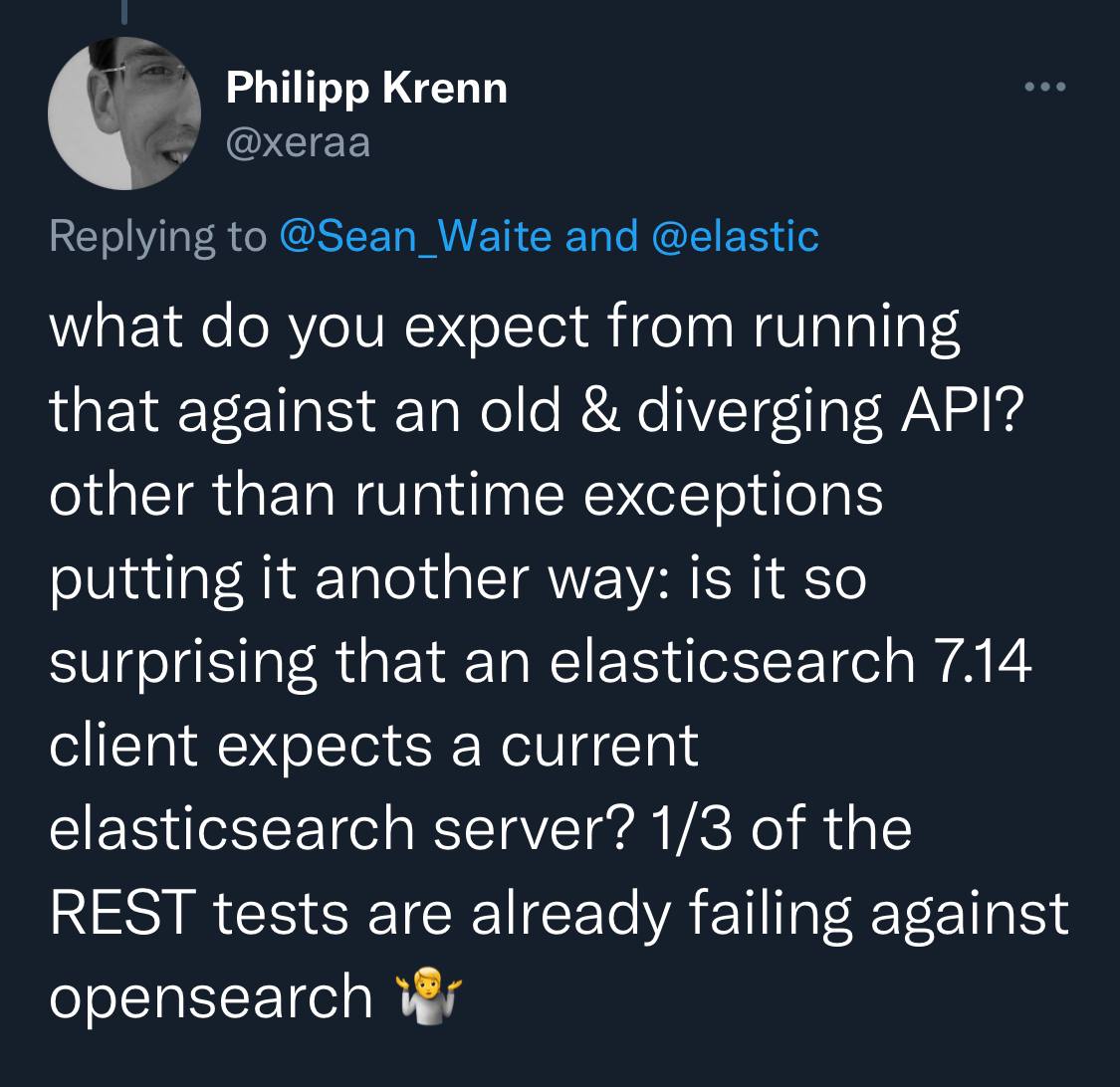
Ok, the headline is a bit clickbait, but the truth is that you have to use Elastic 7.14 in order to upgrade your client libraries. You will get an error otherwise.
On one hand, the recent change in Elastic clients do break compatibility with the older APIs and it generates some righteous anger. On another hand, supporting backward compatibility is hard. You have to make breaking changes sometimes.
In the current situation, it's especially important to understand that OpenSearch and ElasticSearch are different products now. You can keep compatibility between them for some time (this was a promise from AWS, not Elastic, actually) but it's obvious that two products diverge eventually. And Elastic is not obliged to keep their products compatible with whatsoever AWS has.
Although, Elastic did this change as per the minor version update, which kinda violates semVer principles. However, it seems to me that no one cares about the semVer principles these days (see the previous post).
#elasticsearch #aws
On one hand, the recent change in Elastic clients do break compatibility with the older APIs and it generates some righteous anger. On another hand, supporting backward compatibility is hard. You have to make breaking changes sometimes.
In the current situation, it's especially important to understand that OpenSearch and ElasticSearch are different products now. You can keep compatibility between them for some time (this was a promise from AWS, not Elastic, actually) but it's obvious that two products diverge eventually. And Elastic is not obliged to keep their products compatible with whatsoever AWS has.
Although, Elastic did this change as per the minor version update, which kinda violates semVer principles. However, it seems to me that no one cares about the semVer principles these days (see the previous post).
#elasticsearch #aws
Getting back to the AWS architecture diagram from yesterday.
First of all, that was a joking post. If such an infrastructure works for them, that's OK.
The diagram is from this article, where they suggest 3 tips for working with Kinesis streams. So, if you're running Kinesis in your production systems as well, this article might be interesting for you too.
Also, they describe why did they move to such a serverless infrastructure in a series of short posts:
- An overview
- Testing and CI/CD
- Operations
There are actually more useful links for Lambda users inside those articles.
Enjoy!
#aws #serverless
First of all, that was a joking post. If such an infrastructure works for them, that's OK.
The diagram is from this article, where they suggest 3 tips for working with Kinesis streams. So, if you're running Kinesis in your production systems as well, this article might be interesting for you too.
Also, they describe why did they move to such a serverless infrastructure in a series of short posts:
- An overview
- Testing and CI/CD
- Operations
There are actually more useful links for Lambda users inside those articles.
Enjoy!
#aws #serverless
theburningmonk.com
AWS Lambda —3 pro tips for working with Kinesis streams
Learn to build production-ready serverless applications on AWS
An article about what qualities should one have to be a success part of a platform team. More precisely, which qualities should one have in that particular company.
It's a bit annoying, because this is yet another story about all-in-one engineer. However, it's even more annoying because this is particularly true.
So, a good platform engineer should:
- Handle the product management
- Be good in tech and be able to debug non-trivial things
- Sale their ideas to the rest of organization
- Build good UX
- Write decent documentation
Also, this article makes an interesting point about a purpose of the platform team. According to it, the platform team should be a "knowledge bus" inside the company. So, an organization can make sure that the knowledge it generates is not only preserved, but also shared inside the company in sustainable way.
#culture
It's a bit annoying, because this is yet another story about all-in-one engineer. However, it's even more annoying because this is particularly true.
So, a good platform engineer should:
- Handle the product management
- Be good in tech and be able to debug non-trivial things
- Sale their ideas to the rest of organization
- Build good UX
- Write decent documentation
Also, this article makes an interesting point about a purpose of the platform team. According to it, the platform team should be a "knowledge bus" inside the company. So, an organization can make sure that the knowledge it generates is not only preserved, but also shared inside the company in sustainable way.
#culture
Medium
The Platform Engineer
What does it take to run a successful platform team and what roles do platform engineers need to play?
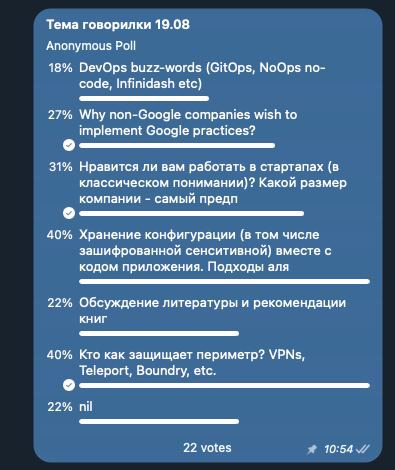
Approximately twice a month we organize a voice chat here in CatOps.
Today is one of such occasions. And today we are going to talk about secret management and how to defent the perimiter, and probably some other toipics as well.
You can join the voice chat via this link:
https://t.iss.one/catops_chat?voicechat
Voice chat is in Ukrainian/Russian
Today is one of such occasions. And today we are going to talk about secret management and how to defent the perimiter, and probably some other toipics as well.
You can join the voice chat via this link:
https://t.iss.one/catops_chat?voicechat
Voice chat is in Ukrainian/Russian
When one admin makes voice chats online, another - makes voice chats offline
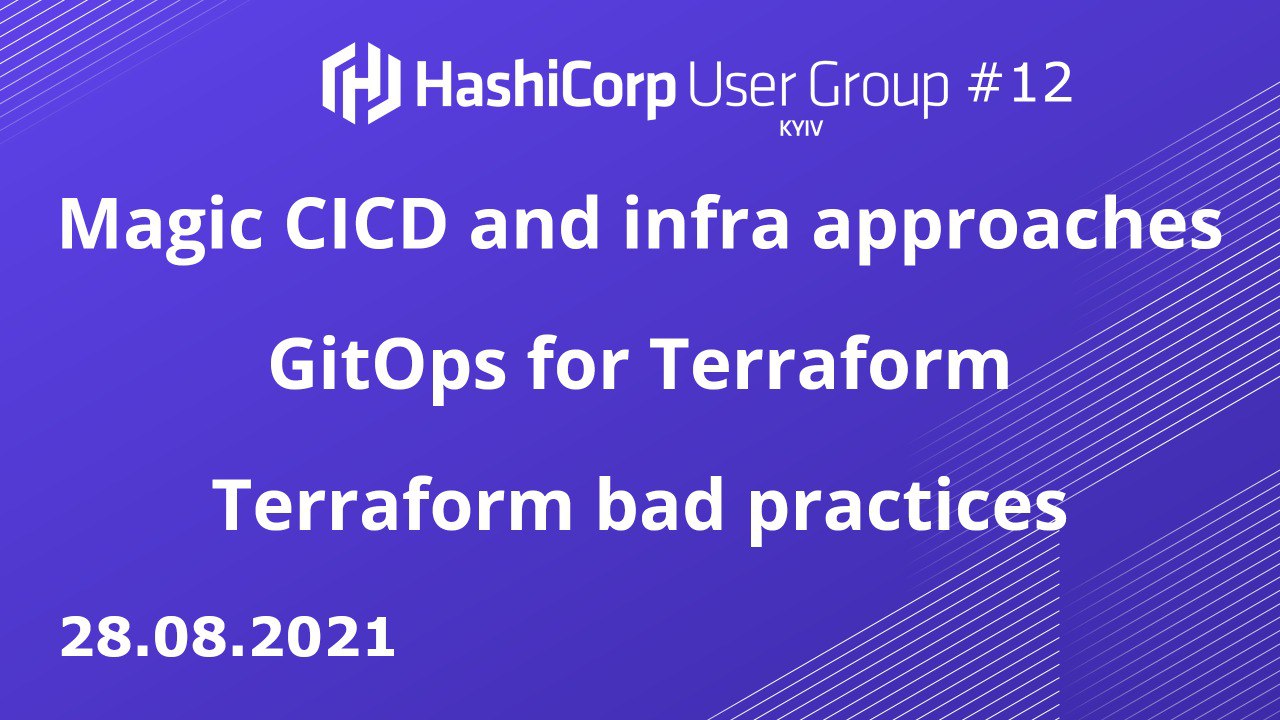
HUG Kyiv #12: CICD, GitOps, Terraform!
What:
- The Magic of CICD approaches and infrastructure building
- GitOps strategies for Terraform
- Terraform bad practices. What I've learned from 2 years working that way.
Who:
- Oleg Chulanov @ Diebold Nixdorf
- Igor Rodionov @ CloudPosse
- Konstantin Lazarenko @ Star
When: Saturday 28th August, 18:00 (Kyiv TZ)
Where: Officially it's Kyiv, details in meetup. + Online
Languages: Russian, Ukrainian
Please, register here
#event
HUG Kyiv #12: CICD, GitOps, Terraform!
What:
- The Magic of CICD approaches and infrastructure building
- GitOps strategies for Terraform
- Terraform bad practices. What I've learned from 2 years working that way.
Who:
- Oleg Chulanov @ Diebold Nixdorf
- Igor Rodionov @ CloudPosse
- Konstantin Lazarenko @ Star
When: Saturday 28th August, 18:00 (Kyiv TZ)
Where: Officially it's Kyiv, details in meetup. + Online
Languages: Russian, Ukrainian
Please, register here
#event
Not long ago, I wrote about the rise of Kubernetes distributions. So, take a few more:
* Airship - a tool for creating platforms based on Kubernetes, which is backed by some big tech.
* KubeZero - opinionated zero downtime Kubernetes platform
* Cluster.dev - and of course an opinionated Kubernetes cluster setup tool by SHALB
Hope, you can find something useful for you. Or you can build your own opinionated setup tooling, of course.
Because people need platforms, not clusters!
#kubernetes
* Airship - a tool for creating platforms based on Kubernetes, which is backed by some big tech.
* KubeZero - opinionated zero downtime Kubernetes platform
* Cluster.dev - and of course an opinionated Kubernetes cluster setup tool by SHALB
Hope, you can find something useful for you. Or you can build your own opinionated setup tooling, of course.
Because people need platforms, not clusters!
#kubernetes
www.airshipit.org
Airship: Automated clusters Deployment for Open Source Infrastructure
Airship is a collection of loosely coupled but interoperable open source tools that declaratively automate cloud provisioning.
All of us read a lot these days. Documentation, articles, books, how-tos, even the CatOps posts. We need to consume and prcess enormous amounts of information in order to just stay afloat.
So, is there a way to make it better? How can one keep up with the flow?
How to Remember What You Read provides some practical advices on how to improve the quality of the reading process as well as… well, remember what you read.
Although, it’s not at all a technical article, this content may be beneficial for everyone, who’s going through the piles of tech literature. I would even argue that that tese advices might be more valuable in this case. Since, professional literature is usually more data dence than fiction.
If you want to see just a brief summary of this article, let it be this. Quote:
But if you only remember six things after reading this article, it should be the following truths about reading:
1. Quality matters more than quantity. If you read one book a month but fully appreciate and absorb it, you’ll be better off than someone who skims half the library without paying attention.
2. Speed-reading is bullshit. Getting the rough gist and absorbing the lessons are two different things. Confuse them at your peril.
3. Book summary services miss the point. A lot of companies charge ridiculous prices for access to vague summaries bearing only the faintest resemblance to anything in the book. Summaries can be a useful jumping-off point to explore your curiosity, but you cannot learn from them the way you can from the original text.
4. Fancy apps and tools are not needed. A notebook, index cards, and a pen will do just fine.
5. We shouldn’t read stuff we find boring. Life is far too short.
6. Finishing the book is optional. You should start a lot of books and only finish a few of them.
#books #culture
So, is there a way to make it better? How can one keep up with the flow?
How to Remember What You Read provides some practical advices on how to improve the quality of the reading process as well as… well, remember what you read.
Although, it’s not at all a technical article, this content may be beneficial for everyone, who’s going through the piles of tech literature. I would even argue that that tese advices might be more valuable in this case. Since, professional literature is usually more data dence than fiction.
If you want to see just a brief summary of this article, let it be this. Quote:
But if you only remember six things after reading this article, it should be the following truths about reading:
1. Quality matters more than quantity. If you read one book a month but fully appreciate and absorb it, you’ll be better off than someone who skims half the library without paying attention.
2. Speed-reading is bullshit. Getting the rough gist and absorbing the lessons are two different things. Confuse them at your peril.
3. Book summary services miss the point. A lot of companies charge ridiculous prices for access to vague summaries bearing only the faintest resemblance to anything in the book. Summaries can be a useful jumping-off point to explore your curiosity, but you cannot learn from them the way you can from the original text.
4. Fancy apps and tools are not needed. A notebook, index cards, and a pen will do just fine.
5. We shouldn’t read stuff we find boring. Life is far too short.
6. Finishing the book is optional. You should start a lot of books and only finish a few of them.
#books #culture
Farnam Street
How to Remember What You Read
The benefits of reading are negated if you forget remember what you read. This article discusses a tested system to increase retention. Learn how to use active reading to remember more from books.
Humble Bundle has a new portion of O'Reilly's Linux books
As usual, you can pay €1, ~€9, or ~€15 to unlock books about useful Linux utilities and other related stuff. The bundle is valid till the 12th of September. It includes:
- Bash Cookbook
- Linux Observability with BPF
- Mastering Regular Expressions
- Effective awk Programming
- Linux Pocket Guide
- Cybersecurity Ops with bash
- Learning the Bash Shell
- Learning the vi and Vim Editors
- Linux in a Nutshell
- sed & awk
- Linux System Programming
- Classic Shell Scripting
- Linux Device Drivers
- Introducing Regular Expressions
- grep Pocket Reference
- Unix Power Tools
#books
As usual, you can pay €1, ~€9, or ~€15 to unlock books about useful Linux utilities and other related stuff. The bundle is valid till the 12th of September. It includes:
- Bash Cookbook
- Linux Observability with BPF
- Mastering Regular Expressions
- Effective awk Programming
- Linux Pocket Guide
- Cybersecurity Ops with bash
- Learning the Bash Shell
- Learning the vi and Vim Editors
- Linux in a Nutshell
- sed & awk
- Linux System Programming
- Classic Shell Scripting
- Linux Device Drivers
- Introducing Regular Expressions
- grep Pocket Reference
- Unix Power Tools
#books
Humble Bundle
Humble Book Bundle: Unix & Linux by O'Reilly
O’Reilly wants to make you a Unix and Linux wizard, with books like bash Cookbook & Linux Observability with BPF. Pay what you want & support charity!
Continuing the topic of Linux utilities, here is a good guide about
In nutshell,
#toolz
xargs utility.In nutshell,
xargs allows you to work with outputs provided by another program. So, you can think of many applications of it. My favorite one is that xargs has a -P flag, which allows you to parallel processing of the outputs. So, it can be more optimal than running a for loop in some occasions.#toolz
HUG Kyiv #12: CICD, GitOps, Terraform tommorow!
Program:
- Oleg Chulanov: The Magic of CICD approaches and infrastructure building rus
- Igor Rodionov: GitOps strategies for Terraform rus
- Konstantin Lazarenko: Terraform bad practices. What I've learned from 2 years working that way. ukr
Will be 28th August, 18:00 (Kyiv TZ) in Kyiv and YouTube
#event
Program:
- Oleg Chulanov: The Magic of CICD approaches and infrastructure building rus
- Igor Rodionov: GitOps strategies for Terraform rus
- Konstantin Lazarenko: Terraform bad practices. What I've learned from 2 years working that way. ukr
Will be 28th August, 18:00 (Kyiv TZ) in Kyiv and YouTube
#event
CNCF is creating a new working group around "Cooperative Delivery".
Here is a part of the problem statement this group is trying to address:
In most app-delivery scenarios, the packaging format and delivery mechanism of the application artifacts are targeted, but not necessarily the app's infrastructure dependencies such as data stores and message queues. That is, application and infrastructure delivery are not coordinated. Often, applications are heavily dependent on infrastructure resources that are not directly linked to a specific deployment, and therefore problems with non-existing infrastructure resources might cause deployments to fail. In addition to this, the application and infrastructure lifecycles are not synchronized, creating additional complexity and challenges when delivering workloads.
The goal of this group is not to provide a definitive solution, rather gather the information in the industry on how people are doing "cooperative delivery". Which trends are there. Are there any emerging approaches, etc.
It'll be very interesting to see their findings. Struggles with application bundling is something I encounter personally and I believe a lot of other engineers do.
#culture #cncf
Here is a part of the problem statement this group is trying to address:
In most app-delivery scenarios, the packaging format and delivery mechanism of the application artifacts are targeted, but not necessarily the app's infrastructure dependencies such as data stores and message queues. That is, application and infrastructure delivery are not coordinated. Often, applications are heavily dependent on infrastructure resources that are not directly linked to a specific deployment, and therefore problems with non-existing infrastructure resources might cause deployments to fail. In addition to this, the application and infrastructure lifecycles are not synchronized, creating additional complexity and challenges when delivering workloads.
The goal of this group is not to provide a definitive solution, rather gather the information in the industry on how people are doing "cooperative delivery". Which trends are there. Are there any emerging approaches, etc.
It'll be very interesting to see their findings. Struggles with application bundling is something I encounter personally and I believe a lot of other engineers do.
#culture #cncf
Google Docs
Cooperative Delivery WG - Charter
Cooperative Delivery WG - Charter Cooperative Delivery WG - Charter Interested Parties Problem Statement What combinations of tooling are available out there that aim to resolve this problem, and what are the gaps encountered? Examples of known patterns…
A blog post by Charity Majors about why you should ask Ops questions when interviewing software engineers.
In short, we all are responsible for the stability of our systems as well as encouraging good practices of deploying, releasing, observing software, etc. Therefore, it's not enough to just have an SRE team and push that burden on them. Reliability and operations should be a concern for any team within a company.
Quote:
Our industry has gotten very good at pressing operations engineers to get better at writing code, writing tests, and software engineering in general these past few years. Which is great! But we have not been nearly so good at pushing software engineers to level up their systems skills. Which is unfortunate, because it is just as important.
#culture
In short, we all are responsible for the stability of our systems as well as encouraging good practices of deploying, releasing, observing software, etc. Therefore, it's not enough to just have an SRE team and push that burden on them. Reliability and operations should be a concern for any team within a company.
Quote:
Our industry has gotten very good at pressing operations engineers to get better at writing code, writing tests, and software engineering in general these past few years. Which is great! But we have not been nearly so good at pushing software engineers to level up their systems skills. Which is unfortunate, because it is just as important.
#culture
charity.wtf
Why every software engineering interview should include ops questions
I’ve fallen way behind on my blog posts — my goal was to write one per month, and I haven’t published anything since MAY. Egads. So here I am dipping into the drafts archives! Thi…
An opinionated list of the books on distributed systems and system design.
Many of those books are well-known, but a few of them were new to me. So, I hope you can find something interesting for you there as well!
#books
Many of those books are well-known, but a few of them were new to me. So, I hope you can find something interesting for you there as well!
#books
Best Books Hub
20 Best Books on Distributed Systems (2022 Review) - Best Books Hub
List of best distributed system books review. Discover the good distributed system books for elementary, intermediate and advanced readers.
Ok. That's interesting.
Docker is updating their pricing model once again and here is the interesting part:
At Docker we remain committed to continuing to provide an easy-to-use, free experience for individual developers, open source projects, education, and small businesses. In fact, altogether these communities represent more than half of all Docker usage. Docker Personal and all its components – including Docker CLI, Docker Compose, Kubernetes, Docker Desktop, Docker Build/BuildKit, Docker Hub, Docker Official Images, and more – *remain free for these communities*.
Specifically, small businesses (fewer than 250 employees AND less than $10 million in revenue) may continue to use Docker Desktop with Docker Personal for free. The use of Docker Desktop in large businesses, however, requires a *Pro*, *Team*, or *Business* paid subscription, starting at $5 per user per month.
I'm still not 100%, but it sounds like you won't be able to use Docker Desktop on you corporate laptop starting from 31st January 2022 if your company is "big enough".
Here's a Twitter thread by Corey Quinn on this issue.
#docker
Docker is updating their pricing model once again and here is the interesting part:
At Docker we remain committed to continuing to provide an easy-to-use, free experience for individual developers, open source projects, education, and small businesses. In fact, altogether these communities represent more than half of all Docker usage. Docker Personal and all its components – including Docker CLI, Docker Compose, Kubernetes, Docker Desktop, Docker Build/BuildKit, Docker Hub, Docker Official Images, and more – *remain free for these communities*.
Specifically, small businesses (fewer than 250 employees AND less than $10 million in revenue) may continue to use Docker Desktop with Docker Personal for free. The use of Docker Desktop in large businesses, however, requires a *Pro*, *Team*, or *Business* paid subscription, starting at $5 per user per month.
I'm still not 100%, but it sounds like you won't be able to use Docker Desktop on you corporate laptop starting from 31st January 2022 if your company is "big enough".
Here's a Twitter thread by Corey Quinn on this issue.
#docker
Docker
Announcing Upgraded Docker Plans: Simpler, More Value, Better Development and Productivity | Docker
Docker announces significant upgrades to its subscription plans, delivering more value, flexibility, and tools for customers of all sizes.
There might be a few engineering managers on this channel.
So, here is an awesome engineering management list.
However, it also contains some things that might be interesting for engineers like risk management, capacity planning as well as the list of calendar software, time trackers, etc.
#management
So, here is an awesome engineering management list.
However, it also contains some things that might be interesting for engineers like risk management, capacity planning as well as the list of calendar software, time trackers, etc.
#management
GitHub
GitHub - engineering-management/awesome-engineering-management: Pointers and tools for learning and day-to-day practice of engineering…
Pointers and tools for learning and day-to-day practice of engineering management & leadership. - GitHub - engineering-management/awesome-engineering-management: Pointers and tools for lear...
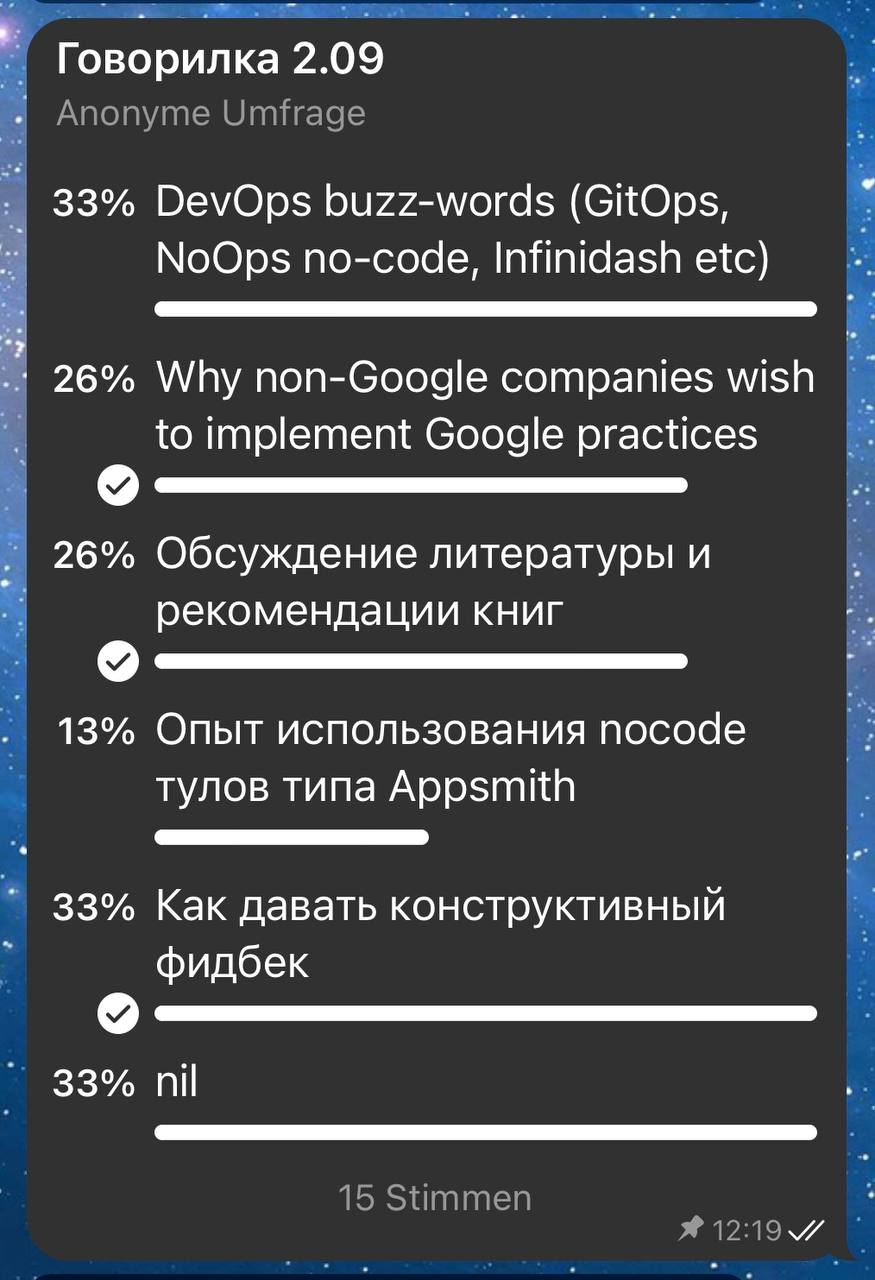
Today at 17:00 UTC we are going to have our usual voice chat (in Ukrainian and Russian) to discuss the topics, you've proposed and voted for in the chat, which follows the DevOps Days Open Spaces format.
Today we are going to talk about "DevOps buzz-words" and how to provide meaningful feedback to your peers.
As usual. We will start from these topics and then if the discussion drifts, it drifts.
You can join the voice chat via this link:
https://t.iss.one/catops_chat?voicechat
Hear you there!
UPD: Voice charts are in Ukrainian or Russian language
#event
Today we are going to talk about "DevOps buzz-words" and how to provide meaningful feedback to your peers.
As usual. We will start from these topics and then if the discussion drifts, it drifts.
You can join the voice chat via this link:
https://t.iss.one/catops_chat?voicechat
Hear you there!
UPD: Voice charts are in Ukrainian or Russian language
#event