
And back to IaC.
Pulumi has presented an Automation API - a generic way to programmatically trigger Pulumi execution.
This API should ease for platform teams the development of self-service developers' portals.
The article contains examples of the Automation API usage as a WebUI, CLI, CI/CD systems' plugin, and even Jupiter notebook.
#iac #pulumi
Pulumi has presented an Automation API - a generic way to programmatically trigger Pulumi execution.
This API should ease for platform teams the development of self-service developers' portals.
The article contains examples of the Automation API usage as a WebUI, CLI, CI/CD systems' plugin, and even Jupiter notebook.
#iac #pulumi
pulumi
Build your perfect interface for the cloud: Automation API
Automation API brings the Pulumi modern IaC engine to any application
Default Tags in the Terraform AWS Provider
Finally!
Required AWS Provider >= v3.38.0, TF >= 0.12.
#aws #terraform
Finally!
Required AWS Provider >= v3.38.0, TF >= 0.12.
#aws #terraform
Why sharing a single article if you can share the whole magazine?
Increment is an online and printed magazine about software and technologies, which is published in a good-old format of monthly issues.
Each issue has its own topic and the 16th dated February 2021 is dedicated to the topic of Reliability!
Enjoy more than 10 articles on reliability, chaos engineering, etc. as well as case studies from various companies. Also, you can buy a printed magazine version if you want.
Increment has already covered topics like On-call, Remote work, Cloud, etc. Honestly, this is the best publishing finding for me this year. I'll definitely dig into it and probably even order a printed version as well!
#reliability
Increment is an online and printed magazine about software and technologies, which is published in a good-old format of monthly issues.
Each issue has its own topic and the 16th dated February 2021 is dedicated to the topic of Reliability!
Enjoy more than 10 articles on reliability, chaos engineering, etc. as well as case studies from various companies. Also, you can buy a printed magazine version if you want.
Increment has already covered topics like On-call, Remote work, Cloud, etc. Honestly, this is the best publishing finding for me this year. I'll definitely dig into it and probably even order a printed version as well!
#reliability
Increment
Increment: Planning
This issue examines the ever-evolving practices of software planning—and how we can craft plans that enrich communication, alignment, and impact on engineering teams.
From our subscriber.
How developers can be their own operations department is a story of DevOps evolution in a single company.
This article doesn't provide any answers on how you should run your operations or organize your teams. However, it gives some historical context. The story of Flipp company is very similar to what happened with the industry as a whole.
If you want to get an insight on how DevOps movement emerged and why it has become so popular - you're welcome to read this one.
P.S. You can propose an article in via chat
#culture #devops
How developers can be their own operations department is a story of DevOps evolution in a single company.
This article doesn't provide any answers on how you should run your operations or organize your teams. However, it gives some historical context. The story of Flipp company is very similar to what happened with the industry as a whole.
If you want to get an insight on how DevOps movement emerged and why it has become so popular - you're welcome to read this one.
P.S. You can propose an article in via chat
#culture #devops
Stack Overflow Blog
How developers can be their own operations department
Many companies run parallel development and operations organizations. But what if you just ran one team that did both?
Job offer negotiations as well as compensation ranges themselves are always hot topics for discussions not only in software development.
Needless to say that the skills to negotiate are important and help you to get a better deal (sometimes even without changing a company).
Today in the CatOps Chat we are going to talk about compensation and salary negotiations in general. Voice chat starts today at 17:00 UTC in the group chat. Important thing to mention: the conversation is usually in Russian or Ukrainian, or (more frequently) both.
And it's not all yet. Here is an article to prepare yourself for such a discussion. It was sitting in my reading list for a few months now, but it looks like today the time to read it has come eventually. I'm happy to share these articles with you as well!
- Ten Rules for Negotiating a Job Offer. (Part I)
- How Not to Bomb Your Offer Negotiation. (Part II)
Enjoy and auf wiederhören!
#culture #jobs
Needless to say that the skills to negotiate are important and help you to get a better deal (sometimes even without changing a company).
Today in the CatOps Chat we are going to talk about compensation and salary negotiations in general. Voice chat starts today at 17:00 UTC in the group chat. Important thing to mention: the conversation is usually in Russian or Ukrainian, or (more frequently) both.
And it's not all yet. Here is an article to prepare yourself for such a discussion. It was sitting in my reading list for a few months now, but it looks like today the time to read it has come eventually. I'm happy to share these articles with you as well!
- Ten Rules for Negotiating a Job Offer. (Part I)
- How Not to Bomb Your Offer Negotiation. (Part II)
Enjoy and auf wiederhören!
#culture #jobs
Telegram
CatOps Chat
Chat of the @catops channel
QUIC - a planned successor of TCP - is now formalized as RFC 9000.
QUIC was initially developed at Google, but later adopted by IETF. It provides some TCP-like features on top of UDP in order to overcome latency and packet loss, especially in the last mile.
HTTP/3, which is built on top of QUIC is not formalized yet, but it's following closely behind. So, it will be likely released soon as well.
So, with HTTP/3 around the corner, have you already switched to HTTP/2?
#networking #quic
QUIC was initially developed at Google, but later adopted by IETF. It provides some TCP-like features on top of UDP in order to overcome latency and packet loss, especially in the last mile.
HTTP/3, which is built on top of QUIC is not formalized yet, but it's following closely behind. So, it will be likely released soon as well.
So, with HTTP/3 around the corner, have you already switched to HTTP/2?
#networking #quic
Fastly
QUIC is now RFC 9000 | Fastly
QUIC version 1 is officially formalized, and QUIC deployments will now move away from using temporary draft versions to the newly minted version 1.
Gatus is a health dashboard written in Go.
It has minimalistic configuration and allows you to set multiple conditions to label an endpoint as "healthy".
Also, you can host it on your own inside your private network. So, if you have security requirements of not to allow external health checkers into the perimeter, this could be a good way to go.
#toolz #observability
It has minimalistic configuration and allows you to set multiple conditions to label an endpoint as "healthy".
Also, you can host it on your own inside your private network. So, if you have security requirements of not to allow external health checkers into the perimeter, this could be a good way to go.
#toolz #observability
GitHub
GitHub - TwiN/gatus: ⛑ Automated developer-oriented status page
⛑ Automated developer-oriented status page. Contribute to TwiN/gatus development by creating an account on GitHub.
Introducing Argo Rollouts v1.0
Now, for those, who's not familiar with Argo universe, there are Argo, ArgoCD, and Argo Rollouts. All these tools are developed under the same umbrella and are complimentary to each other, but they are not the same thing.
Argo Rollouts manages iterative deployments aka progressive delivery aka canary releases. However, progressive delivery is a broader term. Basically, you roll out your application gradually in an automated way based on the health metrics.
Currently, Argo Rollouts supports such metrics providers as: Prometheus, Wavefront, DataDog, NewRelic, Kayenta, custom Kubernetes Job, and custom Web check. And it supports various traffic controllers like: Linkerd, Istio, AWS LoadBalancer, Ambassador, and Nginx.
So, what's new in version 1.0?
- New Argo Rollouts UI
- Ability to reference existing Deployment workloads instead of inlining a PodTemplate at spec.template
- Richer Prometheus stats and Kubernetes events
- Support for Ambassador as a canary traffic router
- Support canarying using Istio DestinationRule subsets
You can read the full changelog in the GitHub release description.
Also, they have a roadmap, so you can check, what's coming next
#cicd #kubernetes #argo
Now, for those, who's not familiar with Argo universe, there are Argo, ArgoCD, and Argo Rollouts. All these tools are developed under the same umbrella and are complimentary to each other, but they are not the same thing.
Argo Rollouts manages iterative deployments aka progressive delivery aka canary releases. However, progressive delivery is a broader term. Basically, you roll out your application gradually in an automated way based on the health metrics.
Currently, Argo Rollouts supports such metrics providers as: Prometheus, Wavefront, DataDog, NewRelic, Kayenta, custom Kubernetes Job, and custom Web check. And it supports various traffic controllers like: Linkerd, Istio, AWS LoadBalancer, Ambassador, and Nginx.
So, what's new in version 1.0?
- New Argo Rollouts UI
- Ability to reference existing Deployment workloads instead of inlining a PodTemplate at spec.template
- Richer Prometheus stats and Kubernetes events
- Support for Ambassador as a canary traffic router
- Support canarying using Istio DestinationRule subsets
You can read the full changelog in the GitHub release description.
Also, they have a roadmap, so you can check, what's coming next
#cicd #kubernetes #argo
Medium
Introducing Argo Rollouts v1.0
Progressive Delivery done right!
Consul Service Mesh for Amazon ECS is now in the Tech Preview.
This means that you can deploy Consul Service Mesh on Fargate type ECS using official Terraform modules. However, only setups for Dev are supported right now, i.e. the official module deploys only a single dev/testing Consul task for now. This will be changed before Consul Service Mesh for AWS ECS hits GA.
#consul #hashicorp #aws #networking
This means that you can deploy Consul Service Mesh on Fargate type ECS using official Terraform modules. However, only setups for Dev are supported right now, i.e. the official module deploys only a single dev/testing Consul task for now. This will be changed before Consul Service Mesh for AWS ECS hits GA.
#consul #hashicorp #aws #networking
HashiCorp
Announcing Tech Preview of Consul Service Mesh for Amazon ECS
AWS users may now select Consul as their service mesh for ECS deployments.

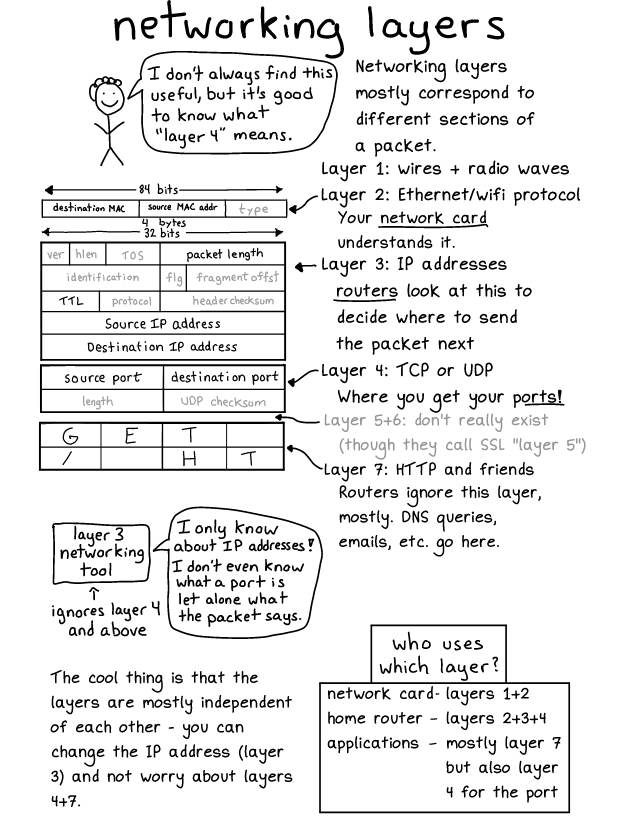
A short article by Julia Evans about why OSI model doesn't map to TCP/IP really well. And why sometimes it's just easier to say things like "TCP load balancer" or "Ethernet switch" rather than "later 4", "layer 2", etc.
tl;dr: primarily, because OSI is old.
Also, there is a diagram of your usual network packet as a bonus.
tl;dr: primarily, because OSI is old.
Also, there is a diagram of your usual network packet as a bonus.
Some time ago we had some weird network timeouts in our Kubernetes clusters. It was also pretty strange that not all service owners reported timeouts and according to the monitoring graphs, these issues usually happened during the day.
A colleague of mine dig into this problem and, well, found a bug in AWS. He described the process of his debug in this article, which steps he took and in what sequence, as well as some tools he used to debug this.
Happy reading!
#kubernetes #aws
A colleague of mine dig into this problem and, well, found a bug in AWS. He described the process of his debug in this article, which steps he took and in what sequence, as well as some tools he used to debug this.
Happy reading!
#kubernetes #aws
N26
N26 engineering team solves Kubernetes challenge
N26's site reliability engineers face exciting challenges each day. Read on to learn about their recent Kubernetes success story.
The Serverless Rules are a compilation of rules to validate infrastructure as code templates for AWS against recommended practices.
They are available as
#aws #serverless
They are available as
cfn-lint or tflint plugins. So, you can check your CloudFormation or Terraform code against them.#aws #serverless
GitHub
GitHub - awslabs/serverless-rules: Compilation of rules to validate infrastructure-as-code templates against recommended practices…
Compilation of rules to validate infrastructure-as-code templates against recommended practices for serverless applications. - awslabs/serverless-rules
I like it when articles on the Web start discussions. Although, sometimes such articles are just click bait, but you can figure it out based discussions they ignite.
Steve Smith wrote an article called "GitOps is a placebo", where he argues that GitOps haven't bought anything new to the table, because all its core concepts already existed in form of Continuous Delivery and Infrastructure as Code.
And here is the reply to this article by Carlos Sanchez in the form of a Twitter thread.
Feel free to share your own thoughts on GitOps in our chat
#cicd #iac #gitops
Steve Smith wrote an article called "GitOps is a placebo", where he argues that GitOps haven't bought anything new to the table, because all its core concepts already existed in form of Continuous Delivery and Infrastructure as Code.
And here is the reply to this article by Carlos Sanchez in the form of a Twitter thread.
Feel free to share your own thoughts on GitOps in our chat
#cicd #iac #gitops
Twitter
Carlos Sanchez
"GitOps is a placebo" Interesting take but let me disagree with some points, a 🧵 twitter.com/SteveSmith_Tec…
Forwarded from Roman Siewko
Identified - The issue has been identified and a fix is being implemented.
Jun 8, 10:44 UTChttps://status.fastly.com/
So, first big announcements from HashiConf Europe, which is happening right now.
Terraform goes 1.0 at last!!
People were expecting this release for a long time. Also, it seems like there gonna be less jokes about Terraform's production readiness from now on.
#hashicorp #terraform
Terraform goes 1.0 at last!!
People were expecting this release for a long time. Also, it seems like there gonna be less jokes about Terraform's production readiness from now on.
#hashicorp #terraform
Fastly has published a report of yesterday's incident
Not much there, to be honest. In the mid May they introduced a bug, which could be triggered by a specific configuration which is valid on its own.
And yesterday, on the 8th of June, someone submitted such configuration eventually.
These are basically all the details they reveal. The good part is that the whole incident lasted for just 49 minutes. And full downtime was much shorter.
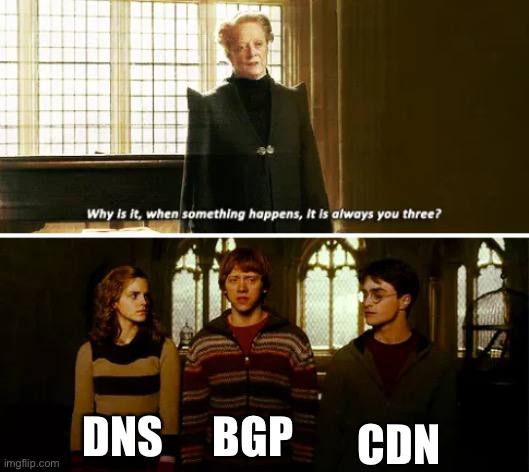
So, it's seems like the Internet has got its 3rd problem.
Not much there, to be honest. In the mid May they introduced a bug, which could be triggered by a specific configuration which is valid on its own.
And yesterday, on the 8th of June, someone submitted such configuration eventually.
These are basically all the details they reveal. The good part is that the whole incident lasted for just 49 minutes. And full downtime was much shorter.
So, it's seems like the Internet has got its 3rd problem.
You can use multi-line RUN commands in Dockerfiles now.
It's not like you couldn't, it's just became more human readable.
To use this feature, set Dockerfile version to labs channel. Currently this feature is only available in docker/dockerfile-upstream:master-labs image.
#docker
It's not like you couldn't, it's just became more human readable.
To use this feature, set Dockerfile version to labs channel. Currently this feature is only available in docker/dockerfile-upstream:master-labs image.
# syntax=docker/dockerfile-upstream:master-labs


# syntax = docker/dockerfile-upstream:master-labs
FROM debian
RUN <<eot bash
  apt-get update
  apt-get install -y vim
eot
#docker
GitHub
buildkit/frontend/dockerfile/docs/syntax.md at master · moby/buildkit
concurrent, cache-efficient, and Dockerfile-agnostic builder toolkit - moby/buildkit