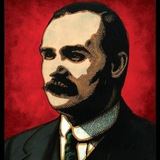
Austen Morgan, author of James Connolly: A Political Biography, describes how Connolly became increasingly more nationalistic and closer to Pearse's views in the final years of his life. This is in contrast to what Ryan described in his book (covered in the last number of posts on the channel) where Pearse leaned more towards Connolly's views. In any case, it is clear that Pearse and Connolly shared very similar outlooks, likely influencing and reinforcing each other's thoughts, and, as we have been pointing out repeatedly, Connolly was as much a nationalist as he was a socialist.
Morgan outlines how Connolly's political life is broken into periods; beginning as more of an international socialist, shifting to syndicalist and finally a fenian nationalist. In the last year's of his life "There were many opportunities to articulate a socialist project, but there is no substantial evidence that he sought to do so."
In one review of Morgan's book, Joe Larragy goes on to say "[Connolly] seriously compromised his socialism to the extent that he subordinated his politics to the propaganda and the conspiracy for revolution", noting that "there is no expression whatever of distinct working-class interests in the proclamation of the Rising."
The Proclamation is often pointed to by those on the Left as an example of a "progressive" document, inferring that certain phrases have a meaning that they obviously do not when the time and circumstances under which it was written are considered.
Morgan outlines how Connolly's political life is broken into periods; beginning as more of an international socialist, shifting to syndicalist and finally a fenian nationalist. In the last year's of his life "There were many opportunities to articulate a socialist project, but there is no substantial evidence that he sought to do so."
In one review of Morgan's book, Joe Larragy goes on to say "[Connolly] seriously compromised his socialism to the extent that he subordinated his politics to the propaganda and the conspiracy for revolution", noting that "there is no expression whatever of distinct working-class interests in the proclamation of the Rising."
The Proclamation is often pointed to by those on the Left as an example of a "progressive" document, inferring that certain phrases have a meaning that they obviously do not when the time and circumstances under which it was written are considered.
"Gaelic culture of the Irish chieftainry was rudely broken off in the seventeenth century, and the continental Schools of European despots implanted in its place in the minds of the Irish students, and sent them back to Ireland to preach a fanatical belief in royal and feudal prerogatives, as foreign to the genius of the Gael as was the English ruler to Irish soil."
#gaelic
#gaelic
"The English slanderer never did as much harm as did these self-constituted delineators of Irish characteristics. The English slanderer lowered Irishmen in the eyes of the world, but his Irish middle-class teachers and writers lowered him in his own eyes by extolling as an Irish virtue every sycophantic vice begotten of generations of slavery."
#slander #slavery
#slander #slavery
"The seventeenth, eighteenth and nineteenth centuries were, indeed, the Via Dolorosa of the Irish race. In them the Irish Gael sank out of sight, and in his place the middle-class politicians, capitalists and ecclesiastics laboured to produce a hybrid Irishman, assimilating a foreign social system, a foreign speech, and a foreign character."
#Gael #foreign
#Gael #foreign
"Fortunately the Irish character has proven too difficult to press into respectable foreign moulds, and the recoil of that character from the deadly embrace of capitalist English conventionalism, as it has already led to a revaluation of the speech of the Gael, will in all probability also lead to a re-study and appreciation of the social system under which the Gael reached the highest point of civilisation and culture in Europe."
#gaelic #civilisation
#gaelic #civilisation
"In the re-conversion of Ireland to the Gaelic principle of common ownership by a people of their sources of food and maintenance, the worst obstacles to overcome will be the opposition of the men and women who have imbibed their ideas of Irish character and history from Anglo-Irish literature. That literature, as we have explained, was born in the worst agonies of the slavery of our race; it bears all the birth-marks of such origin upon it, but irony of ironies, these birth-marks of slavery are hailed by our teachers as ‘the native characteristics of the Celt’."
#celt#gaelic
#celt#gaelic
"the Irishman frees himself from such a mark of slavery when he realises the truth that the capitalist system is the most foreign thing in Ireland."
#slavery #foreign #capitalism
#slavery #foreign #capitalism
All of the above are taken from the Foreword of Labour In Irish History (1910), one of Connolly's most important works. I would encourage everyone to read it in its entirety.
Cartlann
Labour in Irish History
PDF Chapters Author’s Foreword Chapter I: The Lessons of History Chapter II: The Jacobites and the Irish people Chapter III: Peasant Rebellions [...]
"The dispersion of the clans, of course, put an end to the leadership of the chiefs, and in consequence, the Irish aristocracy being all of foreign or traitor origin, Irish patriotic movements fell entirely into the hands of the middle class, and became, for the most part, simply idealised expressions of middle-class interest.
Hence the spokesmen of the middle class, in the Press and on the platform, have consistently sought the emasculation of the Irish National movement, the distortion of Irish history, and, above all, the denial of all relation between the social rights of the Irish toilers and the political rights of the Irish nation. It was hoped and intended by this means to create what is termed 'a real National movement' – i.e. a movement in which each class would recognise the rights of other classes and laying aside their contentions, would unite in a national struggle against the common enemy – England. Needless to say, the only class deceived by such phrases was the working class. When questions of ‘class’ interests are eliminated from public controversy a victory is thereby gained for the possessing, conservative class, whose only hope of security lies in such elimination. Like a fraudulent trustee, the bourgeois dreads nothing so much as an impartial and rigid inquiry into the validity of his title deeds. Hence the bourgeois press and politicians incessantly strive to inflame the working-class mind to fever heat upon questions outside the range of their own class interests."
Hence the spokesmen of the middle class, in the Press and on the platform, have consistently sought the emasculation of the Irish National movement, the distortion of Irish history, and, above all, the denial of all relation between the social rights of the Irish toilers and the political rights of the Irish nation. It was hoped and intended by this means to create what is termed 'a real National movement' – i.e. a movement in which each class would recognise the rights of other classes and laying aside their contentions, would unite in a national struggle against the common enemy – England. Needless to say, the only class deceived by such phrases was the working class. When questions of ‘class’ interests are eliminated from public controversy a victory is thereby gained for the possessing, conservative class, whose only hope of security lies in such elimination. Like a fraudulent trustee, the bourgeois dreads nothing so much as an impartial and rigid inquiry into the validity of his title deeds. Hence the bourgeois press and politicians incessantly strive to inflame the working-class mind to fever heat upon questions outside the range of their own class interests."
"Successful revolutions are not the product of our brains, but of ripe material conditions."