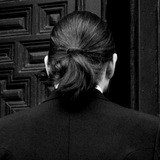
La juventud puede ocultar el mal durante un tiempo, pero a cierta edad, casi todo el mundo tiene la cara que se merece.
ARI·RAM
Photo
Slovenian philosopher Slavoj Zizek (56) and his third (?) wife, Argentinian model, Lacanian Scholar, and psychoanalyst Analia Hounie (26) at their wedding in 2005.
In a 2012 interview with Salon Zizek talks about the wedding:
{Interviewer}: I’ve seen those photos. For someone who describes love as violent and unnecessary, you seem to have pulled off quite the affair. Your wife [Argentinian model Analia Hounie] wore a long white dress and held a bouquet. How traditional!
{Zizek}: Yes, but did you notice something? If you look at the photos, you can see that I am not happy. Even my eyes are closed. It’s a psychotic escape. This is not happening. I’m not really here.
I planted some jokes in my wedding. Like, the organizers asked me to select music. So when I approached wife at the ceremony, they played the second movement from Shostakovich’s 10th Symphony, which is usually known as the “portrait of Stalin.” And then when we embraced, the music that they played was Schubert’s “Death and the Maiden.” I enjoyed this in a childish way! But marriage was all a nightmare and so on and so on.
{Interviewer}: So you did it for your wife, this big wedding?
{Zizek}: Yes, she was dreaming about it.
In a 2012 interview with Salon Zizek talks about the wedding:
{Interviewer}: I’ve seen those photos. For someone who describes love as violent and unnecessary, you seem to have pulled off quite the affair. Your wife [Argentinian model Analia Hounie] wore a long white dress and held a bouquet. How traditional!
{Zizek}: Yes, but did you notice something? If you look at the photos, you can see that I am not happy. Even my eyes are closed. It’s a psychotic escape. This is not happening. I’m not really here.
I planted some jokes in my wedding. Like, the organizers asked me to select music. So when I approached wife at the ceremony, they played the second movement from Shostakovich’s 10th Symphony, which is usually known as the “portrait of Stalin.” And then when we embraced, the music that they played was Schubert’s “Death and the Maiden.” I enjoyed this in a childish way! But marriage was all a nightmare and so on and so on.
{Interviewer}: So you did it for your wife, this big wedding?
{Zizek}: Yes, she was dreaming about it.
In certain lesser-known theological and anthropological traditions, the phenomenon known as kavorka is described not as a gift, but as a destabilizing force—an anomaly of human presence often mistaken for charisma. It is said to manifest as an involuntary emission of irresistible attraction, particularly affecting women, who find themselves drawn with a force that feels both immediate and unexplainable—an instinctive pull that bypasses judgment, decorum, and even their own intentions. The afflicted man does not initiate this attraction; it radiates from him, unbidden, provoking fixation, pursuit, and emotional intensity out of proportion with any real interaction. Conversations become charged before they begin, glances linger too long, and ordinary encounters escalate into unwanted attachment.
Those who carry kavorka do not wield it; they endure it. Social equilibrium fractures around them as relationships lose their natural pacing and boundaries dissolve. What appears externally as effortless magnetism conceals an internal siege—an erosion of autonomy in which every interaction risks misinterpretation, every kindness invites escalation, and every attempt at distance is met with persistence. He becomes an unwilling center of gravity, attracting attention he cannot reciprocate, navigating a constant tension between politeness and self-preservation.
In this framework, kavorka is understood as a curse of asymmetry: to be desired without intention, pursued without consent, and sought after not for who one is, but for the effect one produces. The afflicted man is left with a peculiar isolation—surrounded, admired, even pursued, yet fundamentally unknown—trapped at the center of attention, unable to step outside the force that defines him.
#kavorka
Those who carry kavorka do not wield it; they endure it. Social equilibrium fractures around them as relationships lose their natural pacing and boundaries dissolve. What appears externally as effortless magnetism conceals an internal siege—an erosion of autonomy in which every interaction risks misinterpretation, every kindness invites escalation, and every attempt at distance is met with persistence. He becomes an unwilling center of gravity, attracting attention he cannot reciprocate, navigating a constant tension between politeness and self-preservation.
In this framework, kavorka is understood as a curse of asymmetry: to be desired without intention, pursued without consent, and sought after not for who one is, but for the effect one produces. The afflicted man is left with a peculiar isolation—surrounded, admired, even pursued, yet fundamentally unknown—trapped at the center of attention, unable to step outside the force that defines him.
#kavorka