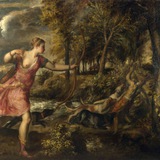
"PANTHEISTS could be here" they thought, "We've never been in this desert before. There could be PANTHEISTS anywhere." The cool wind felt good against their prayer beads. "I HATE PANTHEISTS" they thought. Dies Irae reverberated the horizon, making it pulsate even as the centuries-old Eucharist circulated through their powerful thick Bibles and washed away their (merited) fear of heretics after dark. "With a horizon, you can go anywhere you want" they said to one another, unspoken.
Forwarded from AmoRomA
I know Carl but I never heard of Kra. Enlighten me please!
Kra is born of the nemesis of history. It is the knowing Death of God returning to mysterious forms within darkness.
One of the infinite names of The Unknown God.
One of the infinite names of The Unknown God.
Before Schmitt, there was Nietzsche, Hölderlin, Kleist. They all faced the Kra. Nietzsche tried to harden himself thinking it was the Mill of Heaven.
Every modern man fights with the Kra, and it is on the verge of total victory.
Every modern man fights with the Kra, and it is on the verge of total victory.
"Cicero reports in his book On divination , he never wanted to follow the same route as the others, alleging that his daemon deterred him from doing so. Indeed, Socrates saved himself while everyone else was killed or taken by the adversary’s cavalry."
The Kra is the loss of the Daemon. Now this infinite reversal is destroying man. Absolute devastation.
The Kra is the loss of the Daemon. Now this infinite reversal is destroying man. Absolute devastation.
Forwarded from Quantus tremor est futurus - Actaeon Journal
Political discourse today is repeating your position over and over to wear down opponents, to eliminate them through moral exhaustion. It is the equivalent of the bad songs repeated on the radio until the audience accepts them.
What would Nietzsche think of Schmitt's Land and Sea?
In a sense, the English dealt with the 'uncanny wheelwork' hundreds of years before much of Europe. They became this wheelwork.
To look to the ports, not the sea, would be to miss the English, and the new nomos of the earth.
In a sense, the English dealt with the 'uncanny wheelwork' hundreds of years before much of Europe. They became this wheelwork.
To look to the ports, not the sea, would be to miss the English, and the new nomos of the earth.
"God is dead. God's Mill remains."
Does Nietzsche leave the second part unstated? Does he hammer it again and again trying to weld himself to the wheel?
Does Nietzsche leave the second part unstated? Does he hammer it again and again trying to weld himself to the wheel?
“The man who is free casts to earth that sort of despicable wellbeing that grocers, Christians, cows, women, the English and other democrats dream of” - Friedrich Nietzche
Nietzsche, do not, in the tarnished mirror of the English, lose sight of the despicable power.
Nietzsche, do not, in the tarnished mirror of the English, lose sight of the despicable power.
Socrates Contra Nietzsche - Do not formalise the Muse!
Herder as interlocutor for Jünger and Heidegger - What Muse thinks? What Muse sees? Here Jünger stands with Clio, and Heidegger remains in the world of technique, a second memory – attempting to discern if the appearance of the Muse was real or not.
Quantus tremor est futurus - Actaeon Journal
The Eternal Return https://youtu.be/mko5Y8QUEjI
The conductor-we-have-a-problem-conductor-I-have-a-problem distinction.
How to interpret any of the commentary here on Nietzsche: sword swings, side-stepping. Perhaps at times running away, as we do recognise his power.
Not at all: critique.
Not at all: critique.
This media is not supported in your browser
VIEW IN TELEGRAM
Being vs Becoming