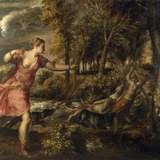
Socrates will eternally be known as a reborn Silenus; Nietzsche proclaimed he was Dionysus – and then was paralyzed by vines.
Sensible center: World Wrestling Entertainment, Inc.
Theological center: Jacob wrestling with the angel.
Theological center: Jacob wrestling with the angel.
The opposition of Nietzsche and Socrates is misplaced. Jünger acknowledges Nietzsche's mistakes, his limits and absolute mortality, but nevertheless stands behind him as a Nestor to Achilles. "He will fight when he can fight."
The question for Nietzscheans is this, who is the hero that would stand, no matter his weaknesses, behind Socrates? Or perhaps we must ask of that which is more than a hero. In this is also the question, what was missing in Alcibiades?
The question for Nietzscheans is this, who is the hero that would stand, no matter his weaknesses, behind Socrates? Or perhaps we must ask of that which is more than a hero. In this is also the question, what was missing in Alcibiades?
The hero, as unbounded striving, is always the question of the Dioscuri: what part of us goes to the heavens, and what to the underworld? This is also the chain which binds the heroes to the titans.
Quantus tremor est futurus - Actaeon Journal
The hero, as unbounded striving, is always the question of the Dioscuri: what part of us goes to the heavens, and what to the underworld? This is also the chain which binds the heroes to the titans.
The pure will is thus an interim of the will to struggle. It is not Patroclus who is the Castor to Achilles – this is Ajax. The absolutely divided is the sacrifice which comes with the willed, absolute wrath.
Patroclus is the absolutely unbound, memory and that which waits at the end of all waters. "Dead in the king's own armour." It is this that awaits return – – infinitely. And too, in this, Hölderlin is the freedom of Ajax, the perfection of a death too good for the dying age of heroes.
If Achilles is removed from events so that he might not be tarnished, it is Ajax who is removed from time itself, the fate of the Hellenes. In this is Hölderlin's greatest achievement, something far beyond tragedy – he frees Homer from the charges of Pindar, and Ajax from death in foreign parts.
Hölderlin found Ajax in the underworld, sacrificed to the modality beyond life – – neither master nor servant, the wound of the underworld.
Patroclus is the absolutely unbound, memory and that which waits at the end of all waters. "Dead in the king's own armour." It is this that awaits return – – infinitely. And too, in this, Hölderlin is the freedom of Ajax, the perfection of a death too good for the dying age of heroes.
If Achilles is removed from events so that he might not be tarnished, it is Ajax who is removed from time itself, the fate of the Hellenes. In this is Hölderlin's greatest achievement, something far beyond tragedy – he frees Homer from the charges of Pindar, and Ajax from death in foreign parts.
Hölderlin found Ajax in the underworld, sacrificed to the modality beyond life – – neither master nor servant, the wound of the underworld.
Some commentary on the state of exception and the medical bureaucracy
I would say that the state of exception cannot be applied to our situation. The state of exception is really a dictatorial response to an existential crisis, it is more-than-legal rather than extra-legal. It must give intensity and authenticity to life, and it does so for the people (Volk) rather than the legal or bureaucratic structures. Particularly after the defeat of Germany there are laws or conditions in place to prevent any sort of dictator as Schmitt meant it, and also what was written into the old constitutions.
What happens today is that any emergency powers are deployed to defend the critical government functions, and as such the government or party stands between the public and any supra-state force. The existential condition and intensity of the people is neutralised rather than elevated. The party is, in its view of itself, representative of the people, and it defends the people through its extra-legal measures. So long as the party survives, the people survive. This was seen in Pierre Trudeau's war measures: the government mobilises against the criminal element to neutralise it, and there is no distinction between public and criminal, everyone is classified as potential criminal. It is, rather than a decision on the exception, an extension of legalism and parliamentary discourse - parliamentarism reduced to force.
The danger is that the exception (crisis/act of god/nature) becomes permanent, and in some sense the technical measures of the government become themselves an exception. In the same way, medical intervention is not a decision, it does not treat the origin of sickness and look to health, it only treats the symptoms. This is a purely technical sense of health, and we see how it has the same traits as indecision, an inability to deal with the exception.
Now enters a doubling of the crisis, the medical institutes and government bureaucracies become a type of decision-making body made sick. But rather than an exception this is only the norm. One need only look to the response to the Bird Flu and SARs, the mass isolation of the elderly, mass prescription of painkillers to children, the AIDs crisis, and psychiatric experimentation to see that medical tyranny is the norm and acts as a depoliticising power. The multiple bodies of technical measures form together as force and crisis necessitate, it is an automatic process rather than decision. And it is why the very character of the state begins to show signs of sickness.
At an existential level this even goes back to the origins of modern health. Study of the perfection of human organs was only made possible by grave robbers, the desecration of bodies. It is in the same way that abstract treatment of the body can only extend and isolate the bodies, mask the sickness with chemical and physical prosthetics if need be. This is why medical treatment becomes itself a metastasis within the body, then outside of it. One cannot simply eat an apple because it is an apple, it must be tested, studied, and have an entire industry dedicated to the refinement of its scientific proof.
I would say that the state of exception cannot be applied to our situation. The state of exception is really a dictatorial response to an existential crisis, it is more-than-legal rather than extra-legal. It must give intensity and authenticity to life, and it does so for the people (Volk) rather than the legal or bureaucratic structures. Particularly after the defeat of Germany there are laws or conditions in place to prevent any sort of dictator as Schmitt meant it, and also what was written into the old constitutions.
What happens today is that any emergency powers are deployed to defend the critical government functions, and as such the government or party stands between the public and any supra-state force. The existential condition and intensity of the people is neutralised rather than elevated. The party is, in its view of itself, representative of the people, and it defends the people through its extra-legal measures. So long as the party survives, the people survive. This was seen in Pierre Trudeau's war measures: the government mobilises against the criminal element to neutralise it, and there is no distinction between public and criminal, everyone is classified as potential criminal. It is, rather than a decision on the exception, an extension of legalism and parliamentary discourse - parliamentarism reduced to force.
The danger is that the exception (crisis/act of god/nature) becomes permanent, and in some sense the technical measures of the government become themselves an exception. In the same way, medical intervention is not a decision, it does not treat the origin of sickness and look to health, it only treats the symptoms. This is a purely technical sense of health, and we see how it has the same traits as indecision, an inability to deal with the exception.
Now enters a doubling of the crisis, the medical institutes and government bureaucracies become a type of decision-making body made sick. But rather than an exception this is only the norm. One need only look to the response to the Bird Flu and SARs, the mass isolation of the elderly, mass prescription of painkillers to children, the AIDs crisis, and psychiatric experimentation to see that medical tyranny is the norm and acts as a depoliticising power. The multiple bodies of technical measures form together as force and crisis necessitate, it is an automatic process rather than decision. And it is why the very character of the state begins to show signs of sickness.
At an existential level this even goes back to the origins of modern health. Study of the perfection of human organs was only made possible by grave robbers, the desecration of bodies. It is in the same way that abstract treatment of the body can only extend and isolate the bodies, mask the sickness with chemical and physical prosthetics if need be. This is why medical treatment becomes itself a metastasis within the body, then outside of it. One cannot simply eat an apple because it is an apple, it must be tested, studied, and have an entire industry dedicated to the refinement of its scientific proof.
'This was the story of N. P., the first instance of a man killed because of lousy superchats.'
https://m.youtube.com/watch?v=37nkErzdTOA
https://m.youtube.com/watch?v=37nkErzdTOA
YouTube
The end of the movie Network
The last five minutes of the classic 1976 Sidney Lumet movie Network, the assassination of Howard Beale.
The twitter situation was rather easy to predict, at least in the general sense, for anyone who has seen Network. The entire point was to restore a sense of normalcy, and extend this as much as possible through the acquisition process. (In the same way that rumours are equivalent to real acquisitions in the stock market.)
Both left and right play their role in the aggressiveness of progress. Without opposition this would not be possible. Wokeness was never the goal, only neutralisation. The sensible center plays right into this, the same way that MAGA was only a populism of effect.
The media is a plebiscite tout le jour, a constant discourse on policy – and then mores. That certain ideas are removed from discourse is not a question of control or oppression, they are only temporarily removed as matters of impossibility. It is akin to the voting process: one cannot vote in other districts, the senate can only be especially elected. There may even be an element of the secret ballot – one's true activity, his second consciousness must not be known.
And as we see in Network, any ideas are acceptable within the medium, even shocking death is not at all shocking.
https://t.iss.one/keith_woods/3409
Both left and right play their role in the aggressiveness of progress. Without opposition this would not be possible. Wokeness was never the goal, only neutralisation. The sensible center plays right into this, the same way that MAGA was only a populism of effect.
The media is a plebiscite tout le jour, a constant discourse on policy – and then mores. That certain ideas are removed from discourse is not a question of control or oppression, they are only temporarily removed as matters of impossibility. It is akin to the voting process: one cannot vote in other districts, the senate can only be especially elected. There may even be an element of the secret ballot – one's true activity, his second consciousness must not be known.
And as we see in Network, any ideas are acceptable within the medium, even shocking death is not at all shocking.
https://t.iss.one/keith_woods/3409
Telegram
Keith Woods
Imagine if a year ago someone would have told you that the richest man in the world would out himself as a free speech activist, buy Twitter, take on the ADL and completely reverse the years of deplatforming in a week. Imagine how insanely unlikely that would…
Quantus tremor est futurus - Actaeon Journal
The twitter situation was rather easy to predict, at least in the general sense, for anyone who has seen Network. The entire point was to restore a sense of normalcy, and extend this as much as possible through the acquisition process. (In the same way that…
Perhaps the same thing in different words:
I think this can simply be turned around to see the danger. This is what I said of the sensible center, which is really just a question of a very limited free speech:
The danger of sensible centrism is that it returns the left-right distinction to reality at the very moment it was becoming a mere formality.
Free speech is the industrialisation of value-free ideas. How it functions in what Schmitt calls the aggressiveness of progress is the problem of growth with stability. Through any sort of crisis one can imagine how certain groups might be used for growth or stability. The need of stability was waiting for the dissident right to be given amnesty at any time.
One can also look to the problem that modern man does not recognise the age until a hydrogen bomb is dropped on his head. In this situation, what real danger could statistics pose? This problem situates both the extreme idea and its total weakness.
One can also look to Network or Look Who's Back to see that anything can be promoted by the media so long as it is framed in a particular way. This not only includes the most brutal images, but even killing its own figureheads and representatives.
https://t.iss.one/ImperiumPressOfficial/1666
I think this can simply be turned around to see the danger. This is what I said of the sensible center, which is really just a question of a very limited free speech:
The danger of sensible centrism is that it returns the left-right distinction to reality at the very moment it was becoming a mere formality.
Free speech is the industrialisation of value-free ideas. How it functions in what Schmitt calls the aggressiveness of progress is the problem of growth with stability. Through any sort of crisis one can imagine how certain groups might be used for growth or stability. The need of stability was waiting for the dissident right to be given amnesty at any time.
One can also look to the problem that modern man does not recognise the age until a hydrogen bomb is dropped on his head. In this situation, what real danger could statistics pose? This problem situates both the extreme idea and its total weakness.
One can also look to Network or Look Who's Back to see that anything can be promoted by the media so long as it is framed in a particular way. This not only includes the most brutal images, but even killing its own figureheads and representatives.
https://t.iss.one/ImperiumPressOfficial/1666
Telegram
Imperium Press
Imagine not being a totalitarian in 2022
I said this of 2021 and it was misunderstood then, and has never been more true. There simply is no imaginable society that does not control what you think.
We should push for free speech, with the understanding…
I said this of 2021 and it was misunderstood then, and has never been more true. There simply is no imaginable society that does not control what you think.
We should push for free speech, with the understanding…
The total state demands the total individual. Bureaucracy is not something separate, distinct from modern man, it is his highest product. He wants to be at once within its inner depths and freed from them – hence the gutted or flayed architecture of brutalism. The foundations, the very mining process, become the shell, the outside. Inside, a completing minimum. One sees in this the defenses of a uranium world, a total sarchophagus.
Communication must be able to penetrate this structure. And the individual, to withstand its forces.
Communication must be able to penetrate this structure. And the individual, to withstand its forces.
Forwarded from Halls of the Hyperboreads
"The causes of Nihilism:
1. The higher species is lacking, i.e., the species whose inexhaustible fruitfulness and power would uphold our belief in Man (think only of what is owed to Napoleon—almost all the higher hopes of this century).
2. The inferior species ('herd,' 'mass,' 'society') is forgetting modesty, and inflates its needs into cosmic and metaphysical values. In this way all life is vulgarized: for inasmuch as the mass of mankind rules, it tyrannizes over the exceptions, so that these lose their belief in themselves and become Nihilists.
All attempts to conceive of a new species come to nothing ('romanticism,' the artist, the philosopher; against Carlyle's attempt to lend them the highest moral values).
The result is that higher types are resisted.
The downfall and insecurity of all higher types. The struggle against genius ('popular poetry,' etc.). Sympathy with the lowly and the suffering as a standard for the elevation of the soul.
The philosopher is lacking, the interpreter of deeds, and not alone he who poetizes them."
- Friedrich Nietzsche, Will to Power
1. The higher species is lacking, i.e., the species whose inexhaustible fruitfulness and power would uphold our belief in Man (think only of what is owed to Napoleon—almost all the higher hopes of this century).
2. The inferior species ('herd,' 'mass,' 'society') is forgetting modesty, and inflates its needs into cosmic and metaphysical values. In this way all life is vulgarized: for inasmuch as the mass of mankind rules, it tyrannizes over the exceptions, so that these lose their belief in themselves and become Nihilists.
All attempts to conceive of a new species come to nothing ('romanticism,' the artist, the philosopher; against Carlyle's attempt to lend them the highest moral values).
The result is that higher types are resisted.
The downfall and insecurity of all higher types. The struggle against genius ('popular poetry,' etc.). Sympathy with the lowly and the suffering as a standard for the elevation of the soul.
The philosopher is lacking, the interpreter of deeds, and not alone he who poetizes them."
- Friedrich Nietzsche, Will to Power
Nihilism is not only a lack or weakness, it can be an excess, a sickness. One may discover an affliction in the most minor conflicts, in this is a mythical horror – one's brother or father ends up as the absolute enemy, contradicting all sense of law.
There is not only the herd of men but also the herd of centaurs – the first ancestors. The greatest men never think of what is owed to them, more often their affliction is having been given too much, and from this a nothing forms – a nothing which threatens more than any enemy.
Even the greatest leader relies on his men, if only as a capable resistance force. They elevate the highest according to their potential strength – which is why Cyrus wanted an army of centaurs. Even one Thersites represents a danger.
*
There is also the modesty which forgets itself, a modesty that comes to know the inner depths of power, destruction. One forgets himself at the moment of annihilation, when the soul is most needed.
A king brought to sickness before a great battle confronts the higher enemy. This is rarely thought of in the case of the late monarchs who abdicated powers to the aristocracy. Perhaps it is too simple a problem, but one must consider the specific manner in which a king confesses, "I am a worm, and no man." His fall will always be greater, and to the extent he was once divine he will drag worlds down with him.
*
"The metaphysical mood is a virginity of the mind," yet there are times, seasons when such a mood is beneficial. In it there is regeneration, mythic silence. Non coerceri maximo, contineri minimo, divinum est. The mythic carries us into the boundless, philosophy upholds the inviolable laws.
*
There is not only the herd of men but also the herd of centaurs – the first ancestors. The greatest men never think of what is owed to them, more often their affliction is having been given too much, and from this a nothing forms – a nothing which threatens more than any enemy.
Even the greatest leader relies on his men, if only as a capable resistance force. They elevate the highest according to their potential strength – which is why Cyrus wanted an army of centaurs. Even one Thersites represents a danger.
*
There is also the modesty which forgets itself, a modesty that comes to know the inner depths of power, destruction. One forgets himself at the moment of annihilation, when the soul is most needed.
A king brought to sickness before a great battle confronts the higher enemy. This is rarely thought of in the case of the late monarchs who abdicated powers to the aristocracy. Perhaps it is too simple a problem, but one must consider the specific manner in which a king confesses, "I am a worm, and no man." His fall will always be greater, and to the extent he was once divine he will drag worlds down with him.
*
"The metaphysical mood is a virginity of the mind," yet there are times, seasons when such a mood is beneficial. In it there is regeneration, mythic silence. Non coerceri maximo, contineri minimo, divinum est. The mythic carries us into the boundless, philosophy upholds the inviolable laws.
*
We no longer see from within the political order, from a position that situates us as one with the machine, but from outside it. To see from an absolute distance is to see from the cold precision of the optic. It is here that one begins to see himself forever at the point of removal, if not death. And it is in this exactness of one's own political removal that we find the specific political character today – the end of political order can only be filled by a limitless man. Repositioning is a type of death and rebirth.
To see from within is to have to identify with the political machinery, the great monster – even if that monster is something so terrifying as the Leviathan. Here we see quite differently: the extreme, as an extreme case in particular, is like the wounding of a limb of the Leviathan. Exactly nothing has changed in the position, the monster remains the monster, he remains one. Yet, at the same time there is a metamorphosis, blood spills out for a moment, but only to clean and then close the wound – either there is healing or the wound festers. The blood pools.
This is how we understand the extreme, as a political process, not as an ideological enemy but something gravely misunderstood within the current spatial nothingness. That the extreme is no longer understood must be part of a greater political movement, or metamorphosis of the great monster. Here it is that a limit has been revealed, even for the once limitless – one can no longer focus on single movements, as movement has become absolute. That which is not at the point of the absolute must be brought to unity, otherwise its movement exists outside of the monstrous machine; it is not absolute, it is merely an extremity.
To see from within is to have to identify with the political machinery, the great monster – even if that monster is something so terrifying as the Leviathan. Here we see quite differently: the extreme, as an extreme case in particular, is like the wounding of a limb of the Leviathan. Exactly nothing has changed in the position, the monster remains the monster, he remains one. Yet, at the same time there is a metamorphosis, blood spills out for a moment, but only to clean and then close the wound – either there is healing or the wound festers. The blood pools.
This is how we understand the extreme, as a political process, not as an ideological enemy but something gravely misunderstood within the current spatial nothingness. That the extreme is no longer understood must be part of a greater political movement, or metamorphosis of the great monster. Here it is that a limit has been revealed, even for the once limitless – one can no longer focus on single movements, as movement has become absolute. That which is not at the point of the absolute must be brought to unity, otherwise its movement exists outside of the monstrous machine; it is not absolute, it is merely an extremity.
Conspiracy theory is an attempt of the purely technical mind to grasp the world of myth and intellectual intuition. That is, a world to which it does not belong.
Regarding Platonism and decline, some arguing Platonic forms leads directly to gender theory
—-
Plato has the myth of love and the original being. It is important to note that Aristophanes tells it, so it is a comic myth. The original being is a monstrous, Janus-like figure, conjoined of different sexes or the same sex. They attack the Olympians, just as the Titans had. Then Zeus cuts them in half to weaken them, and afterwards each searches for its missing half. This striving is a pursuit of wholeness, and is not only a question of sex but of monstrous creation.
The conclusion seems to be that love is brought to perfection through conflict with our monstrous nature. There must be order and reunification of the original being, but humans must not try to attack the Olympians. To find the gods and to die together is the highest act of love. This is an overcoming of monstrous nature rather than denial of it, or trying to remain at a distance.
If anything, the trans problem seems to be the exact opposite contradiction: the impossibility or fear of finding love, one's other half, and a return to monstrous nature in the most secure way possible, by technical means. It is the fear of a higher metamorphosis. I won't say this is entirely a problem of physicalism or materialism, but if there is intellectual intuition there must also be something like a physicalist noumenon. Physicalism does not solve the problem that there is something completely unknown to man, that he is a mystery to himself, that his will is another form of monstrous creation.
While metaphysics can become lost in abstraction, the physicalist being denies the problem completely, or simply tries to include it as part of his overwhelming force. And therein lies the problem, the unknown may be the absolute and monstrous force to begin with, the first cause or coarse lie. Whether the unknown came first, whether it is an inherited affliction or one developed through faults, it announces a new beginning, it is an exception to our being. To deny it can only end in ruin – as with Zeus cutting man in half again, weakening him further.
https://t.iss.one/ImperiumPressOfficial/1704
—-
Plato has the myth of love and the original being. It is important to note that Aristophanes tells it, so it is a comic myth. The original being is a monstrous, Janus-like figure, conjoined of different sexes or the same sex. They attack the Olympians, just as the Titans had. Then Zeus cuts them in half to weaken them, and afterwards each searches for its missing half. This striving is a pursuit of wholeness, and is not only a question of sex but of monstrous creation.
The conclusion seems to be that love is brought to perfection through conflict with our monstrous nature. There must be order and reunification of the original being, but humans must not try to attack the Olympians. To find the gods and to die together is the highest act of love. This is an overcoming of monstrous nature rather than denial of it, or trying to remain at a distance.
If anything, the trans problem seems to be the exact opposite contradiction: the impossibility or fear of finding love, one's other half, and a return to monstrous nature in the most secure way possible, by technical means. It is the fear of a higher metamorphosis. I won't say this is entirely a problem of physicalism or materialism, but if there is intellectual intuition there must also be something like a physicalist noumenon. Physicalism does not solve the problem that there is something completely unknown to man, that he is a mystery to himself, that his will is another form of monstrous creation.
While metaphysics can become lost in abstraction, the physicalist being denies the problem completely, or simply tries to include it as part of his overwhelming force. And therein lies the problem, the unknown may be the absolute and monstrous force to begin with, the first cause or coarse lie. Whether the unknown came first, whether it is an inherited affliction or one developed through faults, it announces a new beginning, it is an exception to our being. To deny it can only end in ruin – as with Zeus cutting man in half again, weakening him further.
https://t.iss.one/ImperiumPressOfficial/1704
Telegram
Imperium Press
https://twitter.com/rex_sacrorum_ip/status/1600284863474851840
Nietzsche's joke. - Nietzsche wanted to prove, in a way that would dumbfound the headless man, that the headless man was right: that was the secret joke of this character. He wrote against popular prejudice in support of the scholars, but for the people and not for the scholars.
Even physical reality has its mysteries. How does one reckon with the longest days, the weeks and even seasons in which the sun, the life-giving, is lost to us?
Socratic ignorance is far more powerful than perspectivism. Ignorance is the death of reason; absolute perspective trusts that nature, the all-destroying, has pure, yet tempered emotions.
Nothing of the romantic sorrows remains with Nietzsche. Nothing of the force of sentiment, only the sentiment of force.
"Glides the soul away like the boat."
https://youtu.be/TEvo9PTnIlo
"Glides the soul away like the boat."
https://youtu.be/TEvo9PTnIlo
YouTube
Schubert: Auf dem Wasser zu singen, Op. 72, D. 774
Provided to YouTube by Universal Music Group
Schubert: Auf dem Wasser zu singen, Op. 72, D. 774 · Dietrich Fischer-Dieskau · Gerald Moore · Franz Schubert
Schubert: Lieder
℗ 1969 Deutsche Grammophon GmbH, Berlin
Released on: 2005-01-01
Producer: Otto…
Schubert: Auf dem Wasser zu singen, Op. 72, D. 774 · Dietrich Fischer-Dieskau · Gerald Moore · Franz Schubert
Schubert: Lieder
℗ 1969 Deutsche Grammophon GmbH, Berlin
Released on: 2005-01-01
Producer: Otto…