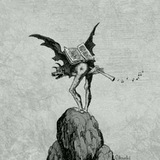
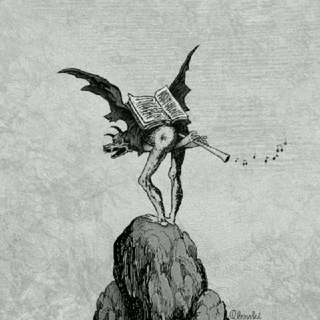
“Satan represents man as just another animal, sometimes better, more often worse than those that walk on all-fours, who, because of his ‘divine spiritual and intellectual development,’ has become the most vicious animal of all!
🎨 Alegoria Szatana" (Allegory of Satan), Ludwik Stasiak, 1900.
#Satanism
⚡1
This media is not supported in your browser
VIEW IN TELEGRAM
Film: The Lighthouse (2019)
Overview: Two lighthouse keepers try to maintain their sanity while living on a remote and mysterious New England island in the 1890s.
#Film #Creatures #Sirens
Overview: Two lighthouse keepers try to maintain their sanity while living on a remote and mysterious New England island in the 1890s.
#Film #Creatures #Sirens
❤🔥2
Forwarded from Daily Ancient Egypt - 𓆎 𓅓 𓏏𓊖
#NewKingdom 18th Dynasty - ca. 1480—1425 B.C.E - source
Relief of the goddess Satet
From: Temple of Satet, Elephantine, Upper Egypt
Currently expropriated and displayed in the Louvre Museum, Paris.
Satis was the protective goddess of the southern frontier and a principal deity of the region around Elephantine, near the First Cataract of the Nile. Closely associated with the annual Nile flood, she formed part of the local triad with the gods Khnum and Anuket.
❤🔥3
Forwarded from EN EREBOS PHOS
Mythology itself is not simply a crude mass of superstitions or gross delusions. It is not merely chaotic, for it possesses a systematic or conceptual form. But, on the other hand, it would be impossible to characterize the structure of myth as rational. Language has often been identified with reason, or with the very source of reason. But it is easy to see that this definition fails to cover the whole field. It is a pars pro toto; it offers us a part for the whole. For side by side with conceptual language there is an emotional language; side by side with logical or scientific language there is a language of poetic imagination. Primarily language does not express thoughts or ideas, but feelings and affections. And even a religion “within the limits of pure reason” as conceived and worked out by Kant is no more than a mere abstraction. It conveys only the ideal shape, only the shadow, of what a genuine and concrete religious life is. The great thinkers who have defined man as an animal rationale were not empiricists, nor did they ever intend to give an empirical account of human nature. By this definition they were expressing rather a fundamental moral imperative. Reason is a very inadequate term with which to comprehend the forms of man’s cultural life in all their richness and variety. But all these forms are symbolic forms. Hence, instead of defining man as an animal rationale, we should define him as an animal symbolicum. By so doing we can designate his specific difference, and we can understand the new way open to man—the way to civilization.
Ernst Cassirer, An Essay on Man: An Introduction to a Philosophy of Human Culture
Ernst Cassirer, An Essay on Man: An Introduction to a Philosophy of Human Culture