Though thousands of people indulge themselves in it regularly, and even develop a taste for it, there is no doubt in my mind (and that of scientists whom I employ to prove it) that Work is a dangerous and destructive drug, and should be called by its right name, which is Fatigue.
— Robertson Davies,
The Diary of Samuel Marchbanks (XLV)
Of feigned industry
I spent a busy day today, but got little done. This is because I am at last becoming perfect in the art of seeming busy, even when very little is going on in my head or under my hands. This is an art which every man learns, if he does not intend to work himself to death. By shifting papers about my desk, writing my initials on things, talking to my colleagues about things which they already know, fumbling in books of reference, making notes about things which are already decided, and staring out of the window while tapping my teeth with a pencil, I can successfully counterfeit a man doing a heavy day’s work. Nobody who watched me would ever be able to guess what I was doing, and the secret of this is that I am not doing anything, or creating anything, and my brain is having a nice rest.
— Robertson Davies,
The Table Talk of Samuel Marchbanks (§2)
Criminality is greatest where exhaustion is greatest, i.e., where the most senseless work is done, in the sphere of trade and industry.
Overwork, exhaustion, need for stimulation (vices), increase of irritability and weakness (so that they become explosive).
— Friedrich Nietzsche,
Nachgelassene Fragmente (1888) (15[37])
“What do people get for all the toil and anxious striving with which they labor under the sun? All their days their work is grief and pain; even at night their minds do not rest. This too is meaningless.”
Ecclesiastes 2:22-23 (NIV)
Ecclesiastes 2:22-23 (NIV)
😢4
Forwarded from Disobey
“I was now my own master.… I worked that day with a pleasure I had never before experienced.”
— Frederick Douglass,
Narrative of the Life of Frederick Douglass, an American Slave (1845)
(Frederick Douglass on his liberation from slavery and the joy of work as a free man)
— Frederick Douglass,
Narrative of the Life of Frederick Douglass, an American Slave (1845)
(Frederick Douglass on his liberation from slavery and the joy of work as a free man)
Forwarded from Disobey
“Experience demonstrates that there may be a wages of slavery only a little less galling and crushing in its effects than chattel slavery, and that this slavery of wages must go down with the other.”
— Frederick Douglass,
Three Addresses on the Relations Subsisting Between the White and Colored People of the United States (1886)
(Douglass towards the end of his life. He realized that wage slavery was almost as bad as chattel slavery.)
— Frederick Douglass,
Three Addresses on the Relations Subsisting Between the White and Colored People of the United States (1886)
(Douglass towards the end of his life. He realized that wage slavery was almost as bad as chattel slavery.)
Today capitalism requires a different kind of person to those it required in the past. Up until recently there was a need for people with professional capacities, a pride in this capacity and particular qualifications. The situation is quite different now. The world of work requires a very modest qualification level whereas qualities that did not exist and were even inconceivable in the past such as flexibility, adaptability, tolerance, the capacity to intervene at meetings, etc. are required in their place.
Huge production units based on assembly lines for example now use robots or are built on the conceptual basis of islands, small groups working together who know each other and control each other and so on. This kind of mentality is not only found in the factory. It is not just a ‘new worker’ they are building, but a ‘new man’; a flexible person with modest ideas, rather opaque in their desires, with considerably reduced cultural levels, impoverished language, standardised reading, a limited capacity to think and a great capacity to make quick yes or no decisions. They know how to choose between two possibilities: a yellow button, a red button, a black button, a white button. This is the kind of mentality they are building. And where are they building it? At school, but also in everyday life.
— Alfredo M. Bonanno,
The Anarchist Tension
We are not concerned with the political problems of those who see unemployment as a danger to democracy and order. We do not feel any nostalgia for lost professionalism.
We are even less interested in elaborating libertarian alternatives to grim factory work or intellectual labour, which are unwittingly doing nothing but toe the line of the advanced post-industrial project. Nor are we for the abolition of work or its reduction to the minimum required for a meaningful happy life.
Behind all this there is always the hand of those who want to regulate our lives, think for us, or politely suggest that we think as they do.
We are for the destruction of work...
— Alfredo M. Bonanno, Let's Destroy Work, Let's Destroy the Economy
🔥1
It is assumed by most people nowadays that all work is useful, and by most well-to-do people that all work is desirable.
Most people, well-to-do or not, believe that, even when a man is doing work which appears to be useless, he is earning his livelihood by it – he is “employed,” as the phrase goes; and most of those who are well-to-do cheer on the happy worker with congratulations and praises, if he is only “industrious” enough and deprives himself of all pleasure and holidays in the sacred cause of labour.
In short, it has become an article of the creed of modern morality that all labour is good in itself – a convenient belief to those who live on the labour of others. But as to those on whom they live, I recommend them not to take it on trust, but to look into the matter a little deeper.
— William Morris,
Useful Work vs Useless Toil
What madness the love of work is!
With great scenic skill capital has succeeded in making the exploited love exploitation, the hanged man the rope and the slave his chains.
This idealisation of work has been the death of the revolution until now. The movement of the exploited has been corrupted by the bourgeois morality of production, which is not only foreign to it, but is also contrary to it. It is no accident that the trade unions were the first sector to be corrupted, precisely because of their closer proximity to the management of the spectacle of production.
It is time to oppose the non-work aesthetic to the work ethic.
We must counter the satisfaction of spectacular needs imposed by consumer society with the satisfaction of man’s natural needs seen in the light of that primary, essential need: the need for communism.
In this way the quantitative evaluation of needs is overturned. The need for communism transforms all other needs and their pressures on man.
— Alfredo M. Bonanno, Armed Joy (IV)
🔥3
The only way for the exploited to escape the globalising project of capital is through the refusal of work, production and political economy.
— Alfredo M. Bonanno, Armed Joy (IV)
🔥2
The need for communism transforms everything. Through the need for communism the need for non-work moves from the negative aspect (opposition to work) to the positive one: the individual’s complete availability to themselves, the possibility to express themselves absolutely freely, breaking away from all models, even those considered to be fundamental and indispensable such as those of production.
— Alfredo M. Bonanno, Armed Joy (IV)
🔥1
When we become conscious of the process of exploitation the first thing we feel is a sense of revenge, the last is joy. Liberation is seen as setting right a balance that has been upset by the wickedness of capitalism, not as the coming of a world of play to take the place of the world of work.
— Alfredo M. Bonanno, Armed Joy (V)
🔥1
No real joy can reach us from the rational mechanism of capitalist exploitation. Joy does not have fixed rules to catalogue it. Even so, we must be able to desire joy. Otherwise we would be lost.
The search for joy is therefore an act of will, a firm refusal of the fixed conditions of capital and its values. The first of these refusals is that of work as a value. The search for joy can only come about through the search for play.
— Alfredo M. Bonanno, Armed Joy (VI)
🔥2
The reign of death, i.e. the reign of capital, which denies our very existence as human beings and reduces us to ‘things’, seems very serious, methodical and disciplined. But its possessive paroxysm, its ethical rigour, its obsession with ‘doing’ all hide a great illusion: the total emptiness of the commodity spectacle, the uselessness of indefinite accumulation and the absurdity of exploitation. So the great seriousness of the world of work and productivity hides a total lack of seriousness.
— Alfredo M. Bonanno, Armed Joy (VI)
🔥1
Hurry comrade, shoot the policeman, the judge, the boss. Now, before a new police prevent you.
Hurry to say No, before the new repression convinces you that saying no is pointless, mad, and that you should accept the hospitality of the mental asylum.
Hurry to attack capital before a new ideology makes it sacred to you.
Hurry to refuse work before some new sophist tells you yet again that ‘work makes you free’.
Hurry to play. Hurry to arm yourself.
— Alfredo M. Bonanno, Armed Joy (VII)
⚡2
When the whole of reality is spectacular, to refuse the spectacle means to be outside reality. Anyone who refuses the code of commodities is mad. Refusal to bow down before the commodity god will result in one’s being committed to a mental asylum.
— Alfredo M. Bonanno, Armed Joy (X)
🔥1
Let’s be done with waiting, doubts, dreams of social peace, little compromises and naivety. All metaphorical rubbish supplied to us in the shops of capitalism.
Let’s put aside the great analyses that explain everything down to the most minute detail. Huge volumes filled with common sense and fear.
Let’s put aside democratic and bourgeois illusions of discussion and dialogue, debate and assembly and the enlightened capabilities of the Mafiosi bosses.
Let’s put aside the wisdom that the bourgeois work ethic has dug into our hearts. Let’s put aside the centuries of Christianity that have educated us to sacrifice and obedience.
Let’s put aside priests, bosses, revolutionary leaders, less revolutionary ones and those who aren’t revolutionary at all. Let’s put aside numbers, illusions of quantity, the laws of the market.
Let us sit for a moment on the ruins of the history of the persecuted, and reflect.
— Alfredo M. Bonanno, Armed Joy (XI)
🔥1
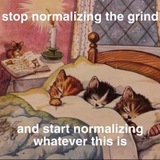
During the thousands of years cats and people have lived together, cats have refused to be involved in human concerns. They have never let themselves be recruited into the army, turned into policemen, janitors, court jesters, or paid entertainers.
Work—other people’s work—is an intolerable idea to a cat. Can you picture cats herding sheep or agreeing to pull a cart? They will not inconvenience themselves to the slightest degree. They insist on being exactly as they are: unrepentant, unabashed, without flattery (except when they have ulterior motives), and always completely themselves. This offends some people and makes them bitter enemies of cats. But with a fine disregard for Dale Carnegie, they have won friends and influenced people. Other animals have admirers, but none brings out the same violent enthusiasm. It’s hard to be calm about cats, one way or the other. You hate them or love them.
— Louis J. Camuti & Lloyd Alexander,
Park Avenue Vet (V)
❤2💘2
I just don't understand the world's unhealthy obsession with work. Its all about vanity anyway. Ooh, look how hard I worked! And what a good work I did. Well screw you, workie. Get lost. Shut up. We're trying to listen to records here.
— John Swartzwelder,
Detective Made Easy
❤1
When workers who are hungry, owing to wage-squeezing, go on strike, their act is a direct result of their economic situation. The same applies to the man who steals food because he is hungry. That a man steals because he is hungry, or that workers strike because they are being exploited, needs no further psychological clarification. In both cases ideology and action are commensurate with economic pressure. Economic situation and ideology coincide with one another.
Reactionary psychology is wont to explain the theft and the strike in terms of supposed irrational motives; reactionary rationalizations are invariably the result.
Social psychology sees the problem in an entirely different light: what has to be explained is not the fact that the man who is hungry steals or the fact that the man who is exploited strikes, but why the majority of those who are hungry don't steal and why the majority of those who are exploited don’t strike.
— Wilhelm Reich, The Mass Psychology of Fascism (chapter 1)
🔥2❤1⚡1